
Date: 16 January 2026 | Category: News
Authors: Mei-Huei Lin, Yan-Ting Kuo, Kim Le Mai Hoang and Peter H. Seeberger*
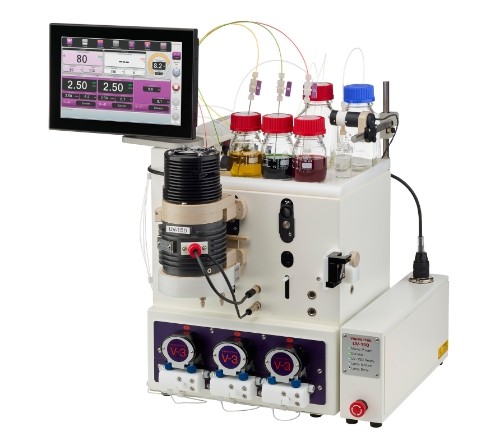
The Seeberger group have successfully used the Vapourtec E-Series easyMedChem system equipped with the UV-150 photochemical reactor to photolytically cleave a p-nitrobenzyloxycarbonyl-protected (pNZ) oligosaccharide from a resin quickly and efficiently [1]. In particular, the development of the pNZ group for the automated production of oligosaccharides means that research into the functional role of human milk oligosaccharides (HMOs) can be facilitated.
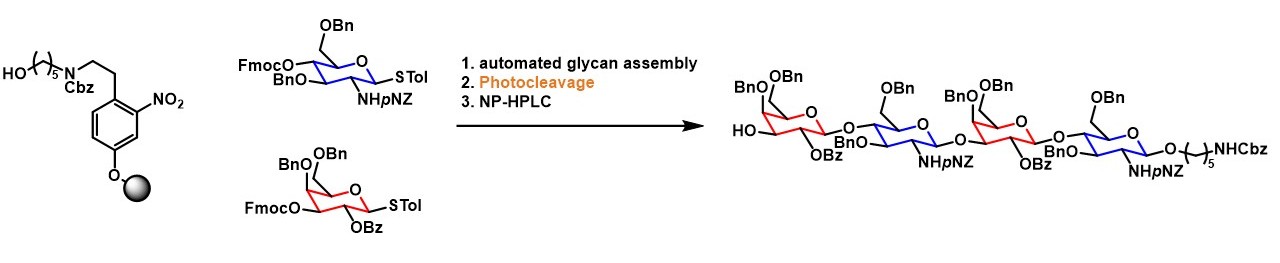
Figure 1: Preparation of oligosaccharides using automated glycan assembly (AGA), followed by UV-mediated resin cleavage then purification.
Human milk oligosaccharides (HMOs)
Breastmilk is the primary source of nutrition for young babies during their first few months of life. In addition to its nutritional value, human breast milk also supports a wide range of physiological functions, including: i) improving the gastrointestinal barrier; ii) promotion of a bifidobacterium-rich gut microbiome to build protection against infection, strengthen the epithelial barrier, and create immunomodulatory metabolites [2]. Human breast milk is a complex mixture of materials, including water, fats, proteins and vitamins. Approximately one third is carbohydrates – more specifically, human milk oligosaccharides (HMOs), which are extremely diverse in terms of their structure and function. However, understanding of the functional roles of these HMOs has proven difficult due to challenges in their isolation from natural sources. Synthesis is also non-trivial, with issues in relation to protecting group selection and orthogonality. Development of an efficient protecting group approach would facilitate access points for fluorescent labelling, biorthogonal chemistry and modulation of their pharmacological properties.
The protecting group quandary
Preparation of complex oligosaccharides can be achieved through automated glycan assembly (AGA), which can be both rapid and efficient. While amines are commonly masked as either trichloroethylchloroformate (Troc) and phthaloyl (Phth) groups in solution-phase synthesis, both are known to have drawbacks: Troc is base-labile, therefore incompatible with some AGA protocols, and Phth requires cleavage through use of either toxic hydrazine or other strong nucleophiles, which may require elevated temperatures or large excesses of reagents, potentially impacting upon the integrity of the final polysaccharide material. Trichloroacetyl (TCA) and carbobenzyloxy (Cbz) groups have also been explored, but their stability often causes other issues.
Key to Seeberger and co-workers’ successful synthesis of HMOs was introduction of p-nitrobenzyloxycarbonyl (pNZ), a carbamate-type protecting group. In solution, use of this group was found to lead to tempered nucleophilicity of the protected amine, however in solid phase synthesis this offers an advantage, as donor decomposition and side-reactions are suppressed, improving synthetic efficiency. In this work, use of pNZ proved pivotal in enabling both branched and linear HMOs to be formed through AGA-based procedures, with neutral linear, symmetrical- and unsymmetrical-branched N-acetyllactosamine- (LacNAc) based oligosaccharides and HMOs prepared in good yield. The pNZ group could be selectively cleaved relatively easily using reductive chemistry, such as tetrahydroxydiboron (B2(OH)4)/4,4’-bipyridine, to reveal the free primary amine that could be further functionalised, as necessary.
Cleavage of the final HMOs from the resin was achieved using the Vapourtec easy-MedChem E-Series system, equipped with a UV-150 photochemical reactor containing a UV-150 medium-pressure mercury lamp surrounded by a long-pass UV filter. The final material was the purified with analytical normal phase HPLC then characterised rigorously.
Summary
In summary, p-nitrobenzyloxycarbonyl has been shown to be a useful protecting group in the synthesis of complex oligosaccharides using AGA. In particular, the ease at which it can be installed and removed, as well as its orthogonal reactivity and compatibility with other functional groups, means that its utility could be widespread, especially in the automated synthesis of complex glycans. During resin-based synthesis, the Vapourtec easy-MedChem E-Series system equipped with a UV-150 photochemical reactor enabled facile cleavage and product isolation.
References:
[1] p-nitrobenzyloxycarbonyl protective group as key to automated glycan assembly of neutral human milk oligosaccharides. (M.-H. Lin, Y.-T. Kuo, K. Le Mai Hoang, P. H. Seeberger, Natures Commun., 2025, 16, 10941). https://doi.org/10.1038/s41467-025-66557-3
[2] Functional effects of human milk oligosaccharides (HMOs). (M. Dinleyici, J. Barbieur, E. Cagri Dinleyici, Y. Vandenplas, Gut Microbes, 2023, 15, 2186115). https://doi.org/10.1080/19490976.2023.2186115