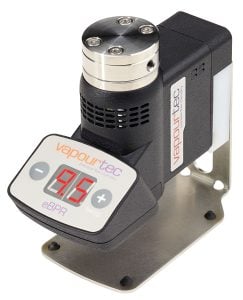
The Heated Back Pressure Regulator (BPR) extends the heated flow path to the point of pressure release, preventing cooling of the reaction stream between the reactor and the back pressure regulator. By maintaining the reaction at elevated temperatures until pressure is released, it prevents product precipitation, reduces the risk of blockages and enables reliable operation of high-temperature continuous flow processes.
Application examples
- High-temperature continuous flow synthesis
- Preventing product precipitation after heated reactions
- Neat and solvent-free flow chemistry
- Processing viscous reaction mixtures
- Reactions producing high-melting products
- Continuous crystallisation avoidance
- Pressure-dependent flow chemistry
Heated BPR features
Key advantages
Many high-temperature flow reactions suffer from product precipitation as the reaction stream cools between the heated reactor and the back pressure regulator. The Heated BPR maintains the reaction at elevated temperature until pressure is released, preventing blockages and ensuring reliable continuous operation. By maintaining products in solution throughout the flow path, the Heated BPR improves process robustness, supports neat and viscous chemistries, and extends the range of reactions that can be performed under pressurised continuous flow conditions.