Organometallic chemistry remains one of the most powerful tools available to synthetic chemists, providing access to highly efficient bond-forming reactions and enabling routes that are often inaccessible through alternative methodologies. Despite their utility, many organometallic reagents present practical challenges due to their sensitivity to air and moisture, narrow operating windows, and tendency to undergo rapid decomposition or exothermic side reactions. These characteristics can make reaction optimization difficult and can limit the safe exploration of new synthetic pathways.
Organometallic compounds
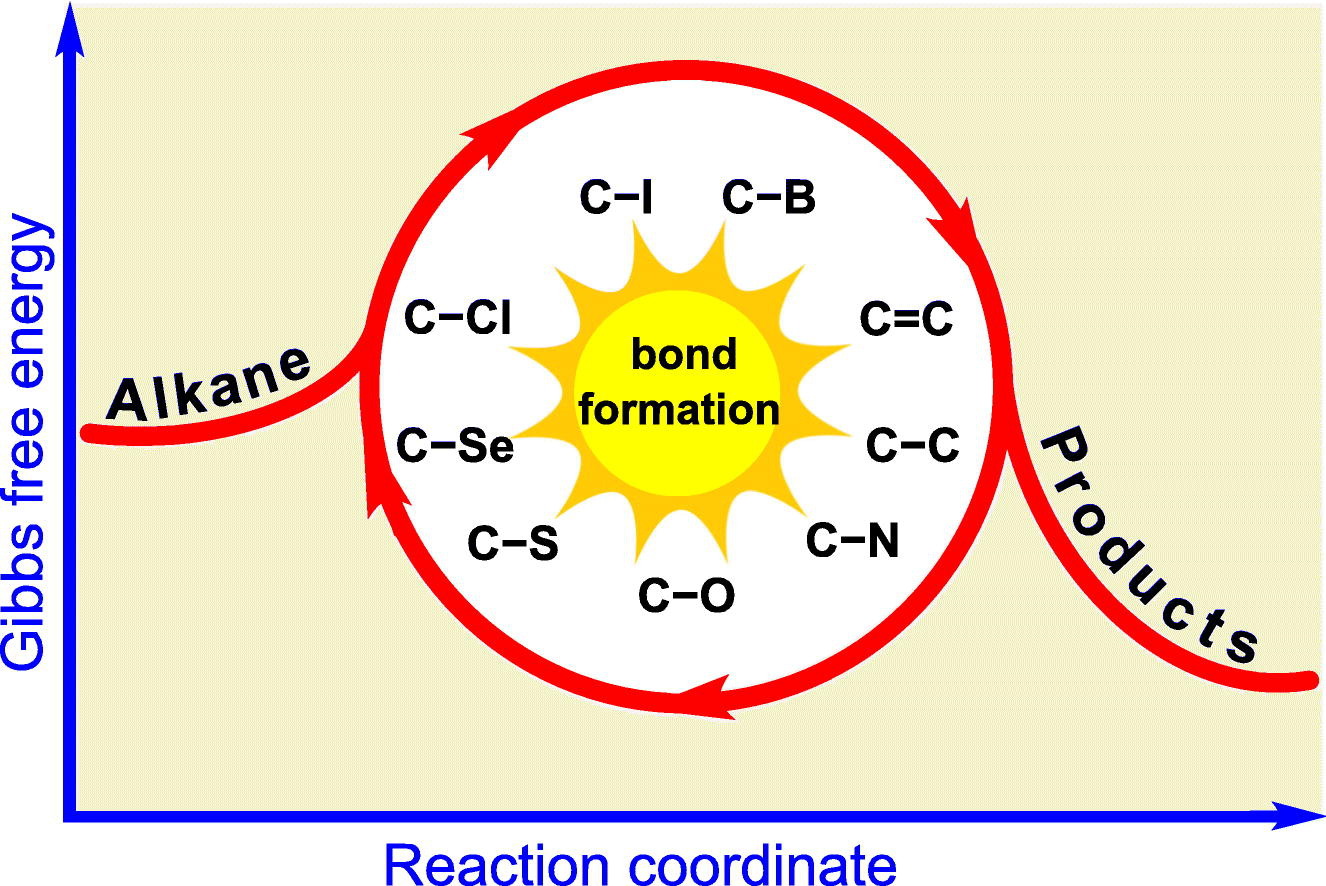
Organometallic compounds are organic compounds incorporating carbon-metal bonds. Organometallic compounds have been known and studied for nearly 200 years, and their unique properties have been widely used in synthetic transformations. Depending on the reduction potential of the metal, the reactivity of organometallic compound can vary greatly. The most reactive compounds require low to moderate temperatures and inert conditions (atmosphere and solvents) for preparation and use and the highly reactive compounds can be pyrophoric.
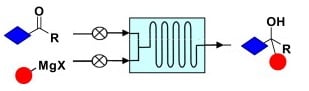
Continuous flow chemistry is an excellent tool for undertaking reactions utilising organometallic reagents for many reasons; precise control of reaction temperature, time and mixing, low volume sealed system so easily maintained dry and inert, efficient to keep continuous reactors cool when compared with batch reactors, improved safety through lower inventory of hazardous materials and handling of pyrophoric reagents eliminated.
Organometallic chemistry in flow
The use of organometallic species – such as organolithiums, organomagnesiums and organozincs – as a means for generating new covalent bonds is deeply embedded across several industries, from fine chemicals, to pharmaceuticals and agrichemicals, to functional materials. However, using these organometallic species can be non-trivial and comes with several risks: they are often pyrophoric or water-sensitive, can necessitate the use of specific solvents or additives to break up aggregates, usually require rigorous exclusion of oxygen, and in some cases the inert atmosphere necessitates the use of more expensive argon gas rather than nitrogen – especially true during formation of the organometallic species from the parent metal. Nevertheless, despite these risks their adoption is widespread, and many industrialists have invested in hardware and instrumentation specifically designed to enable their use. Nowadays, there are many methods that allow these versatile species to be generated and used reliably and safely, with the ability to temper and tune reactivity through judicious metal, and sometimes solvent, selection.[1]
While initial adoption within flow chemistry was slow, primarily due to perceived difficulties relating to these species’ compatibility with a flow set-up, pioneering work between Novartis and MIT in the early 2010s showcased the lithiation of an aryl species to give a lithiation/borylation/Suzuki–Miyaura cross-coupling cascade.[2] In 2013, Yoshida and co-workers disclosed the use of flash chemistry as a means to quickly generate and use highly reactive organolithium species.[3] Since these milestone publications, a range of organometallic species have been used to facilitate a variety of different reactions through a flow-based approach. Furthermore, while initial experiments focussed upon using pre-prepared or pre-purchased organometallic species, in recent years the generation of organometallic reagents in flow has become increasingly popular – likely due to the enhanced safety profile, improved mixing and heat transfer, and thermal control in these miniaturised devices – with access to new classes of reagents, such as organosodiums, being achieved in flow more reliably and more safely than in batch.[4]
Organolithiums in flow
Organolithium reagents are crucial to a range of chemical transformations and have wide utility within chemical synthesis. The polarity of the C–Li bond means that they can act as both a strong base, for example in the case of n-BuLi, LDA, LiHMDS etc, or as nucleophile, leading to formation of new C–C bonds. However, the use of organolithiums in this way is known to generate large exotherms, meaning that scale-up of these processes in batch is hard to achieve safely, and heat dissipation is a major limiting factor. Furthermore, precipitate formation can be troublesome, with challenges in solubility and therefore reactivity sometimes seen.
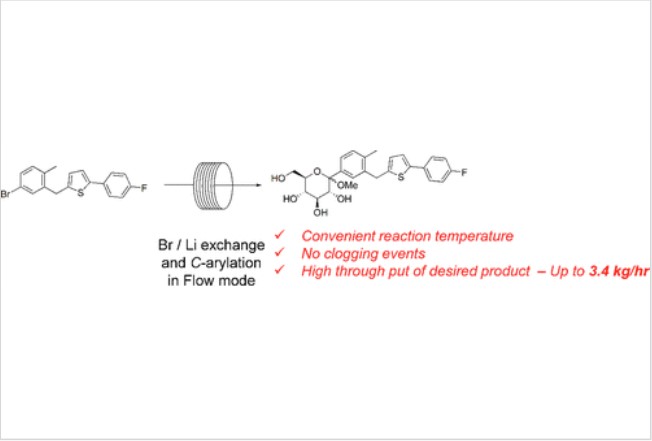
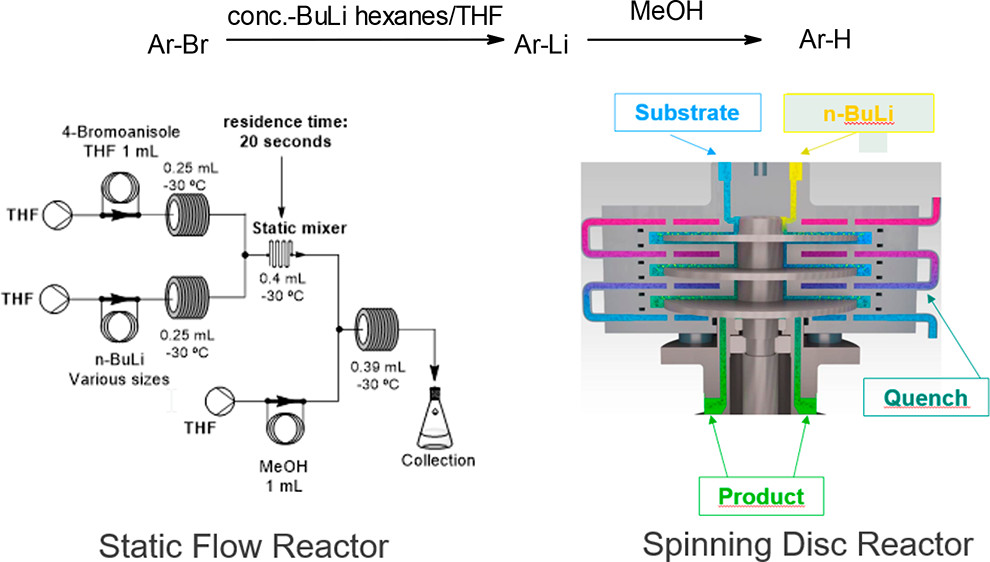
Continuous flow circumvents several of these issues, with the high surface area-to-volume ratio in a continuous flow set-up addressing the thermal constraints, and the superior thermal profile meaning that, in some cases, cryogenic temperatures of –78 °C are no longer needed: in many cases temperatures between –20 and 0 °C are the norm. For example, Srihari Pabbaraja and co-workers used the Vapourtec R-Series for preparation of multigram quantities of crisaborole, a boron-containing phosphodiesterase inhibitor, Figure 1.[5] In this case, a flow-based approach improved yields from the established batch procedure by over 50% and allowed the reaction temperature to be raised from –78 °C to –60 °C with no detrimental effect.
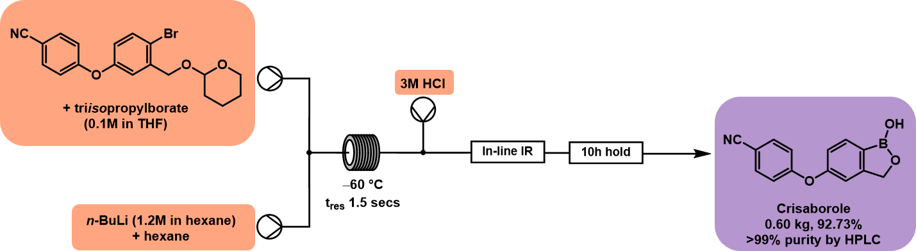
Figure 1: A continuous flow approach provided crisaborole over 92% yield, with excellent purity by HPLC. In particular, the very short residence times resulted from good mixing, higher temperature and enhanced reactivity, which ensured good scalability.
The exquisite thermal control offered by flow chemistry is due to the rapid dissipation of any exotherm. Extending this further, any reaction where heat release needs to be control through use of cryogenic conditions – such as a lithiation – will often see clear advantage through the use of flow because in batch, unless good mixing can occur, hot-spots may form that can lead to side-reactions or the potential for thermal run-away. In flow, good mixing (mass transfer) and miniaturisation (the high surface-area to volume ratio) leads to a reduction in the likelihood of hot-spot formation, therefore reduced likelihood of degradation and an improvement in safety.
However, improved thermal control is not the only aspect that can improve a reaction’s safety profile: if a high-energy or highly reactive intermediate is required, only small quantities of these hazardous species are generated, which also improves safety. This approach has been showcased by Thomas Wirth and co-workers, who used a Vapourtec E-Series to generate small quantities of the highly energetic species ethyl lithiodiazoacetate in situ, which was then directly exposed to the substituted acetophenone substrate, Figure 2.[6] While batch experiments were unreliable, giving low yields and being unsuitable for scale-up due to the extreme safety risk, the use of flow, where thermal control and immediate use of the intermediate was possible, improved reproducibility and reliability.
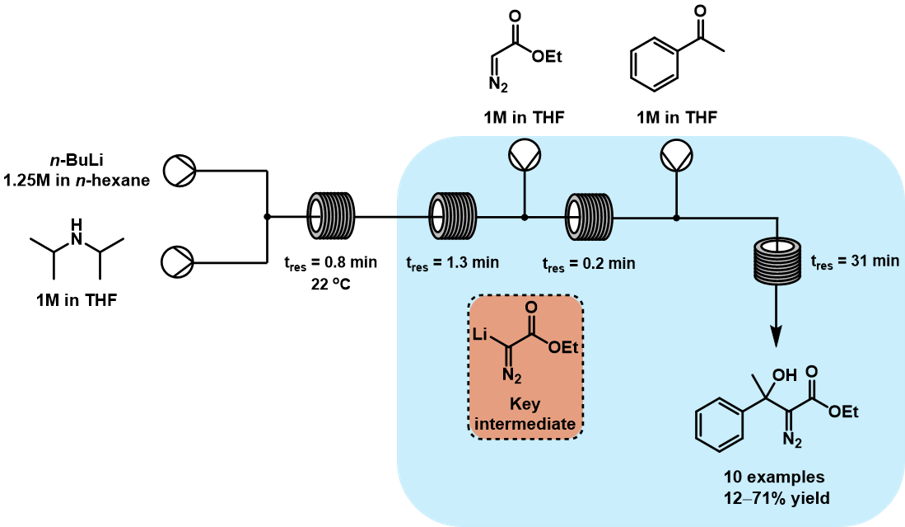
Figure 2: Rapid generation and safe handling of ethyl lithiodiazoacetate as an extremely unstable, but highly versatile building block for flexible synthesis
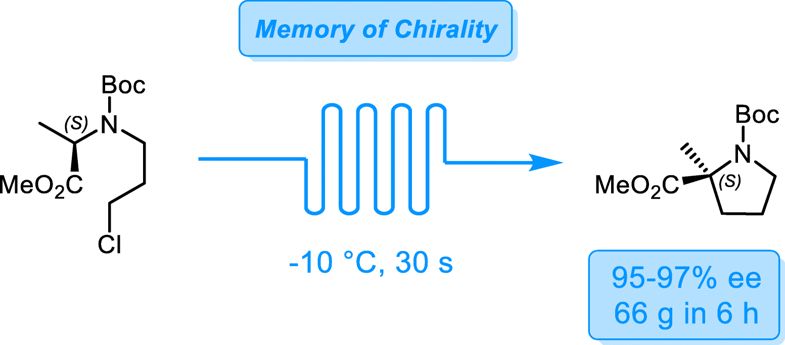
Another versatile reaction is the Matteson reaction, which allows the iterative homologation of boronate esters, with flow-based approaches disclosed by Kuhwald and Kirschning to provide access to homo-, bishomo-, and trishomo-terpenols after oxidative workup,[7] and the large-scale production of a pharmaceutical intermediate achieved by the team at Patheon.[8] For further information, several reviews, including those by Miyagishi and Nagaki,[9] Kappe and Luisi,[10] and McGlacken [11] give an excellent overview of the use of organolithiums in flow.
Grignards in flow
Organomagnesium reagents, or Grignards, are also a highly versatile reagent class, with diverse applications across organic synthesis. In analogy with organolithiums, large-scale use of Grignard species in batch can be troublesome due to large exotherms often necessitating slow addition of materials leading to extended reaction times, which may in turn cause material decomposition and diminished yields. Furthermore, upon quench, formation of gelatinous, insoluble magnesium salts can hamper work-up and purification.
However, the use of flow can offer several advantages, including excellent heat transfer and thermal control that can lead to reduced reaction times and, by extension, formation of fewer side-products and improved yields. Furthermore, in some cases there is the opportunity to generate the Grignard reagent in situ by using a magnesium-packed-bed flow reactor, meaning that Grignards that were previously considered unstable are now accessible.[12] In addition to this, the use of a Vapourtec Variable Bed Flow Reactor (VBFR) provides significant advantage, as when the magnesium reacts to form the Grignard reagent, the column volume can be reduced so the gaps and channels created – which can reduce efficacy as the reaction progresses – are removed, ensuring packing remains consistent and the metal insertion remains reliable. Generation and use of turbo-Grignard, iPrMgCl•LiCl, or other Grignard species coordinated to LiCl is also possible.
Whelligan and co-workers used the Vapourtec R-Series to prepare primary vinylarenes through in-line formation of (trimethylsilyl)methyl Grignard, and subsequent Peterson olefination. Using this approach, 2-vinylthiophene was prepared in 93% yield at 37 g scale, Figure 3.[13} A range of other vinylarenes were also prepared, including 2-vinylfuran, 3-methylstyrene, and methyl 4-vinylbenzoate.
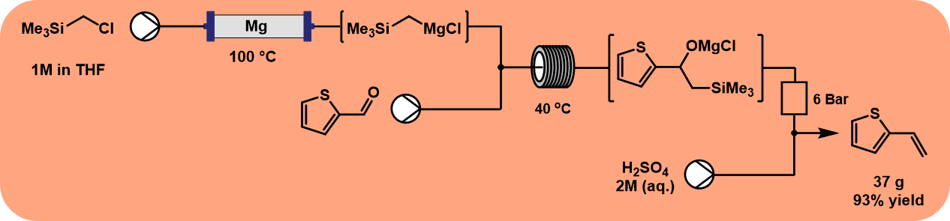
Figure 3: Formation of 2-vinylthiophene using in-line Grignard formation followed by Peterson olefination. Back-pressure regulators not shown to ensure clarity.
Organozincs in flow
Organozincs are a class of organometallic reagent with a diverse range of applications due to their tempered reactivity. For example, organozinc species tend to be less nucleophilic than organolithiums and organomagnesiums, enabling C–C bond formation – including cyclopropanation, nucleophilic addition, carbozincation, halogen-zinc exchange and Negishi cross-couplings – to occur under mild conditions.[14] In analogy with organolithium and organomagnesium generation, organozincs can be generated in situ by flowing the substrate over a packed-bed reactor containing zinc dust, allowing their rapid generation and use, Figure 4.[15]
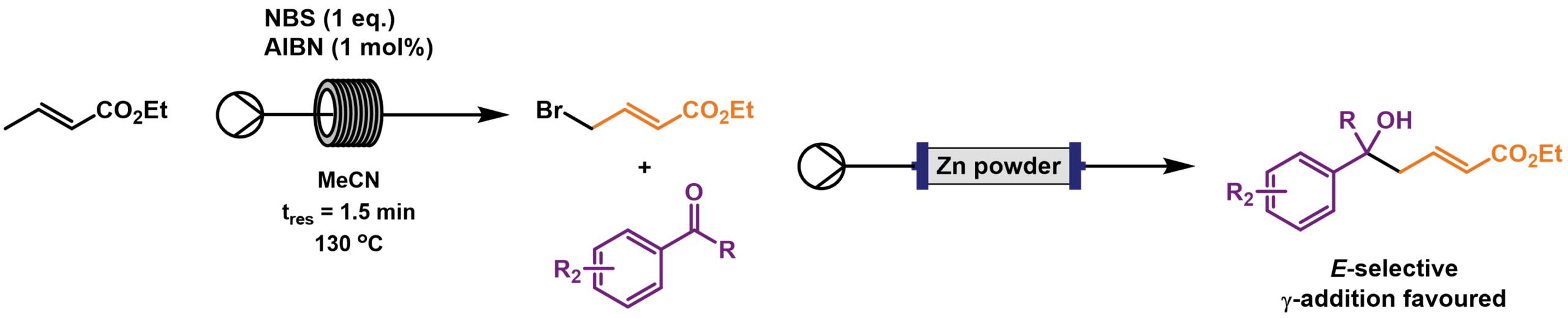
Figure 4: Charette and Boivin generated and used organozincs from γ-bromocrotonate ester in situ in a Reformatsky reaction.
Organosodiums in flow: the next frontier
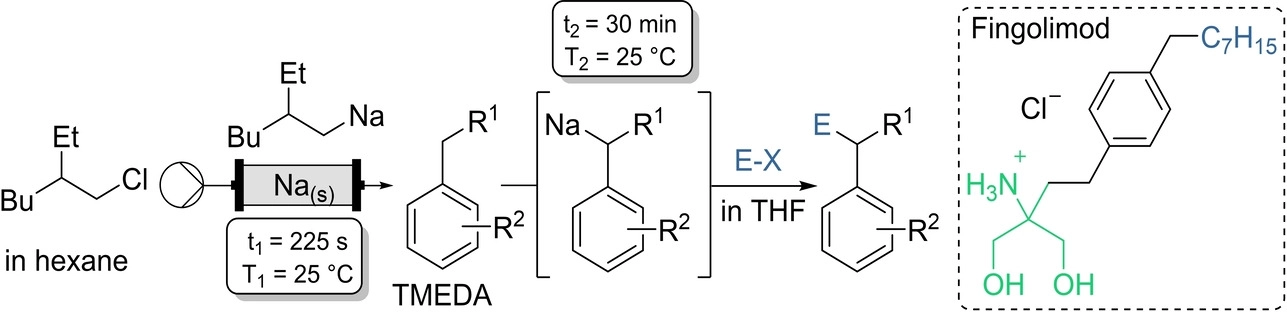
While the ‘big three’ – organolithiums, organomagnesiums and organozincs – are all well-established within both batch and flow chemistry approaches, the generation and use of organosodiums arguably is restricted to future development in flow because of these species’ high reactivity and instability. The Hilt group recently disclosed the use of flow chemistry as a means for generation of a primary alkylsodium species that was used to generate benzylic sodium nucleophiles or ortho-metalated sodium nucleophiles.[16] These secondary intermediates were then used derivatised further to form ketones. The Knochel group have also used a continuous flow approach to generate benzylic organosodium species.[17]
Take home
The use of flow chemistry can offer real advantage when it comes to organometallics, by virtue of the improved thermal control, the ability to generate and use highly reactive intermediates in situ, and ready scale-up of reactions. While the use of organolithiums, organomagnesiums and organozincs is well-established, the recent development of organosodium species – which suffer from severe limitations in batch mode is an exciting advancement.
References
[1] Taming hazardous chemistry by continuous flow technology (M. Movsisyan, E. I. P. Delbeke, J. K. E. T. Berton, C. Battilocchio, S. V. Ley, C. V. Stevens, Chem. Soc. Rev., 2016, 45, 4892–4928). https://doi.org/10.1039/c5cs00902b
[2] Continuous-Flow Synthesis of Biaryls Enabled by Multistep Solid-Handling in a Lithiation/Borylation/Suzuki–Miyaura Cross-Coupling Sequence (W. Shu, L. Pellegatti, M. A. Oberli, S. L. Buchwald, Angew. Chem. Int. Ed., 2011, 50, 10665–10669). https://doi.org/10.1002/anie.201105223
[3] Flash chemistry: flow chemistry that cannot be done in batch (J.-I. Yoshisa, Y. Takahashi, A. Nagaki, Chem. Commun., 2013, 49, 9896–9904). https://doi.org/10.1039/c3cc44709j
[4] Continuous Flow Preparation of Benzylic Sodium Organometallics (J. H. Harenberg, R. Reddy Annapureddy, K. Karaghiosoff, P. Knochel, Angew. Chem. Int. Ed., 2022, 61, e202203807). https://doi.org/10.1002/anie.202203807
[5] Flow Process for Production of Crisaborole Using Organolithium Chemistry with Control over Impurity Formation (C. S. Bohara, M. S. Phull, S. Pabbaraja, ACS Omega, 2025, 10, 55920–55931). https://doi.org/10.1021/acsomega.5c07458
[6] Ethyl Lithiodiazoacetate: Extremely Unstable Intermediate Handled Efficiently in Flow (S. T. R. Müller, T. Hokamp, S. Ehrmann, P. Hellier, T. Wirth, Chem. Eur. J., 2016, 22, 11940–11942). https://doi.org/10.1002/chem.201602133
[7] Matteson Reaction under Flow Conditions: Iterative Homologations of Terpenes (C. Kuhwald, A. Kirschning, Org. Lett., 2021, 23, 4300–4304). https://doi.org/10.1021/acs.orglett.1c01222
[8] Development of a Continuous Flow Process for a Matteson Reaction: From Lab Scale to Full-Scale Production of a Pharmaceutical Intermediate (C. Stueckler, P. Hermsen, B. Ritzen et al., Org. Proc. Res. Dev., 2019, 23, 1069–1077). https://doi.org/10.1021/acs.oprd.8b00340
[9] Use of Organolithiums in Flow Chemistry (J. M. Campagne et al., Science of Synthesis, 2025/1). https://doi.org/10.1055/sos-SD-108-00434
[10] Flow Technology for Telescoped Generation, Lithiation and Electrophilic (C3) Functionalization of Highly Strained 1-Azabicyclo[1.1.0]butanes (P. Musci, T. von Keutz, F. Belaj et al., Angew. Chimie, 2021, 12, 6465–6469). https://doi.org/10.1002/ange.202014881
[11] Organolithium Bases in Flow Chemistry: A Review (M. Power, E. Alcock, G. P. McGlacken, Org. Proc. Res. Dev., 2020, 24, 1814–1838). https://doi.org/10.1021/acs.oprd.0c00090
[12] Grignard Reagents on a Tab: Direct Magnesium Insertion under Flow Conditions (L. Huck, A. de la Hoz, A. Díaz-Ortiz, J. Alcázar, Org. Lett., 2017, 19, 3747–3750). https://doi.org/10.1021/acs.orglett.7b01590
[13] Continuous-Flow Synthesis of Primary Vinylarenes via Inline Grignard Reagent Formation and Peterson Olefination (M. J. Burrell, J. R. Varcoe, D. K. Whelligan, ACS Omega, 2025, 10, 17887–17897). https://doi.org/10.1021/acsomega.5c00823
[14] Structure–Reactivity Relationship of Organozinc and Organozincate Reagents: Key Elements towards Molecular Understanding (J. Rio, L. Perrin, P.-A. Payard, Eur. J. Org. Chem., 2022, 44, e202200906). https://doi.org/10.1002/ejoc.202200906
[15] Synthesis and Reactivity of Organozinc Reagents Derived From γ-Bromocrotonate Ester in Continuous Flow (R. Boivin, A. B. Charette, Synthesis, 2026, 58, 389–396). https://doi.org/10.1055/a-2722-7093
[16] The Application of Flow Chemistry for the Synthesis of Alkyl Sodium Compounds and Their Transformations with Weinreb Amides and Carboxylic Acids (P. Knupe-Wolfgang, B. Mahn, G. Hilt, Org. Lett., 2024, 26, 6972–6976). https://doi.org/10.1021/acs.orglett.4c02314
[17] Continuous Flow Preparation of Benzylic Sodium Organometallics (J. H. Harenberg, R. Reddy Annapureddy, K. Karaghiosoff, P. Knochel, Angew. Chem. Int. Ed., 2022, 61, e202203807). https://doi.org/10.1002/anie.202203807