

Date: 5 February 2026 | Category: News
Authors: Paula Knupe-Wolfgang, B. Mahn, Gerhard Hilt
The Hilt group from the University of Oldenburg have recently disclosed the in-situ generation and use of a highly reactive primary organosodium species [2]. In this case, the use of a continuous flow approach meant that stabilisation of the alkyl sodium by a tertiary amide, a key requirement for a batch-based approach, was not necessary, allowing preparation of the organosodium directly from an alkyl chloride in one step.
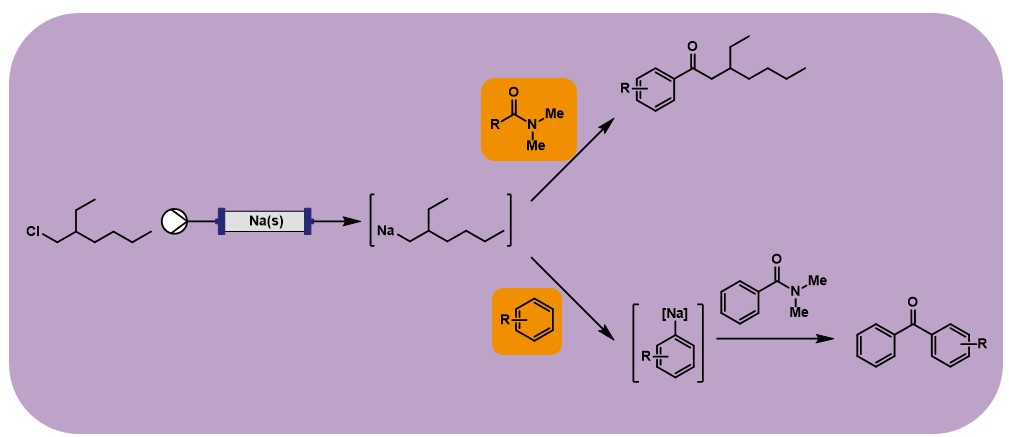
Figure 1: In-flow generation of organosodium and reaction with a) N,N-dimethylbenzamides or b) generation of a secondary organosodium to generate benzophenones.
While the use of carbon-based nucleophiles, such as organolithiums or Grignard reagents, is commonplace within organic synthesis, the use of the corresponding organosodium species is much less widespread. The reasons for this are threefold: their instability – they often require chelation by a tertiary amine for stabilisation [1, 2, 3] – their high reactivity, and their poor solubility in many solvents.
However, despite these issues they offer several advantages including avoidance of lithium, which can fluctuate significantly in price, the high abundance of sodium in the earth’s crust, rendering it more environmentally friendly, and the high reactivity of organosodium reagents. In recent years, the general development and applicability of organosodiums has grown, likely aided by the widespread adoption and use of continuous flow techniques [3, 4].
Flow chemistry: a versatile tool to access reactive and unstable species
The advantages of flow chemistry, especially in relation to the generation and use of highly reactive species in situ, were exploited by the Hilt group. In this work, the primary organosodium species, 2-ethylhexyl) sodium, was generated by passing a solution of 3-(chloromethyl)heptane in n-hexane through a bed of sodium metal within a flow set-up. The resulting organosodium was then used directly, either as a nucleophile for generation of ketones from N,N-dimethyl amides, or as a base for deprotonation of arenes to generate a secondary alkyl sodium species that could then undergo further reaction, Figure 2. The use of flow chemistry meant that inclusion of a tertiary amine to chelate to the alkyl sodium – a key requirement for batch synthesis – was not necessary, improving both atom economy and reaction efficiency.
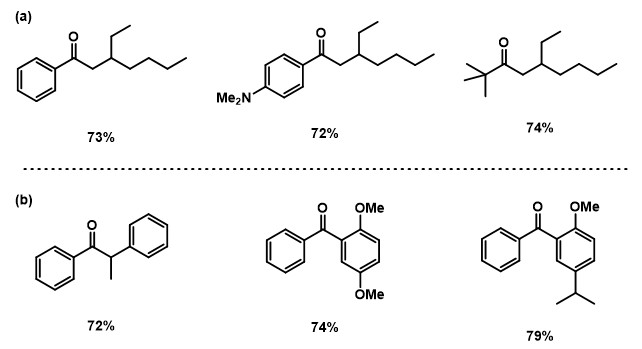
Figure 2: (a) Examples of products formed through reaction with N,N-dimethylbenzamides; (b) Examples of products formed through generation of an initial organosodium intermediate, then deprotonation of an arene, followed by coupling to an N,N-dimethylamide reactant.
Flow chemistry to tame reactive intermediates
While the generation and use of organosodium species is fraught with difficulty when using traditional batch methods, using the Vapourtec E-Series Flow Chemistry System means that the utility of these highly unstable and reactive species can be harnessed. Alkyl, benzylic and sp2-hybridized sodium reagents were all generated and subsequently used to effect nucleophilic addition into an N,N-dimethyl amide, with wide functional group tolerance. While this application is still in its infancy, the utility of flow chemistry means that it could be adapted and expanded to become much more general in scope.
References:
[1] Recent Advances in Transition Metal-Free Strategies for the Transformation of Amides into Carbonyl Compounds (K. R. Rajamanickam, R. P. Sirvin Rajan, N. Pootheri, C.-F. Lee, S. Lee, Eur. J. Org. Chem., 2025, e202500210). https://doi.org/10.1002/ejoc.202500210
[2] The Application of Flow Chemistry for the Synthesis of Alkyl Sodium Compounds and Their Transformations with Weinreb Amides and Carboxylic Acids (P. Knupe-Wolfgang, B. Mahn, G. Hilt, Org. Lett., 2024, 26, 6972–6976). https://doi.org/10.1021/acs.orglett.4c02314
[3] Continuous Flow Preparation of Benzylic Sodium Organometallics (J. H. Harenberg, R. R. Annapureddy, K. Karaghiosoff, P. Knochel, Angew. Chem. Int. Ed., 2022, 61, e202203807). https://doi.org/10.1002/anie.202203807
[4] The Transformation of Alkyl- and Aryl-Sodium Reagents with Simple Amides for the Direct Synthesis of Ketones (P. Knupe-Wolfgang, G. Hilt, Synthesis, 2025, 57, 3263–3272). https://doi.org/10.1055/a-2644-2500