
Date: 12 February 2026 | Category: News
Authors: Emily M. Luteran,* Marc R. Aloisi, Wendi L. Akerley, Robert D. Gilbertson
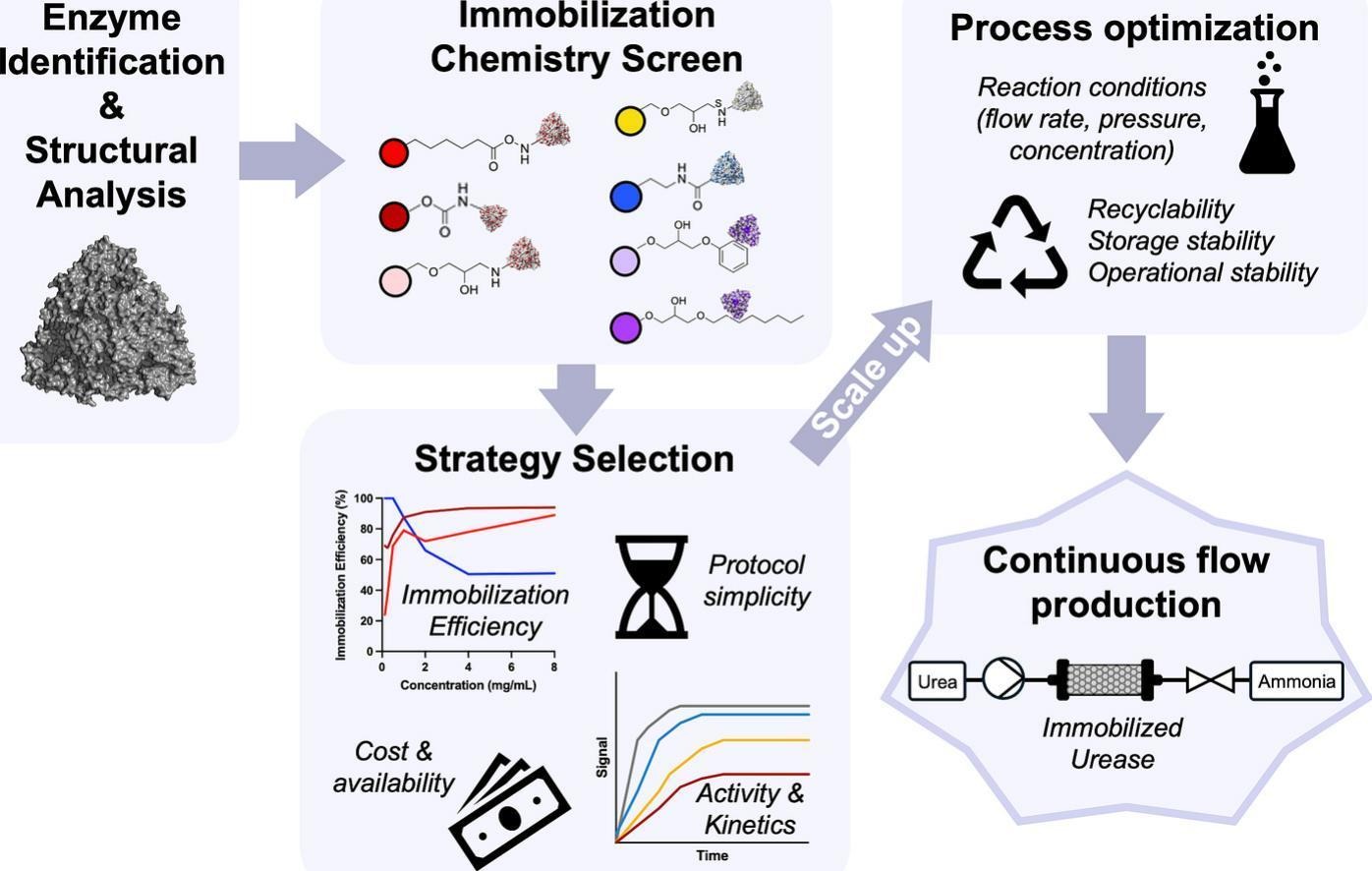
Researchers from the Los Alamos National Laboratory in the USA have assessed various strategies for immobilization of enzymes on solid supports, focussing on immobilization efficiency, protocol simplicity and the kinetics of the model enzyme, C. ensiformis (Jack bean) urease.[1] The best solid supports were then selected for production scaleup using a large-scale continuous flow set up, the Vapourtec R-Series modular flow chemistry system, where product yields, operational stability and long-term stability were all readily assessed. It was found that the immobilization technique had a clear impact upon enzyme stability and performance.
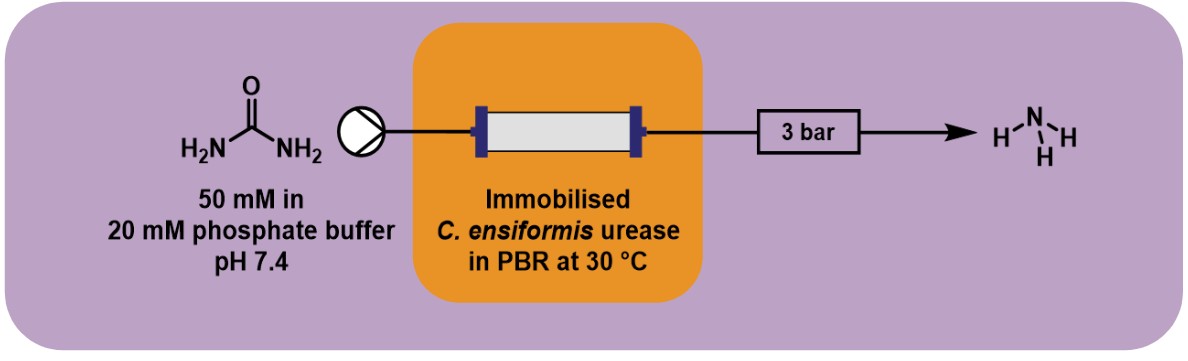 Figure 1: General scheme of ammonia production from urea
Considerations for enzyme use in chemical synthesis
The use of enzymes as biological catalysts is of great interest to synthetic chemists as they offer significant benefits when compared with traditional chemical production approaches. For example, enzymes can be highly specific, have excellent catalytic efficiency, are non-hazardous and are amendable to engineering.[2] They can also provide a pathway towards ‘green chemistry’ by circumventing the requirement for toxic solvents and generation of less chemical waste.[3] However, the large-scale use of enzymes can be non-trivial due to their sensitivity to environmental conditions and cumbersome purification requirements. Immobilization of enzymes can be a useful tool within enzyme-catalysed synthesis, and in some cases can provide better physical control of the enzyme and improved enzymatic performance,[4] as well as enhance shelf-life, operational stability, environmental resilience, target specificity and turnover number.
Enzymes in continuous flow
Immobilization of enzymes also offers the opportunity for their integration into a continuous flow-based process. This offers many advantages, including ease of scale-up, a smaller laboratory footprint than traditional bioreactors, and an improved safety profile. However, assessing the impact of immobilizing an enzyme during a continuous flow process can be time-consuming – especially in relation to assessing the impact of a solid support on enzyme longevity and catalytic performance.
The Vapourtec R-Series system as a tool for screening and optimising enzyme immobilisation strategies
The Vapourtec’s R-Series modular flow system was selected by Luteran and co-workers to evaluate different immobilization strategies. Attachment to the solid support was achieved by either covalent interactions at different sites and positions on the enzyme (a primary amine, a carboxylic acid or a thiol), or adsorption-based approaches. It was quickly discovered that adsorption-based immobilisation was not appropriate for continuous flow manufacturing due to enzyme leaching from the resin. Assessment of covalent resins revealed that:
- NHS-agarose and CDI-agarose were the most efficient at bioconversion of urea to ammonia under continuous flow conditions
- A faster flow-rate led to increased yield.
Overall, this study showcases the Vapourtec R-Series system as a robust tool for screening and assessing immobilized enzymes during continuous flow manufacturing. The ease of integration of immobilized enzymes into the continuous flow system, and the ability to vary temperature and flow rate, and automated sample collection were key to rapid data generation and reaction development.
References:
[1] Workflow for evaluating enzyme immobilization and performance for continuous flow manufacturing (E. M. Luteran, M. R. Aloisi, W. L. Akerley, R. D. Gilbertson, Curr. Res. Biotechnol., 2025, 10, 100327). https://doi.org/10.1016/j.crbiot.2025.100327
[2] Current status and emerging frontiers in enzyme engineering: An industrial perspective (O. G. Ndochinwa, Q.-Y. Wang, O. C. Amadi, T. N. Nwagu, C. I. Nnamchi, E. S. Okeke, A. N. Monekea, Heliyon, 2024, 10, e32673). https://doi.org/10.1016/j.heliyon.2024.e32673
[3] Green chemistry and biocatalysis: Engineering a sustainable future (R. A. Sheldon, Catalysis Today, 2024, 431, 114571). https://doi.org/10.1016/j.cattod.2024.114571
[4] Carbonic anhydrase-embedded ZIF-8 membrane reactor with improved the recycling and stability for efficient CO2 capture (R. Wang, Y. Chang, J. Li, S. Yang, T. Zhu, Y. Bi, J. Cui, Int. J. Biol. Macromol., 2024, 280, 136083). https://doi.org/10.1016/j.ijbiomac.2024.136083