
Date: 19 March 2026 | Category: News
Authors: Chander Singh Bohara, Manjinder Singh Phull, and Srihari Pabbaraja*
The Pabbaraja group at the CSIR-Indian Institute of Chemical Technology, Hyderabad, India has used the Vapourtec R-Series to prepare crisaborole, a boron-containing phosphodiesterase inhibitor, on multigram scale.[1]
The use of a flow-based approach improved yields over the established batch procedure by 50%, which was attributed to more precise control of the reaction kinetics and thermal regulation during n-BuLi addition.
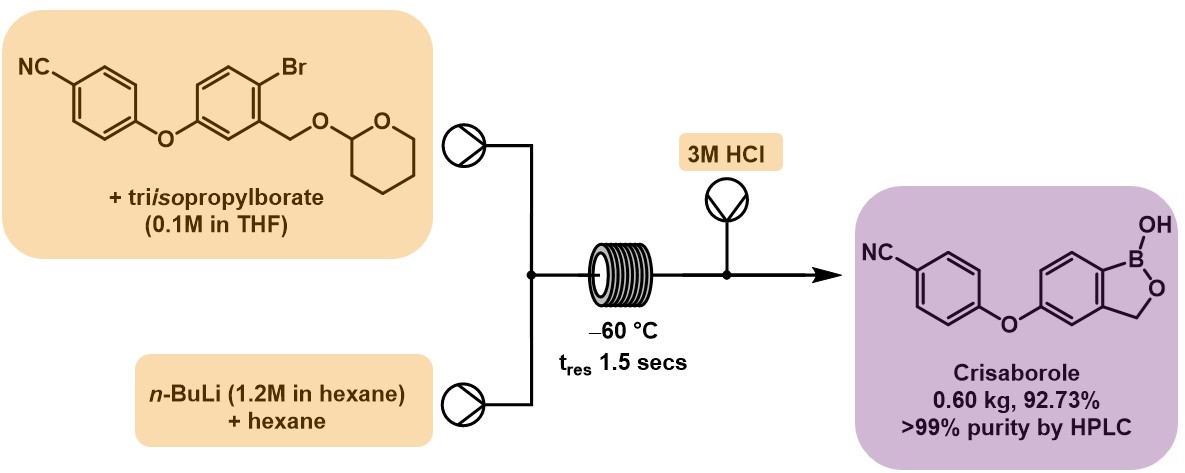
Scheme 1: A continuous flow approach provided crisaborole over 92% yield, with excellent purity by HPLC.
Phosphodiesterases: a key target for treatment of disease
Phosphodiesterases play a key role in the modulation of inflammation, as well as ensuring epithelial integrity of key cells, such as immune cells, brain cells and epithelial cells. Phosphodiesterase inhibitors block single or multiple subtypes of phosphodiesterases, leading to reduction in the activity of intercellular messengers such as cyclic adenosine monophosphate (cAMP) and cyclic guanosine monophosphate (cGMP). [2] Phosphodiesterase inhibitors currently on the market include enoximone, for treatment of congestive heart failure, apremilast for treatment of psoriasis, and sildenafil, for treatment of pulmonary hypertension and erectile dysfunction in men.
Crisaborole is a unique API, in that it contains a boron atom, which enables more effective skin penetration and is crucial for efficient binding to the bimetal centre of the receptor. It was approved by the FDA and is used in the clinic for treatment of atopic dermatitis and eczema in adults and children.
Established crisaborole synthesis: bottlenecks with lithiation and product purity
The existing large-scale route for synthesis of crisaborole is performed in batch and requires large-scale lithiation of an arylhalide at cryogenic temperatures, followed by treatment with a trialkyl borate. However, there are several drawbacks to this approach, including the instability of the lithiated species, which is exacerbated during large-scale synthesis; potential for hotspot formation during lithiation increasing risk of byproduct formation; limitations with functional compatibility; and, the requirement for low temperatures, which increases costs. In this regard, flow chemistry is a tempting alternative for the lithiation step, as it allows for control over various processing parameters including:
- Residence time
- Pressure
- Temperature
- Reagent mixing
- Stoichiometry
- Concentration
Continuous flow: giving exquisite reaction control leading to improved outcomes
During initial studies, the research team performed the lithiation/ cyclisation reaction in batch, at –78 °C, achieving a 40.2% isolated yield of crisaborole, alongside the presence of significant impurities. Due to the reasons outlined above, translation to a flow-based process was pursued.
During optimisation in flow using the Vapourtec R-Series system it became immediately apparently that the temperature could be raised to –60 °C with no detrimental impact on the process. In fact, the warmer conditions meant that the lithiation reaction duration could be reduced, addressing issues with instability of the organolithium intermediate. Reactor clogging and concomitant pressure build-up due to formation of lithium salts were addressed by the in situ formation, and immediate use of the lithiated species through reaction with triisopropylborate, which was introduced as a mixture with the starting aryl bromide. This both had the effect of diluting the reaction mixture further, helping to mitigate reactor clogging, and avoided undesired reaction with the nitrile by butyllithium.
Continuous flow: the opportunity for implementation of process analytical technology (PAT)
The use of a continuous flow approach also facilitated the implementation and use of process analytical technology (PAT), a useful tool for online reaction monitoring. In particular, online IR monitoring allowed rapid optimisation of the overall process, in real-time. Finally, implementation of a quality by design (QbD) framework was aided by identification of critical process parameters (CPPs) through use of both one factor at a time (OFAT) and design of experiment (DoE) methodologies.
Summary
The efficient synthesis of crisaborole was greatly facilitated by use of a continuous flow approach, improving reaction yield by over 50% when compared with the established batch approach. Key to this improvement was in situ lithiation of the arylbromide, and immediate quench with the boron electrophile. The excellent thermal transfer and efficient mixing afforded by flow chemistry ensured by-product formation was minimal. In-line quenching and collection of the output stream, followed by extraction into ethyl acetate, simple solvent removal and recrystallisation. For scale up the flow conditions derived using the Vapourtec R-Series were transferred to a 4 mL INNOSYN flow reactor to furnished kilogram quantities of crisaborole in 92.73% yield, and 99.38% purity by HPLC.
References
[1] Flow Process for Production of Crisaborole Using Organolithium Chemistry with Control over Impurity Formation (C. Singh Bohara, M. Singh Phull, S. Pabbaraja, ACS Omega, 2025, 10, 55920). https://doi.org/10.1021/acsomega.5c07458
[2] (a) Phosphodiesterase inhibitors (V. Boswell-Smith, D. Spina, C. P. Page, Br. J. Pharmacol., 2006, 147, S252) https://doi.org/10.1038/sj.bjp.0706495; (b) ABCD of the phosphodiesterase family: interaction and differential activity in COPD (D. Halpin, Int. J. Chronic. Obstruct. Pulmon. Dis., 2008, 3 (4), 543). https://doi.org/10.2147/COPD.S1761