Vapourtec Ltd

Telephone +44(0)1284 728659
Email [email protected]
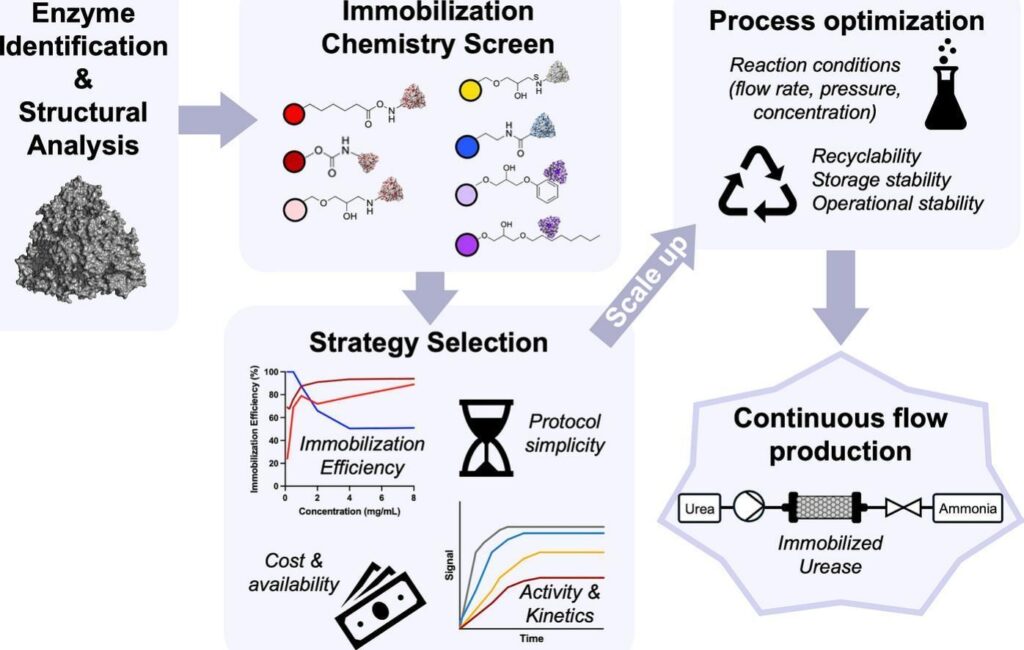
Enzymes have shown promise in various industries due to their functional specicity, catalytic efciency, and environmental sustainability. These biological catalysts can be a pivotal component of manufacturing pipelines like continuous ow chemistry. For this, there exists a need to robustly immobilize enzymes on solid supports and assess the effects of the solid supports on catalytic performance and stability. Here, we use an industrially relevant model enzyme, C. ensiformis (Jack bean) urease, to demonstrate immobilization and assess performance in the context of continuous ow manufacturing. Various immobilization strategies were screened focusing on immobilization efciency, protocol simplicity, and urease biocatalyst kinetics. Based on this, CDI-agarose and NHS-agarose resins were identied as the best-performing immobilization strategies for urease. CDI-agarose- urease and NHS-agarose-urease were then scaled up and applied to a large-scale continuous ow reactor to evaluate product yields, operational stability, and long-term stability. These experiments identied differences in stability and performance depending on the immobilization method tested. This highlights the importance of screening immobilization methods and subsequent enzyme performance for each candidate biocatalyst used in manufacturing to promote optimal performance and stability. As such, this work provides a framework for evaluating enzyme biocatalyst immobilization approaches to improve performance and enable transition into industrial processes