Vapourtec Ltd

Telephone +44(0)1284 728659
Email [email protected]
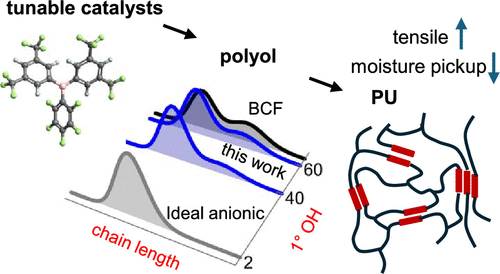
Tris(pentafluorophenyl)borane (BCF) is a highly active catalyst in the ring-opening polymerization (ROP) of propylene oxide (PO) and yields polyether polyols with high primary alcohol (1° OH) selectivity. However, an unwanted side reaction in which BCF isomerizes PO to propionaldehyde (PA) has limited its industrial applicability. Herein, we demonstrate that the selectivity for both 1° OH and PA formation can be tuned through substitution changes on the triarylborane framework. A scalable polymerization process involving dual-stage catalyst addition with tris(3,5-bis(trifluoromethyl)phenyl)borane (1) was developed, enabling improved economics through reduction in catalyst usage. Poly(propylene oxide) triols were synthesized using the optimized process at parts per million (ppm) levels of catalyst and benchmarked against analogous KOH-catalyzed polyols in a flexible packaging adhesive polyurethane application (PU). PU films with fewer defects (bubbles) and improved tensile strength were produced. This work highlights the central role of catalysis in achieving affordable, yet improved, materials, especially in proven and mature markets.