Vapourtec Ltd

Telephone +44(0)1284 728659
Email [email protected]
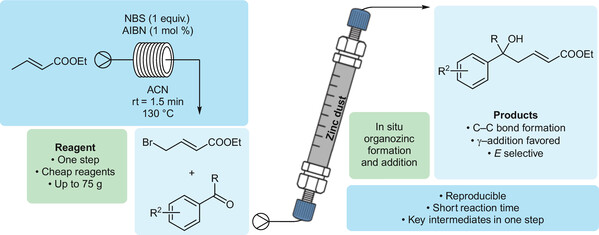
The Reformatsky reaction is a well-established method for the synthesis of β-hydroxyesters, a structural motif commonly found in natural products. While continuous-flow adaptations of the traditional Reformatsky reaction, which offer improved safety and efficiency, have been reported, related transformations using γ-bromocrotonate esters have not yet been explored in flow chemistry. Under batch conditions, the corresponding organozinc reagent can yield both γ- and α-adducts, depending on the metal employed and the specific reaction parameters. In this study, we report the first Reformatsky-type reaction in continuous flow using ethyl γ-bromocrotonate, with conditions optimized to favor γ-selectivity and the synthesis of homoallylic alcohols. Zinc dust was utilized as the reagent, and the reaction scope was demonstrated with a variety of carbonyl compounds, including in a four-step synthesis of piperine. Furthermore, the synthesis of ethyl γ-bromocrotonate was efficiently accomplished under continuous-flow conditions on a multigram scale via a Wohl–Ziegler bromination.