Vapourtec Ltd

Telephone +44(0)1284 728659
Email [email protected]
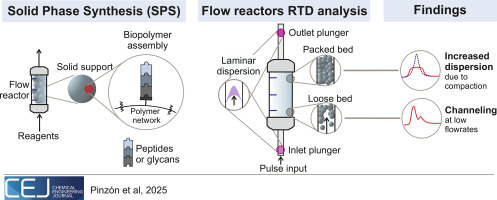
Flow reactors for Solid phase synthesis (SPS) have gained attention, as they appear to be more efficient than the widely used stirred tanks. In either Packed Bed (PBR) or Loose Bed Reactors (LBR) configurations, the theoretical description of such platforms is limited. This study evaluates the Residence Time Distribution (RTD) for small scales (60–400 mg) of Merrifield resin (100–200 mesh) as a solid support with dichloromethane (DCM) and dimethylformamide (DMF) as solvents. For a 6.6 mm diameter column (3.0 mL total volume), we propose the tanks-in-series (TIS) model and a convolution methodology to consider the effect of inlet and outlet plungers. We assess the impacts of compaction (ΔP from 1 to 12 bar) through a Variable Bed Flow Reactor (VBFR). Our results indicate that for a PBR, increased solid support compaction broadens the RTD, indicating a higher degree of back mixing. The Kozeny-Carman equation describes the pressure increase through a packed bed in relation to the reduction in void fraction. For the LBR configuration, channeling is observed at low flow rates (DMF below 1 mL/min), and the use of a static mixer improves flow distribution. For both configurations, we present a descriptive model and a parametric analysis of the system, which is valuable for defining operational conditions.