Vapourtec Ltd

Telephone +44(0)1284 728659
Email [email protected]
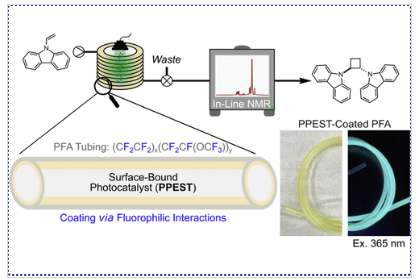
The design of flow reactors for heterogeneous photocatalysis is key to enhancing the control, efficiency, and scalability of chemical reactions. However, conventional designs such as slurry reactors and fixed bed reactors often suffer from poor light penetration, challenging catalyst attachment to the support, and difficult separations. We report an efficient and robust methodology for the functionalization of perfluoroalkoxy (PFA) coil reactors with different fluorinated photocatalysts [a perylene diimide (F-PDI) and poly(p-phenylene ethynylene) polymers (PPEST and POLPDI)] through fluorophilic interactions. We have evaluated the efficiency of photocatalyst-functionalized coil reactors in continuous flow experiments through the [2 + 2] photocycloaddition of 9-vinylcarbazole (VCZ) using blue and green light (440 and 525 nm). The conversion of VCZ to the product 1,2-trans-dicarbazylcyclobutane (t-DCZCB) was continuously monitored by in-line nuclear magnetic resonance (NMR) spectroscopy, and we found that PPEST was the most robust photocatalyst coating of those studied, leading to high conversions with different lamp powers and residence times. Further experiments proved that PPEST-functionalized coil reactors were stable and efficient after 18 h of continuous flow with conversions from around 50 to 75%.