
High-Throughput Electrochemistry: State of the Art, Challenges, and Perspective

Added on:
31 Mar, 2026

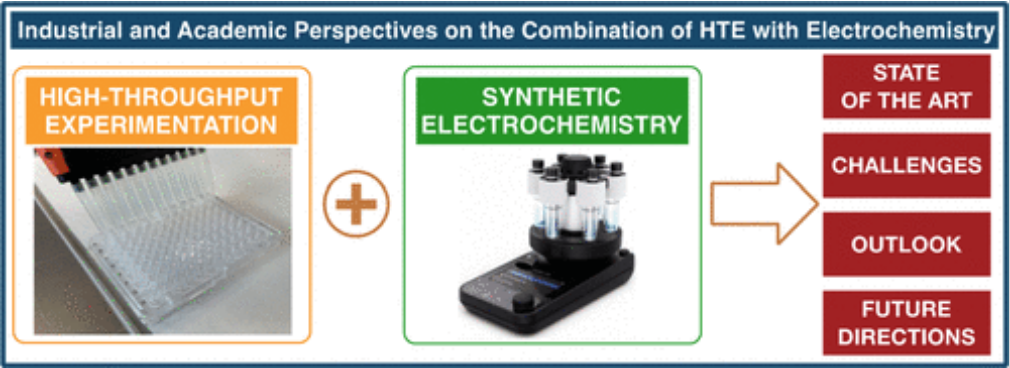
Electrochemical transformations involve complex parameter interactions, ranging from universal chemistry variables such as solvent and reagents to specialist factors including electrode material and current density. Hence, the development of a robust and scale-independent electrochemical reaction can currently be a challenge. High-throughput experimentation (HTE) is an enabling method for reaction optimization and robustness testing. Here we provide an industrial and academic perspective on the state of the art of the combination of HTE with electrochemical reaction optimization for applications, including scale-up. We then present our vision for a future in which HTE reduces barriers to wide adoption of electrochemistry across the field of chemical synthesis.
  • Wills A1,2
  • Charvet S3
  • Battilocchio C4
  • Scarborough C4
  • Wheelhouse K5
  • Poole D1
  • Carson N6
  • Vantourout J3
  •   1Medicinal Chemistry, GlaxoSmithKline, Medicines Research Centre, Gunnels Wood Road, Stevenage SG1 2NY, United Kingdom
  • 2Department of Pure & Applied Chemistry, University of Strathclyde, Thomas Graham Building, 295 Cathedral Street, Glasgow G1 1XL, United Kingdom
  • 3Univ Lyon, Université Lyon 1, CNRS, INSA, CPE-Lyon, ICBMS, UMR 5246, Bâtiment LEDERER, 1 rue Victor Grignard, 69622 Villeurbanne Cedex, France
  • 4Research Chemistry, Syngenta Crop Protection, Schaffhauserstrasse 101, CH-4332 Stein, Switzerland
  • 5Chemical Development, GlaxoSmithKline, Medicines Research Centre, Gunnels Wood Road, Stevenage SG1 2NY, United Kingdom
  • 6Syngenta Jealott’s Hill International Research Centre, Bracknell, Berkshire RG42 6EY, United Kingdom
Read the publication that featured this abstract