Vapourtec Ltd

Telephone +44(0)1284 728659
Email [email protected]
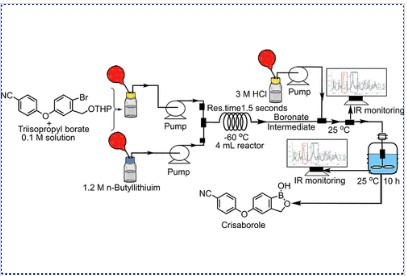
Crisaborole, a distinctive boron-containing phosphodiesterase inhibitor, is used for the treatment of atopic dermatitis and eczema in adults and children. The development process for crisaborole involves organolithiation through a Br/Li exchange at −78 °C in batch mode. A continuous flow chemistry process was successfully developed for the synthesis of the key boronate intermediate of crisaborole, enabling efficient mixing, impurity control, and improved yield. The flow approach reduced the residence time dramatically from 1800 s in batch mode to just 1.5 s, and while elevating the temperature from −78 to −60 °C, it maintained precise control over impurity formation and achieved a significant improvement in overall yield. The boronate intermediate was subsequently subjected to one-pot THP deprotection and cyclization, resulting in the successful production of crisaborole in kilogram quantities. This approach allowed for effective control over product formation, optimized conditions for scalability, and careful management of the three impurities. The application of a quality by design (QbD) approach in the flow synthesis of crisaborole enabled systematic control and minimization of three critical impurities by establishing a thorough understanding of process parameters and their impact on product quality while also ensuring optimized conditions for scalability and effective control over product formation.