Vapourtec Ltd

Telephone +44(0)1284 728659
Email [email protected]
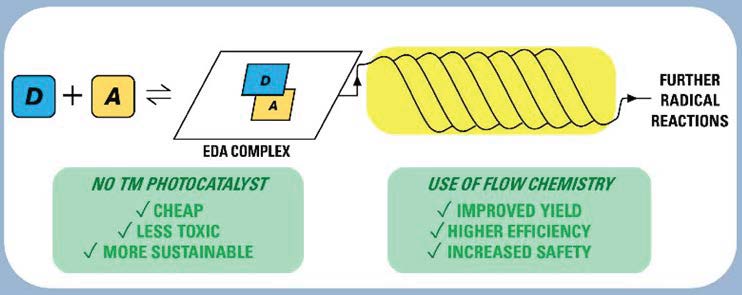
In recent years, electron donor-acceptor (EDA) complexes have emerged as sustainable, cost-effective, and inherently safer alternatives to traditional transition metal-based photocatalysts in photochemical processes. Formed via the association of neutral electron-rich and electron-deficient species, EDAs offer an environmentally benign route to radical generation across a broad spectrum of reactions. Concurrently, flow chemistry has gained prominence as a burgeoning area of scientific inquiry, enhancing reaction control, safety, mixing efficiency, and, critically, light penetration. In this mini review, we highlight recent works that have explored the use of EDA photochemistry with flow methodologies, while assessing both the promising practical advantages and current limitations in bringing these two fields together.