Vapourtec Ltd

Telephone +44(0)1284 728659
Email [email protected]
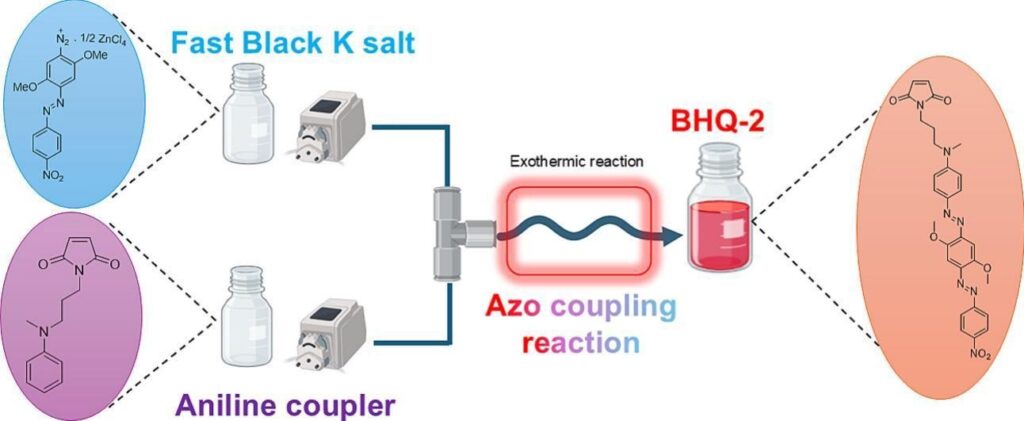
Black Hole Quencher-2 (BHQ-2) is a widely used azo fluorescent quencher (AFQ) due to its strong absorbance in the mid-visible region. However, the synthesis of BHQ-2 derivatives remains challenging and potentially hazardous, primarily due to the use of diazonium salts and the exothermic nature of azo coupling reaction. To overcome these limitations, we investigated a continuous flow approach as an alternative to traditional batch synthesis. Continuous flow offers enhanced heat and mass transfer, improved control over exothermic reactions, and greater safety and scalability. This study explores both the synthesis and photophysical characterization of a series of BHQ-2 derivatives, comparing batch and continuous flow methods. We explore how the presence and positioning of methoxy groups affect azo coupling efficiency and the photophysical properties of resulting novel azo fluorescent quenchers. We also examine the synthesis of halogenated analogues and the generation of triazene by-products. Investigations revealed that the removal or repositioning of methoxy groups influenced both yields and photophysical properties. Notably, complete removal enhanced coupling efficiency but reduced absorption maxima. Continuous flow synthesis reduced reaction time (1 min vs. 7 h in batch for compound 21). However, persistent issues with triazene by-products complicated efforts to telescope these reactions. Overall, our findings contribute to the development of safer and more efficient strategies for accessing BHQ-2 derivatives with desirable photophysical properties.