Vapourtec Ltd

Telephone +44(0)1284 728659
Email [email protected]
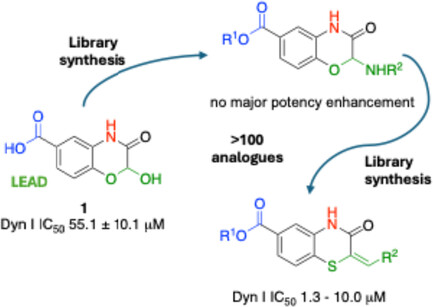
Screening identified 2-hydroxy-3-oxo-3,4-dihydro-2H-benzo[b][1,4]oxazine-6-carboxylic acid (1) as a 55 µM dynamin GTPase inhibitor. Synthesis of three 1-based libraries shows no potency enhancement. However, S-isostere-based 3-oxo-3,4-dihydro-2H-benzo[b][1,4]thiazine-6-carboxylic acid (16) gives rise to Libraries 4–6. Library 4 retains the C6-ester of 1; only H-bond capable analogs (–OH, –CO2H) improves dynamin inhibition (IC50 < 20 µM), with C3′-CO2H 17j returning an IC50 = 1.3 ± 0.5 µM. N-methylation gives Library 5 and essentially removes activity. Most (>80%) of Library 6 analogs are dynamin active. Highest potency is noted with H-bond-accepting aromatic moieties: C3′-OAc 19p, C2′,C3′,C4′-tri-OAc 19r, and C3′,C4′-di-OMe 19y (IC50 values of 5.1, 5.2 and 7.2 µM, respectively). A N,N-dimethylaminopropyl chain enhances activity with C4′-OH 19u to 21, but has no effect with C4′-OH 17u to 20. This may be due to compound remodeling within the active site to best align two of the three H-bond-donating groups (of 19u vs. 17u). There appears to be a minimum requirement of two H-bond donors. Combined this work has identified seven new analogs: C3′–CO2H 17j, C2′–OH 17s, C3′,C4′-di-OMe 18y, C3′-OAc 19p, C2′,C3′,C4′-tri-OAC 19r, C3′,C4′-di-OMe 19y, and C4′-O(CH2)3NMe2 21 with dynamin IC50 values of 1.3–10.0 µM. 118 compounds are synthesized and screened.