Vapourtec Ltd

Telephone +44(0)1284 728659
Email [email protected]
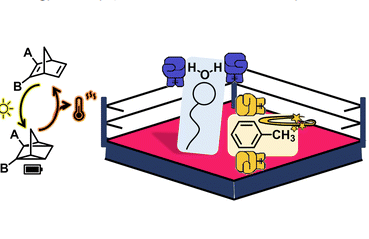
Molecular solar thermal energy storage (MOST) systems, which absorb sunlight, store this energy in chemical bonds, and release it as heat, are receiving increasing attention in renewable energy storage applications. Among the norbornadiene/quadricyclane (NBD/QC) couples developed for MOST, the 2,3-difunctionalized cyano- and p-aryl-substituted NBD/QC couples have received greater attention for their promising properties. However, their application in solution requires the use of hazardous solvents, which limits their potential for large-scale implementation. Here, new greener systems consisting of cyano- and p-alkoxyphenyl-substituted NBD/QC derivatives dissolved in non-ionic surfactants and water were investigated. Concentrations of NBD up to 1.6 M were achieved by tuning the water/surfactant ratio, meeting the solubilization properties of organic solvents. The most promising system was further characterized, and its properties in water-based solutions were compared with those observed in toluene. Integration into a solar energy-harvesting liquid device led to the full conversion of the NBD to QC. The evaluation of the heat release performance upon catalytic trigger resulted in a temperature increase of 4.7 °C in ambient conditions. This demonstrates that promising NBDs/QCs can be used for MOST in aqueous media without compromising key performance parameters such as energy density, photoconversion, and catalyzed heat release.