
Date: 1 December 2025 | Category: News
Authors: Cristopher Tinajero, Marcileia Zanatta, Julián E. Sánchez-Velandia, Eduardo García-Verdugo and Victor Sans*
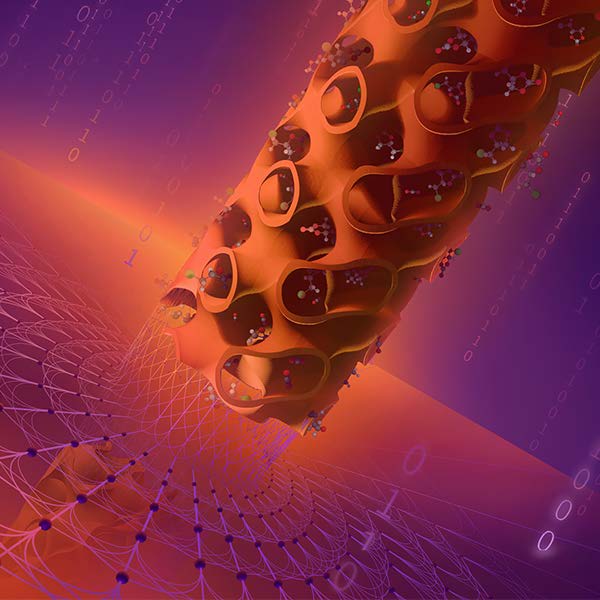
The Sans group from the Institute of Advanced Materials (INAM) at the Universitat Jaume I in Spain have developed a digital platform – Reac-Discovery – that integrates Reac-Gen, a software module for the digital generation and structural assessment of catalytic reactors, Reac-Fab, which is mainly responsible for the physical manufacturing of the reactor, and Reac-Eval, a self-driving algorithm that validates the printability of reactors designed in Reac-Gen and 3D printed with Reac-Fab.[1]
Reac-Discovery offers new avenues for advanced chemical process development employing structured packed devices. By integrating the design and analysis (Reac-Gen), fabrication and functionalisation (Reac-Fab), and rapid evaluation and optimization (Reac-Eval) it is possible to discover novel structures that can undertake chemical reactions and separations with unprecedented performance. The integration of functionalities, such as catalysts, enables complex multiphasic transformations that are more selective and sustainable than traditional counterparts. A key takeaway from the recent publication is that there is no universal structure that performs better than the rest. Hence, Reac-Discovery can offer tailored solutions to a very broad range of chemistries.
Within Reac-Eval there are two key, fully-integrated, pieces of hardware: an automated Vapourtec RS-400 platform, equipped with a sample collector, capable of executing and monitoring reactions in sequence and conducting training experiments autonomously, and a lowfield benchtop NMR spectrometer, allowing real-time reaction monitoring.
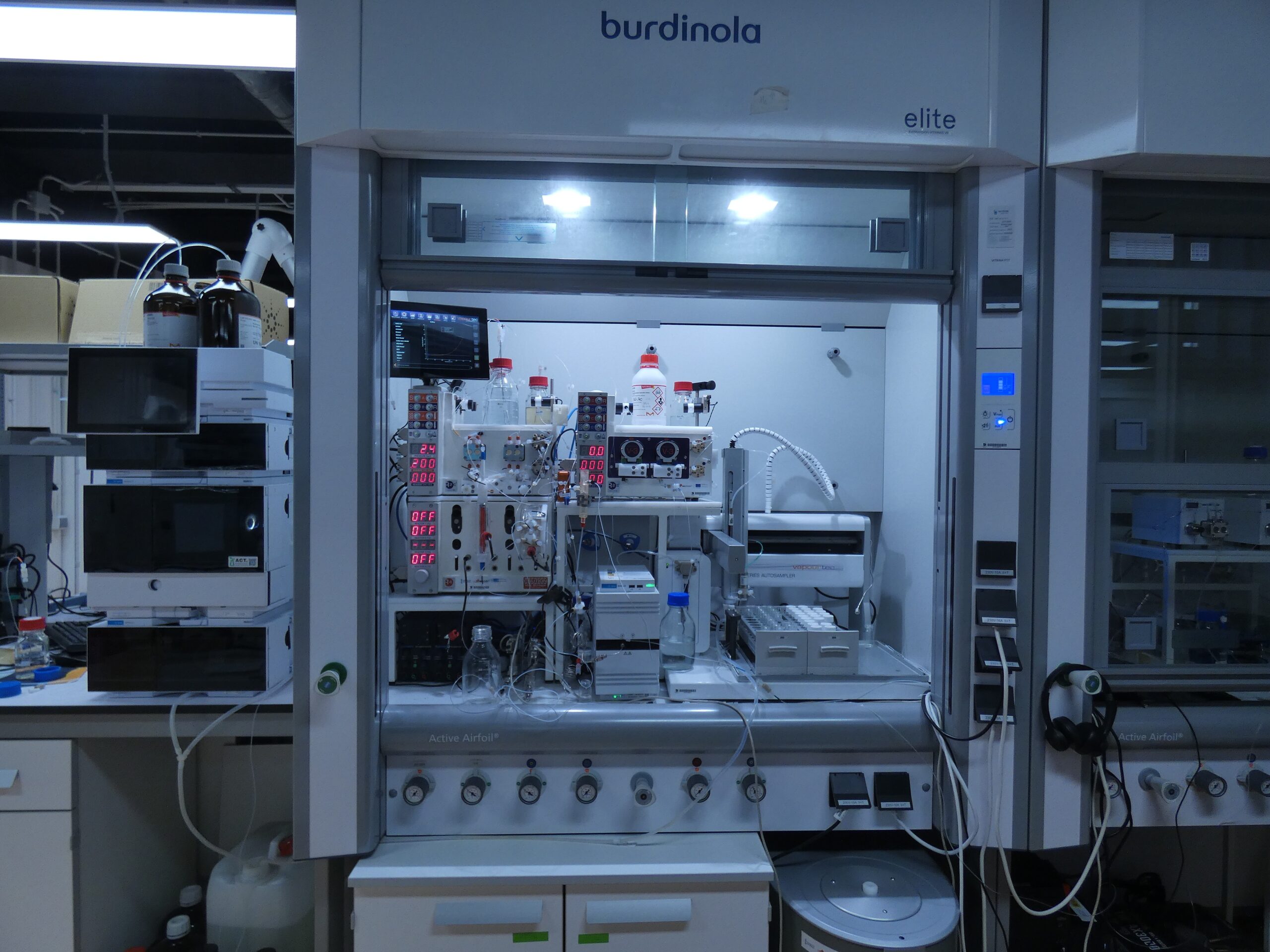 Reac-Discovery platform used for photoredox amine synthesis
 The integration of ML into drug discovery
In recent years, as the field of machine learning (ML) and robotics has advanced, their integration into drug discovery programmes has become increasingly mainstream. This is particularly the case with continuous flow chemistry, which is readily applied in the development of automated and self-optimizing platforms to enhance chemical processes. [2, 3, 4] Also known as self-driving laboratories (SDLs), these platforms enable the optimization of various parameters including temperature, flow rates of gases or liquids, and reaction concentration, while minimizing the resource required and maximizing data generation. More recently, SDLs have been developed for use in advanced additive manufacturing [5] and have been integrated into catalyst design with automated process optimization, [6, 7] with advanced SDLs offering robust capabilities for high throughput experimentation (HTE) and process optimization.
Alongside developments in ML, the advent of 3D printing means that fabrication of bespoke flow reactors with specific geometries and requirements can be readily achieved. Periodic open-cell (POC) structures that contain repeating unit cells with interconnecting pores can be rapidly manufactured through 3D printing and offer significantly better heat and mass transfer when compared to conventional packed-bed reactors.
Reac-Discovery: a semi-autonomous digital platform
Reac-Discovery is a digital platform that integrates the design, fabrication, and optimization of catalytic reactors. Importantly, it facilitates process and topology optimization, so complex multiphasic chemical reactions can be optimized quickly and efficiently. The Sans group showcased the efficiency of the platform through two case studies: low pressure heterogeneous hydrogenation of acetophenone, and the low-pressure cycloaddition of carbon dioxide to epichlorohydrin. Both examples are multiphase transformations, incorporating liquids, gases and solids, with catalysis occurring on the surface of the heterogeneous support. Rate of reaction relies upon the efficiency through which the gaseous reactant diffuses through, or dissolves in, the liquid phase to reach the catalytic sites, as well the activity of the catalytic sites, with the reactor playing a key role in this process.
Case study: hydrogenation of acetophenone
Hydrogenation of acetophenone to 1-phenylethanol is commonly used as a benchmark reaction because it is widely used within fine chemical and pharmaceutical synthesis and requires reagents in three distinct phases: solid (catalyst), liquid (acetophenone in solvent), gas (molecular hydrogen). In this example were two optimization campaigns: G1, where the correlation between reactor design, process parameters and catalytic activity were determined, and G2, where these insights were refined, largely in-silico with limited synthesis to confirm predictions, to optimize reactor geometries and process conditions. During these campaigns, Reac-Gen was used to generate the design and structure of the reactor and Reac-Eval coordinated reactor temperature, gas and liquid flows, and other parameters though use of an integrated 80MHz SpinSolve Ultra benchtop NMR spectrometer and a Vapourtec RS-400 system. Once G1 and G2 were complete, the optimal structure was digitally designed with Reac-Gen, then fabricated and functionalized using Reac-Fab. Reac-Eval then validated the model.
For further information in relation to the R-Series System or for other examples of the use of ML and AI in conjunction with Vapourtec systems, please see this article: Machine learning (ML) drives efficiency in automated chemistry.
References:
[1] Reac-Discovery: an artificial intelligence-driven platform for continuous-flow catalytic reactor discovery and optimization (C. Tinajero, M. Zanatta, J. E. Sánchez-Velandia, E. García-Verdugo, V. Sans, Nature Commun., 2025, 16, 9062). https://doi.org/10.1038/s41467-025-64127-1
[2] A machine learning-enabled process optimization of ultra-fast flow chemistry with multiple reaction metrics (D. Karan, G. Chen, N. Jose, J. Bai, P. McDaidd, A. A. Lapkin, React. Chem. Eng., 2024, 9, 619–629). https://doi.org/10.1039/D3RE00539A
[3] Machine learning-guided space-filling designs for high throughput liquid formulation development (A. Chitre, D. Semochkina, D. C. Woods, A. A. Lapkin, Comp. Chem. Eng., 2025, 195, 109007). https://doi.org/10.1016/j.compchemeng.2025.109007
[4] An integrated self-optimizing programmable chemical synthesis and reaction engine (A. I. Leonov, A. J. S. Hammer, S. Lach, S. H. M. Mehr, D. Caramelli, D. Angelone, A. Khan, S. O’Sullivan, M. Craven, L. Wilbraham, L. Cronin, Nature Commun., 2024, 15, 1240). https://doi.org/10.1038/s41467-024-45444-3
[5] Machine learning-assisted discovery of flow reactor designs (T. Savage, N. Basha, J. McDonough, J. Krassowski, O. Matar, E. Antonio del Rio Chanona, Nature Chem. Eng., 2024, 1, 522–531). https://doi.org/10.1038/s44286-024-00099-1
[6] The rise of self-driving labs in chemical and materials sciences (M. Abolhasani, E. Kumacheva, Nature Synthesis, 2023, 2, 483–492). https://doi.org/10.1038/s44160-022-00231-0
[7] An autonomous laboratory for the accelerated synthesis of novel materials (N. J. Szymanski, B. Rendy, Y. Fei et al., Nature, 2023, 624, 86–91). https://doi.org/10.1038/s41586-023-06734-w