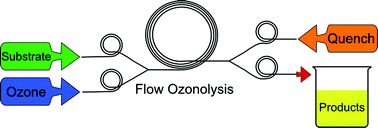
Ozonolysis is a valuable synthetic transformation for the selective cleavage of carbon–carbon double bonds, providing efficient access to aldehydes, ketones, carboxylic acids, and other important intermediates. When performed in continuous flow, ozonolysis benefits from enhanced safety, improved gas–liquid mass transfer, and precise control over reaction conditions, even when working with low-pressure ozone generators. The small reactor volumes minimise the inventory of ozone and potentially hazardous ozonide intermediates, while accurate control of residence time, temperature, and reagent stoichiometry can improve selectivity, reproducibility, and process understanding.
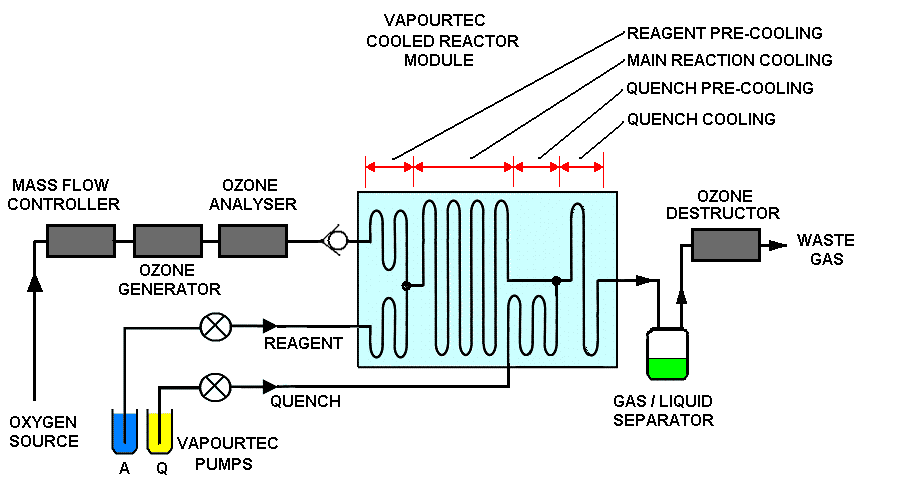
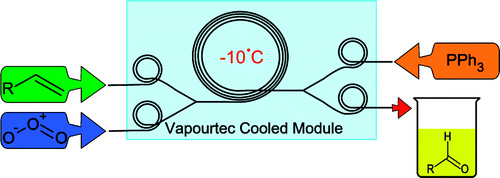
For researchers developing and optimizing ozonolysis methodologies, Vapourtec’s Cooled Reactor provides additional capabilities for low-temperature reaction control, operating from ambient down to -70 °C. The system allows reagent streams and quench solutions to be pre-cooled before mixing and maintains a cooled quench zone throughout the process, helping to suppress over-oxidation and unwanted side reactions. In collaborative studies with UCL, flow ozonolysis of 1-decene at -10 °C achieved complete conversion to nonanal with no detectable nonanoic acid formation following optimization of the quench protocol. These features enable chemists to safely explore reaction parameters, investigate challenging substrates, and accelerate the development of robust ozonolysis processes.
The Vapourtec R-Series system with a cooled reactor was used as shown below: