
Date: 30 July 2026 | Category: Headline News, News
Peptide aggregation is one of the most common causes of poor coupling efficiency, deletion sequences and reduced crude purity during solid-phase peptide synthesis (SPPS). Although its effects are well known, identifying exactly when and where aggregation occurs within a synthesis has traditionally been difficult.
Vapourtec’s latest application note demonstrates how its patented Variable Bed Flow Reactor (VBFR™) technology enables peptide aggregation to be detected and monitored in real time during synthesis.
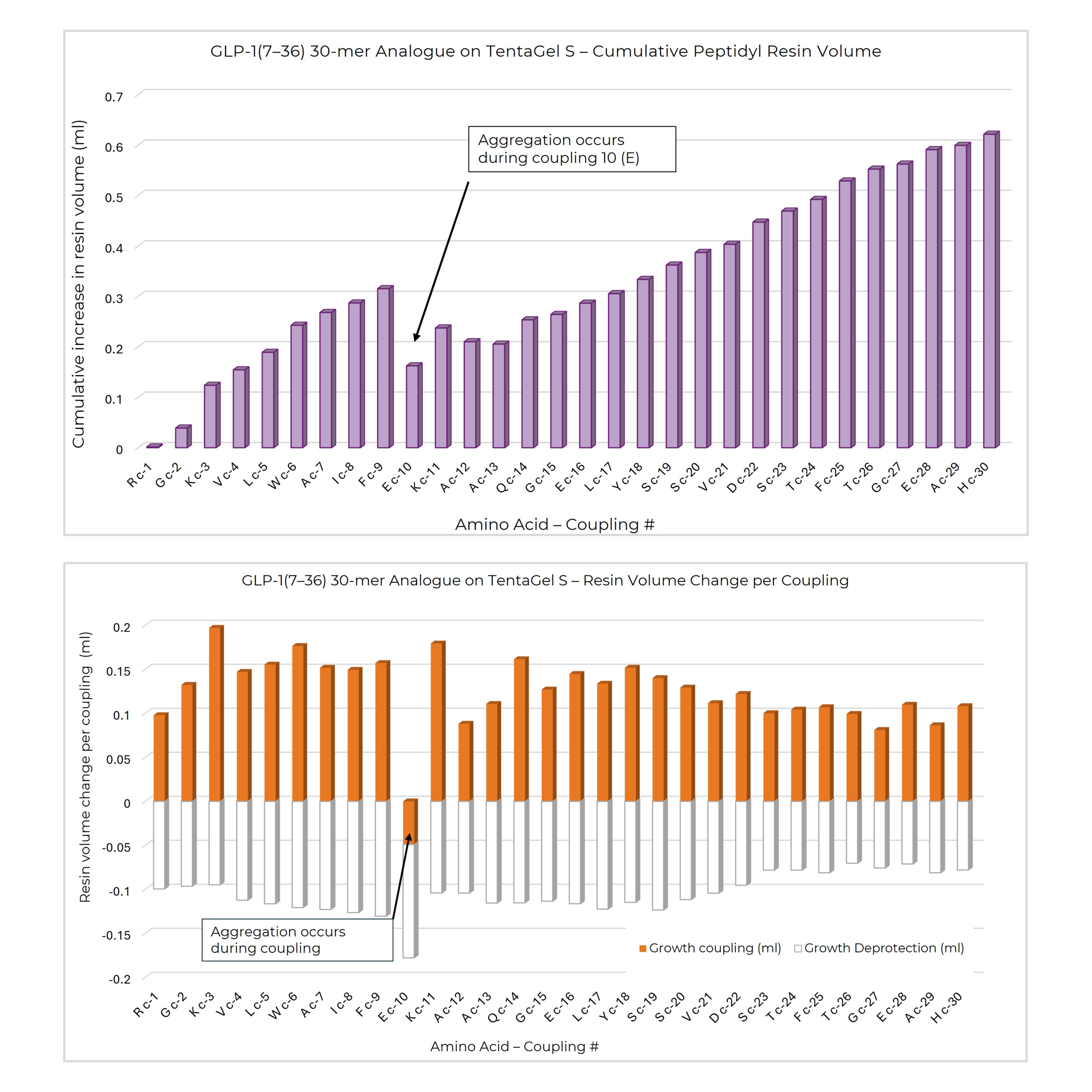
Unlike conventional approaches that rely on analysing the final crude peptide, the VBFR™ continuously monitors changes in resin bed volume throughout chain elongation. Aggregation events are automatically detected and correlated with individual coupling and deprotection steps, allowing chemists to identify problematic regions of a peptide sequence as they occur.
The application note presents results from seven representative peptide sequences, including the widely studied JR-10, ACP, GLP-1 analogue and Barstar peptides. These examples demonstrate how real-time monitoring reveals different aggregation behaviours, from transient events that resolve naturally to persistent aggregation that may require changes to the synthesis protocol.
By understanding exactly where aggregation begins, peptide chemists can make targeted process improvements, such as modifying coupling conditions, introducing pseudoproline dipeptides or optimizing solvent systems, without unnecessarily extending synthesis time or increasing reagent consumption.
Whether you are developing new peptide syntheses or optimizing challenging sequences, this application note demonstrates how real-time process monitoring can provide valuable insight into peptide behaviour and support the development of more robust synthesis methods.
Rather than relying on crude purity alone to reveal aggregation after synthesis, Vapourtec’s VBFR™ technology enables aggregation to be detected, monitored and localised as it develops. Download the application note to discover how real-time aggregation monitoring can accelerate method development, improve synthesis robustness and give peptide chemists a deeper understanding of sequence-dependent aggregation.