

Date: 25 June 2026 | Category: Headline News, News
Authors: Julián E. Sánchez-Velandia, Mattia Annatelli, Cristopher Tinajero, Marcileia Zanatta, Victor Sans, Fabio Aricò and Eduardo García-Verdugo
Eduardo García-Verdugo and co-workers from the Universidad Jaume I have developed a biorefinery strategy for the efficient conversion of sugar-derived biomass into nitrile-containing compounds with high value in the polymer industry. This work uses Task-Specific Solid Ionic Liquid Phases (TS-SILPs), which exploit the stabilising properties of ionic liquids and DMSO within a solid-phase solvent system. [1] In the synthesis of 5-hydroxymethylfurfural (HMF), this allows acceleration of both the synthesis and downstream synthetic transformations. Furthermore, because TS-SILPs are on a solid support, they can be placed in a packed-bed rector, rendering them amenable to continuous separation of the product from the immobilised ionic liquid equivalent, as well as recycling, addressing concerns around green chemistry and sustainability, Scheme 1.
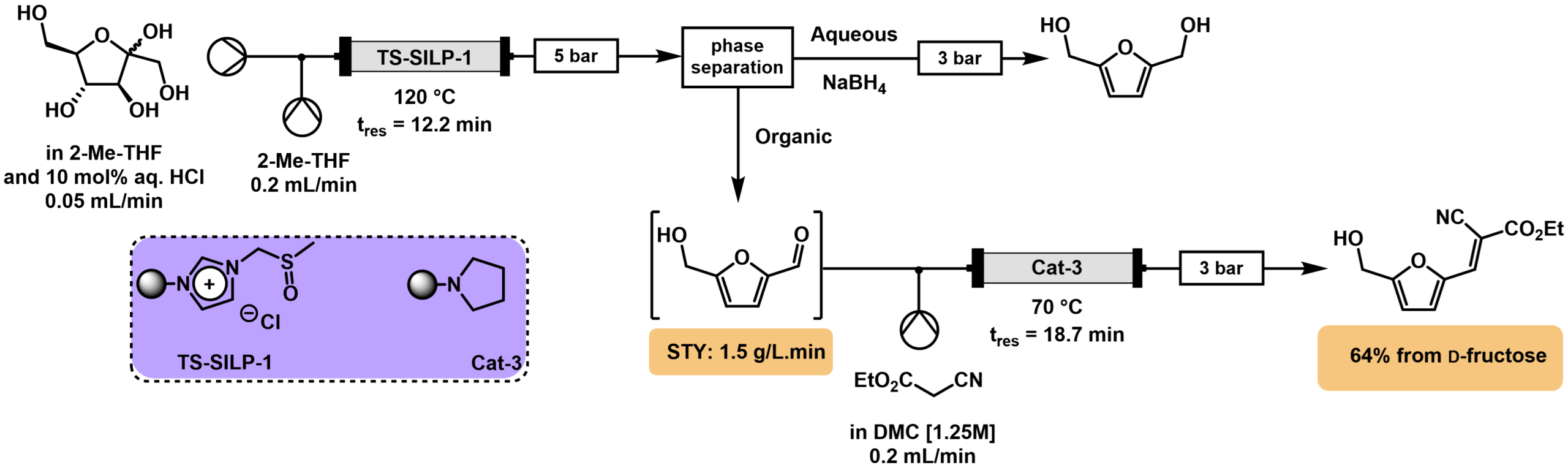
Scheme 1: Overview of the flow-based approach for the conversion of D-fructose into HMF, which was then functionalised directly through Knoevenagel reaction with ethyl cyanoacetate. NB: phase separation is with a Zaiput liquid/liquid separator.
5-hydroxymethylfurfural (HMF): a versatile feedstock material
The use of 5-hydroxymethylfurfural (HMF) as a key feedstock material, accessible from sugars, has attracted considerable attention in recent years due to the opportunities for development of green and sustainable approaches for its synthesis.[2] However, while laboratory-scale approaches have relied upon batch reactors, these are not without issue during scale-up, with reductions in efficiency, heat and mass transfer limitations, and environmental concerns all regularly cited. Furthermore, HMF is unstable, therefore it must be used as quickly as possible to avoid degradation and irreversible breakdown. The adoption of a flow-based approach provides an opportunity to circumvent these issues, as well as offer an improved safety profile, easier separation of catalysts from products, and improved scalability.[3]
Task-Specific Solid Ionic Liquid Phases (TS-SILPs)
Both monophasic and biphasic approaches for HMF formation from sugars have been reported. While monophasic systems are generally more efficient, they can suffer from issues relating to solubility of the HMF precursors. One way to address this is through addition of an aqueous acid to the solvent to facilitate dissolution, then subsequent extraction of the dissolved precursor by partitioning into the organic phase. However, while this approach can offer reasonable levels of productivity, scale-up can be tricky.
Although the use of ionic liquids in continuous flow is generally considered challenging due to their high viscosity, which can lead to pumping issues, Task-Specific Solid Ionic Liquid Phases (TS-SILPs) may provide a valuable alternative, allowing access to more scalable processes and improved reaction efficiency. TS-SILPs are materials that are specifically engineered to act as efficient solid co-solvents and enable easy handling and recovery of the ionic liquid phase. They can avoid the issues seen with some ionic liquids, such as solubility in the organic solvent, which may be undesired. In this case, the TS-SILP combines the advantages of ionic liquids – including high catalytic activity and stability – with those of DMSO as a solvent. In this work, García-Verdugo and co-workers took PS-DVB Merrifield resin and appended the functionalized imidazole, ImDMSO, leading to formation of the equivalent of a solvent on solid support, which could be used in combination with other solvents, such as water, that are not polymer-supported, Scheme 2.
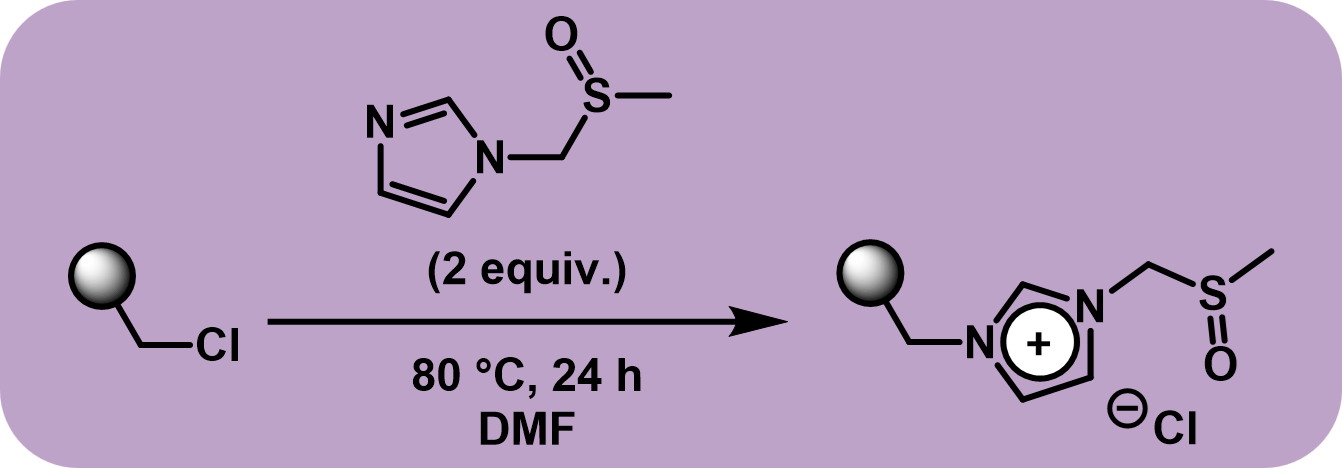
Scheme 2: Formation of TS-SILP-1 for loading into a fixed-bed flow reactor.
D-Fructose to HMF conversion using TS-SILPs
To achieve conversion of fructose into HMF, a solvent mixture of 2-MeTHF with water (4:1) was used, with the water phase containing 10 wt% D-fructose and 10 mol% HCl relative to the sugar. Increasing the fructose concentration was also successful, with 15 wt% providing the best yields. While a STY for HMF production of 1.5 g/L.min was lower than other reported processes, the downstream handing in comparison was much improved and using the HMF product in subsequent processes was facile.
Telescoping of the HMF product into a Knoevenagel reaction, for formation of α-β-unsaturated ester, required use of 10 wt% fructose in water in 2-MeTHF:water (4:1), and a residence time of 12 minutes. Inclusion of a Zaiput liquid–liquid phase separator enabled separation of the organic and aqueous phases. However, the aqueous phase contained some HMF, due to the solubility of 2-MeTHF in water, therefore this material was reduced in situ with sodium borohydride to give 2,5-bis(hydroxymethyl)furan (BHMF). The organic phase was telescoped further and combined with a solution of ethyl cyanoacetate in dimethyl carbonate that was passed through a fixed-bed reactor containing 1.0 g of an immobilised-pyrrolidine catalyst. This two-step telescoped procedure furnished an overall yield of Knoevenagel product of 64%, and was shown to be robust for 48 hours of continual production, with the final nitrile-containing product collected by filtration.
Flow chemistry as a means for green biorefinery
The Vapourtec R-Series system, fitted with peristaltic pumps, was used in the efficient conversion of D-fructose into HMF-derived nitrile compounds through a Knoevenagel condensation, and 2,5-bis(hydroxymethyl)furan by borohydride-mediated reduction. The use of TS-SILPs was key for this work, as they allowed integration of the stabilising properties of DMSO and ionic liquids into one polymer-supported material – crucial for preventing premature breakdown of the HMF product – and could be loaded into a pre-packed fixed-bed reactor.
References:
[1] A sweet flow: HMF production and in situ valorization into valuable nitrile-containing compound via telescopic flow chemistry (J. E. Sánchez-Velandia, M. Annatelli, C. Tinajero, M. Zanatta, V. Sans, F. Aricò, E. García-Verdugo, Green Chem., 2026, 18, 2715–2723). https://doi.org/10.1039/d5gc04694g
[2] 5-Hydroxymethylfurfural and its Downstream Chemicals: A Review of Catalytic Routes. (C. Chen, M. Lv, H. Hu, L. Huai, B. Zhu, S. Fan, Q. Wang, J. Zhang, Adv. Mat., 2024, 36, 2311464) https://doi.org/10.1002/adma.202311464
[3] Microflow chemistry and its electrification for sustainable chemical manufacturing. (T.-Y. Chen, Y. W. Hsiao, M. Baker-Fales, F. Cameli, P. Dimitrakellis, D. G. Vlachos, Chem. Sci., 2022, 13, 10644–10685). https://doi.org/10.1039/D2SC01684B