

Date: 16 July 2026 | Category: Headline News, News
Authors: Tribani Boruah, Sagar Arepally, Rebecca L. Melen, and Thomas Wirth
Researchers at Cardiff University have demonstrated a scalable continuous- flow electroreduction process for α,β-unsaturated carbonyl compounds using the Vapourtec Ion Electrochemical Reactor. By numbering-up parallel electrochemical reactors, the team successfully translated the process from gram quantities to 100 g while maintaining reaction performance and achieving a 75-fold improvement in productivity compared with conventional batch electrochemistry. The methodology was demonstrated across a broad substrate scope, including chalcones, heterocyclic enones, esters, ketones and carboxylic acids, Figure 1.[1]
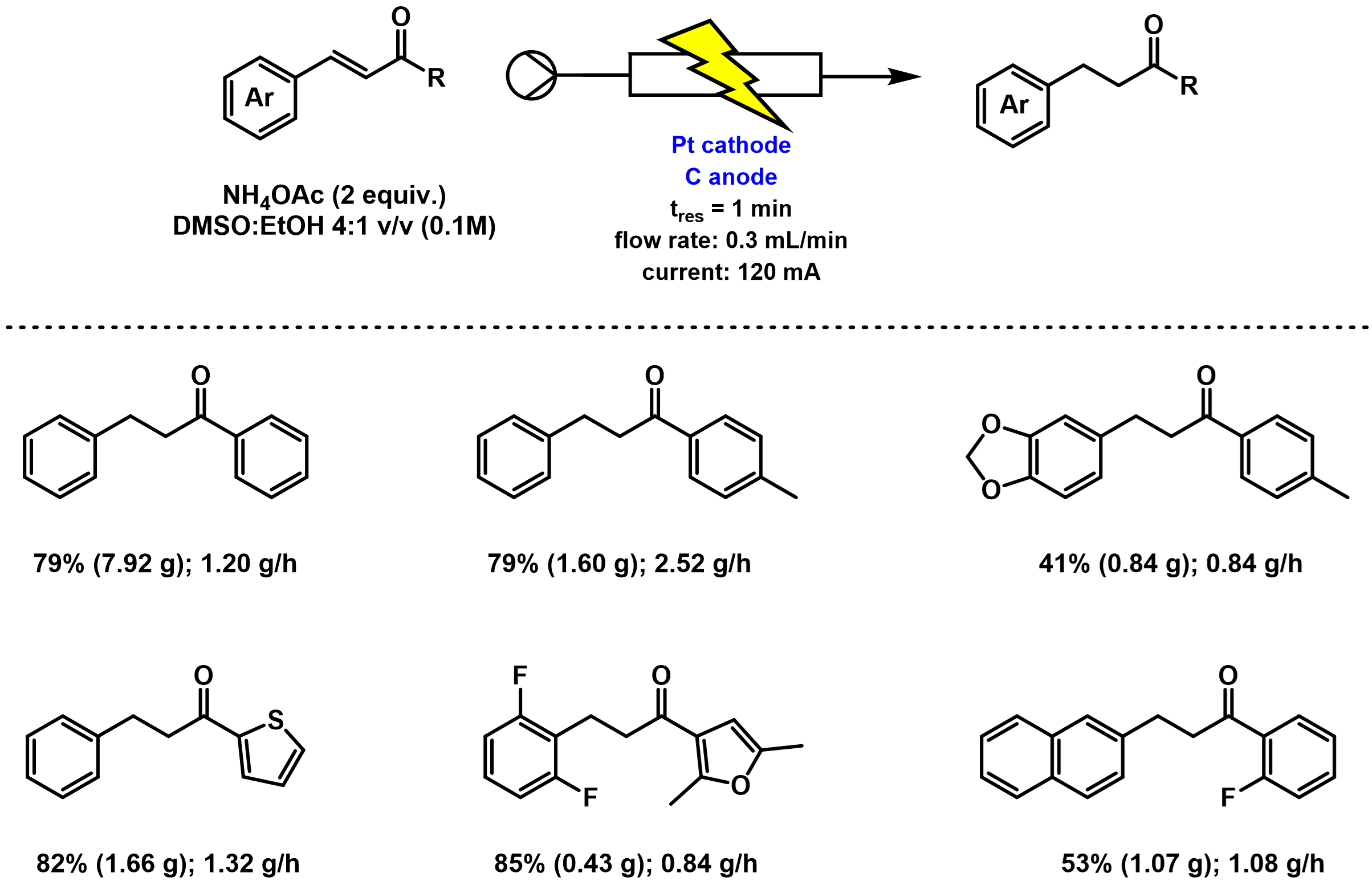
Figure 1: Reaction set-up and substrate scope for the electrochemical reduction of α,β-unsaturated carbonyl species into the corresponding alkane. NB not all substrates are shown.
What is numbering-up?
Rather than increasing the size of a reactor, numbering-up increases production by operating multiple identical flow reactors in parallel. This approach maintains the excellent heat transfer, mixing and mass transfer characteristics of microreactors while increasing throughput in a predictable and scalable manner.
Electrochemical Reduction: powerful but under-used
Electrochemical reduction offers an attractive alternative to conventional hydrogenation and chemical reducing agents. Using electrons as the reagent improves atom economy, reduces waste and avoids handling hazardous reducing agents. Despite these advantages, adoption of electrochemistry within synthetic organic chemistry has been limited because conventional batch electrochemical systems often require high electrolyte concentrations and can be difficult to scale reliably.
Continuous flow addresses many of these challenges. Microreactors provide efficient mass and heat transfer, enabling precise control of current density, residence time and temperature. [2, 3, 4] These characteristics improve selectivity, reproducibility and safety while making electrochemical processes significantly easier to scale.
The Cardiff Group developed a modular, cost-effective, dual cathode flow cell architecture, designed for straightforward numbering-up and efficient electrode utilization to enhance productivity. The architecture enables precise control of the Critical Process Parameters (CPPs) required during scale-up and can be coupled with online NMR for reaction monitoring. Finally, this work demonstrated pilot-scale quantities of material can be processed, clearly bridging the gap between academic and industrial laboratory approaches.
Parallel reactors allow simultaneous processing
Following optimisation, the reduction was evaluated across a broad substrate scope using four parallel reactors operating simultaneously. Compared with the batch process, electrolyte consumption was halved and solvent usage reduced by 50%. Most strikingly, a 1 g reduction required 6 hours using conventional batch electrochemistry, whereas the equivalent electrochemical reduction in flow was completed in just one minute.
The process was subsequently scaled from 10 g to 100 g without loss of efficiency, delivering a 79% yield of 1,3-diphenylpropan-1-one at a productivity of 1.2 g h⁻¹. Overall, the flow process achieved a 75-fold increase in productivity compared with the batch approach.
Electrochemistry in flow: fast, reliable and scalable
This work demonstrates how continuous- flow electrochemistry can bridge the gap between laboratory development and pilot-scale production. Using the Vapourtec Ion Electrochemical Reactor, the Cardiff team developed a rapid, scalable electroreduction process that combined excellent productivity with straightforward scale-up through parallelisation, demonstrating clear advantages in productivity, process control and industrial scalability over conventional batch electrochemistry.
References:
[1] Numbering-Up Flow Electroreduction of α,β-Unsaturated Carbonyls from Gram to Pilot-Relevant Scale (T. Boruah, S. Arepally, R. L. Melen, T. Wirth, Org. Proc. Res. Dev., 2026, ASAP). https://doi.org/10.1021/acs.oprd.6c00175
[2] The Fundamentals Behind the Use of Flow Reactors in Electrochemistry (T. Noël, Y. Cao and G. Laudadio, Acc. Chem. Res., 2019, 52, 2858 – 2869) https://doi.org/10.1021/acs.accounts.9b00412
[3] Bridging Lab and Industry with Flow Electrochemistry (N. Tanbouza, T. Ollevier and K. Lam, iScience, 2020, 23, 101720) https://doi.org/10.1016/j.isci.2020.101720
[4] A field guide to flow chemistry for synthetic organic chemists (L. Capaldo, Z. Wen and T. Noël, Chem. Sci., 2023, 14, 4230 – 4247) https://doi.org/10.1039/d3sc00992k
Learn more about the Ion Electrochemical Reactor
Learn more about electrochemistry