
Date: 23 April 2026 | Category: News
Authors: Zheng Zhao, Jadid E. Samad, Christopher Chabot, Steven M. Guinness, and Joel M. Hawkins
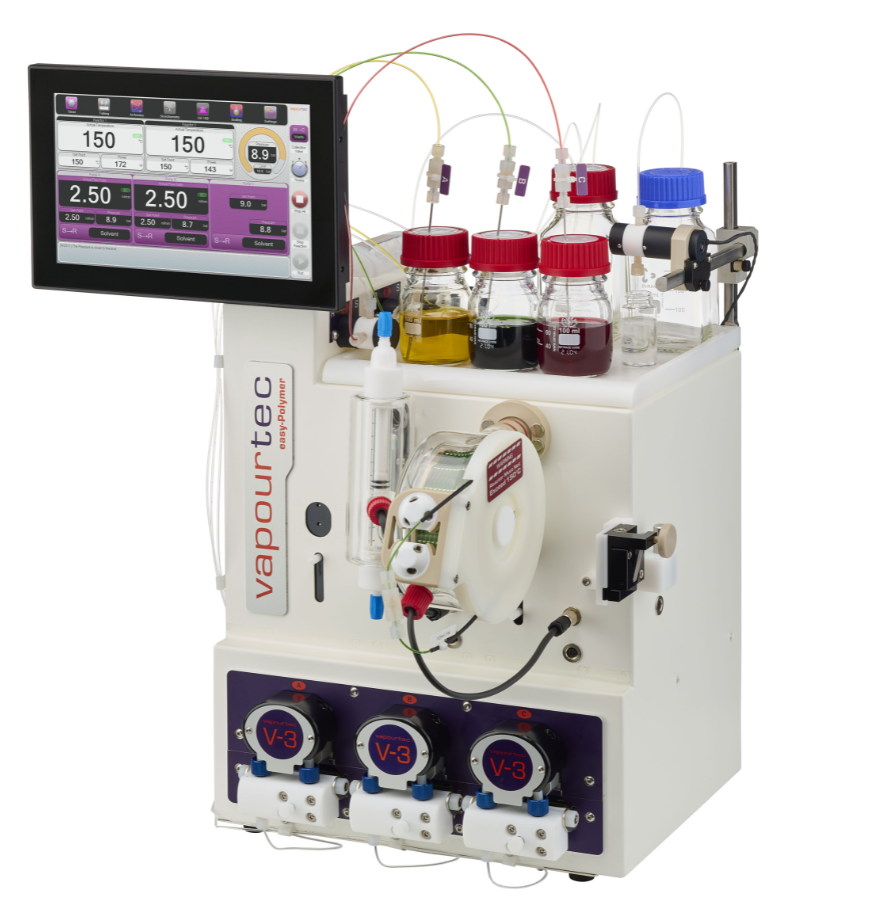
Zheng Zhao and co-workers, from Pfizer, have successfully developed a process that exploits continuous flow for acetal hydrolysis, through use of a packed bed reactor (PBR) containing a solid acid, and was used in the synthesis of Vepdegestrant. [1] This work relied upon the E-Series easy-MedChem system.
 Figure 1: Vepdegestrant, an oestrogen receptor degrader for treatment of breast cancer that uses PROTAC technology.
Flow Chemistry for Small Molecule APIs
While the use of flow chemistry for production of APIs initially faced a sluggish start, in recent years there have been moves within both pharmaceutical and agrochemical manufacturers towards the adoption and development of continuous flow processes.[2] This approach can offer several advantages, including:
- Improved heat and mass transfer, leading to greater thermal control
- Smaller equipment footprint
- Safer processes
- A decreased risk of failure during scale-up
- Reduced process mass intensity (PMI)
- The opportunity to include in-line process analytical technologies (PAT) and automation.
The use of packed bed reactors (PBRs) within a flow set-up enables the incorporation of catalysts at a specific point in a synthetic sequence. When using a PBR, the catalyst is housed within a tubular vessel that the reactant is passed through, usually as a solution: this ensures maximum contact between reactants and reagents, improving overall reaction efficiency. Within the pharmaceutical industry, PBRs have primarily been utilised for continuous hydrogenations, often improving the reaction safety profile,[3] but other applications are continuously being developed, usually with sustainability and greener chemistry in mind.[1]
The use of ‘solid acids’ in continuous flow
Within a chemical process, Brønsted or Lewis acid(s) are often required – either for effecting a reaction or during work-up. Usually these acids are homogeneous, necessitating the incorporation of a separation step, often an extraction, which is process intensive and requires substantial volumes of organic solvent. Furthermore, homogeneous acids can be highly corrosive, can release poisonous fumes, and may be moisture sensitive. The use of heterogeneous solid acids provides opportunity for several process improvements: they are noncorrosive, the acid sites are part of the surface structure and therefore only reactive upon adsorption of reacting species, and when placed in a PBR, catalyst re-use is enabled and downstream waste treatment simplified.
Vepdegestrant synthesis: an opportunity for solid acids to improve process efficiency
Vepdegestrant is a potent, selective, orally bioavailable PROTAC that is designed as a targeted oestrogen receptor degrader for the treatment of breast cancer.[4] Within the commercial synthesis, there were two steps identified by the Pfizer team where substitution of a homogeneous acid for a ‘solid acid’ would prove advantageous: acid-catalysed N-Boc deprotection and acetal hydrolysis.[4]. Unfortunately, after experimentation the N-Boc deprotection was deemed unsuitable for a ‘solid acid’ approach due to formation of a large number of impurities, which were attributed to the use of DMAc as a solvent. However, acetal hydrolysis using flow was significantly more successful.
The use of solid acids for acetal hydrolysis
The batch process for acetal hydrolysis used an H2SO4 aqueous solution at 30 °C, with approximately 8 h required for complete reaction. Upon work-up, the reaction was quenched using trisodium citrate, followed by separation and then a series of distillations. While giving good yields of product in high purity, this approach suffered from a high process mass intensity (PMI) and the requirement for several operations for product isolation, presenting an opportunity for streamlining and a reduction in the environmental impact.
It was noted that tungstated zirconia WZ-powder (15.75 wt % WO3/ZrO2) gave good results in batch, but direct translation into flow mode was deemed impractical, as fine powders can cause high pressure drops across the packed column and are more likely to clog filter frits.[1] In this case, using the more granular material WZ-0.7 mm (20 wt % WO3/ZrO2) circumvented the issue, allowing the reaction to be undertaken in DMAc at 120 °C, with a residence time of only 8.4 minutes.
Summary
Use of a ‘solid acid’ loaded into a PBR enabled continuous flow-mediated acetal deprotection in the synthesis of Vepdegestrant. While the WZ-powder used in batch was deemed unsuitable due to the potential for reactor blockages, granular WZ-0.7 enabled full conversion to the desired product in 40 min at 120 °C, with a mean residence time of 8.4 min and liquid hourly space velocity (LHSV) of 5.9 h−1. Furthermore, the use of flow enabled a substantial decrease in step PMI from 33 in the commercial process to only 17, through minimisation of operations per unit step, particularly during the work-up. Key to this work was use of the E-Series easy-MedChem system, which includes features such as:
- Inclusion of an adjustable packed bed column reactor, with operating temperatures from ambient to 150 °C
- Tube reactor assembly
- Variability in reactor set-up
- Compatibility with the R-Series reactors, and option to include specific instrumentation including the UV-150 photochemical reactor
References:
[1] Solid Acid-Enabled N‑Boc Deprotection and Acetal Hydrolysis in the Synthesis of Vepdegestrant (Z. Zhao, J. E. Samad, C. Chabot, S. M. Guinness, J. M. Hawkins, Org. Process. Res. Dev., 2025, 29, 2625–2635). https://doi.org/10.1021/acs.oprd.5c00179
[2] Continuous-Flow Technology—A Tool for the Safe Manufacturing of Active Pharmaceutical Ingredients (B. Gutmann, D. Cantillo, O. C. Kappe, Angew. Chem. Int. Ed., 54, 6688–6728). https://doi.org/10.1002/anie.201409318
[3] Fixed Bed Continuous Hydrogenations in Trickle Flow Mode: A Pharmaceutical Industry Perspective (E. Masson, E. M. Maciejewski, K. M. P. Wheelhouse, L. J. Edwards, Org. Proc. Res. Dev., 2022, 26, 2190–2223). https://doi.org/10.1021/acs.oprd.2c00034
[4] (a) Development of a Commercial Manufacturing Process for Vepdegestrant, an Orally Bioavailable PROTAC Estrogen Receptor Degrader for the Treatment of Breast Cancer (S. Avery, J. M. Buske, D. Chem et al., Org. Proc. Res. Dev., 2024, 28, 4709–4090). https://doi.org/10.1021/acs.oprd.4c00362; (b) A Second-Generation Route to the Cereblon Fragment of ARV-471, Vepdegestrant (D. J. Bernhardson, J. Fifer, Z. C. Girvin et al., Org. Proc. Res. Dev., 2025, 29, 3636–2648). https://doi.org/10.1021/acs.oprd.5c00271