Lead Optimization of Multimutant KRAS Switch-II Pocket Macrocyclic Inhibitors via Isosteric Replacement to Improve ADME and Oral Exposure

Added on:
29 Oct, 2026

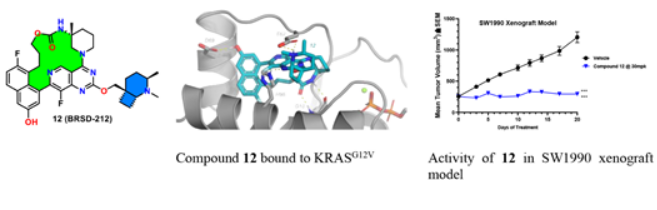
Starting from our internally discovered, potent panKRAS inhibitor BRSD-143 (1), we executed a targeted bioisosteric optimization of the naphthol and fluoropyrrolizidine motifs to preserve (or increase) KRAS pan-inhibitory potency while improving DMPK/ADME liabilities. These studies delivered 12 (BRSD-212), a highly potent and efficacious lead in which (2-azabicyclo[4.2.0]octan-6-yl)methanol (ABO) serves as a bioisostere for the widely deployed 2-fluoropyrrolizidine substituent. In parallel, replacement of the naphthol moiety with an indazole afforded 21, which demonstrated improved pharmacokinetic performance and ADME characteristics by mitigating glucuronidation-mediated clearance as the dominant metabolic pathway.

Equipment used in this paper: R-Series Flow Chemistry System, Continuously Stirred Tank Reactor (CSTR) 
  • Phillips DP
  • Alper PB
  • Borkin D
  • Han D
  • Kochanek SE
  • Gurjar J
  • Mathison CJN
  • Nelson JM
  • Pei W
  • Nguyen BN
  • Hoffman T
  • Okram B
  • Nguyen TN
  • Jiang S
  • Masick BT
  • Wang Z
  • Cho CY
  • Yin H
  • Chen Y
  • Juarez J
  • Jia Y
  • Zhou V
  • Liu G
  • Wright C
  • Nguyen T
  • Knee DA
  • Liu Q
  • Liu J
  • Li J
  • Virata C
  • de Oliveira C
  • DiDonato M
  • Bursulaya B
  • Vidal-Biggart A
  • Jones DH
  • Witmer D
  • Chu C
  • Jin H
  • Herath A
  • Richmond W
  • Groessl T
  • Shapiro M
  • Effenberger K
  • Arroyo K
  • Bretz A
  • Honda A
  • Gordon WP
  • Molteni V
  • Haling JR
  •   Novartis Biomedical Research, 10675 John Jay Hopkins Drive, San Diego, California 92121, United States
Lead Optimization of Multimutant KRAS Switch-II Pocket Macrocyclic Inhibitors via Isosteric Replacement to Improve ADME and Oral Exposure
Read the publication that featured this abstract