Vapourtec Ltd

Telephone +44(0)1284 728659
Email [email protected]
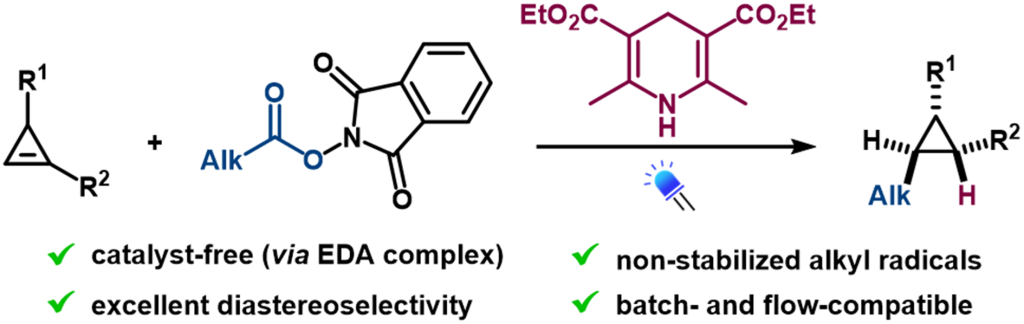
Hydroalkylation of cyclopropenes with non-stabilised alkyl radicals remains largely unexplored due to their high reactivity and the propensity of cyclopropyl radicals to undergo ring-opening. Herein, we report a metal-free, visible-light-driven ring-retentive hydroalkylation of cyclopropenes enabled by electron donor–acceptor (EDA) complex-mediated activation of redox-active N-hydroxyphthalimide esters. This strategy enables the controlled decarboxylative generation and direct addition of a broad range of primary, secondary, and tertiary alkyl radicals, affording polysubstituted cyclopropanes bearing two new stereogenic centres with excellent diastereoselectivity. The reaction proceeds under mild conditions with broad functional-group tolerance and is compatible with continuous-flow operation. Mechanistic investigations, including radical trapping, deuterium labelling, UV-Vis studies, and DFT calculations, support a ground-state EDA-initiated radical pathway in which steric effects govern both radical addition and the subsequent hydrogen-atom transfer, accounting for the observed regio- and stereoselectivity.
Equipment used in this paper: UV-150 Photochemical Reactor, SF-10 Laboratory Pump