Vapourtec Ltd

Telephone +44(0)1284 728659
Email [email protected]
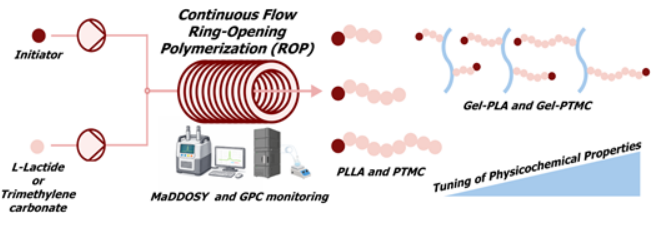
Both natural and synthetic polymers offer distinct advantages in regenerative medicine, yet their properties are often orthogonal, requiring trade-offs when used individually. Gelatin, the gold standard, exhibits cell adhesivity and is biodegradable but suffers from low mechanical tunability, a UCST around physiological conditions, and inferior porosity following hydrogel production. In contrast, poly(l-lactic acid) (PLA) and poly(trimethylene carbonate) (PTMC) often display mechanical tunability and low batch-to-batch variability, but lack bioactivity. Herein, PLA and PTMC were grafted onto gelatin through thiol-ene coupling, producing hybrid grafted constructs with either semicrystalline or amorphous grafts. These constructs can form physical gels through hydrophobic interactions, which can be covalently cross-linked into porous hydrogels. Graft lengths between 2000 and 10000 g mol were studied, combined with a successful translation to continuous flow ring-opening polymerization. Mass Determination Diffusion Ordered Spectroscopy (MaDDOSY) using a benchtop NMR was employed to measure molar masses, in which good agreements (Δ = 0.02 ± 0.09) were found with conventional techniques. After thiolation (>93 %), no influence of graft length on thiol-ene coupling yields was observed. By varying graft length and graft type (PLA vs PTMC), a high tunability of physical hydrogels’ mechanical properties (4–50 kPa), transparency (25–97 %), swelling capacity (500–2500 %), and pore areas (10–100 000 μm2) upon cross-linking was achieved. These hybrid systems highlight the strong synergy between natural and synthetic polymers for regenerative materials design.
Equipment used in this paper: E-Series Flow Chemistry System, easy-Polymer, Tubular Reactor