Vapourtec Ltd

Telephone +44(0)1284 728659
Email [email protected]
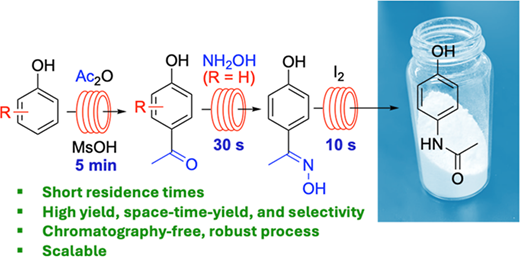
A three-step process using flow chemistry to produce acetaminophen is described. First, the use of biodegradable methanesulfonic acid as a promoter enables a mild and metal-free flow approach for the Friedel–Crafts acylation of different phenols, thereby addressing the limited selectivity of this reaction in acetaminophen synthesis. Subsequently, oximation and a Beckmann rearrangement with readily available and inexpensive reagents afford acetaminophen in a viable flow process, utilizing continuous extraction and crystallization as the sole purification methods, thus avoiding the need for chromatography, which is impractical for large-scale processes. Acetaminophen was formed in yields of up to 66 % (60 g) in a three-step process and up to 75 % (436 g) in a two-step process, with a purity of 99.93 % after recrystallization.
Equipment used in this paper: R-Series Flow Chemistry System