
Date: November 11, 2026
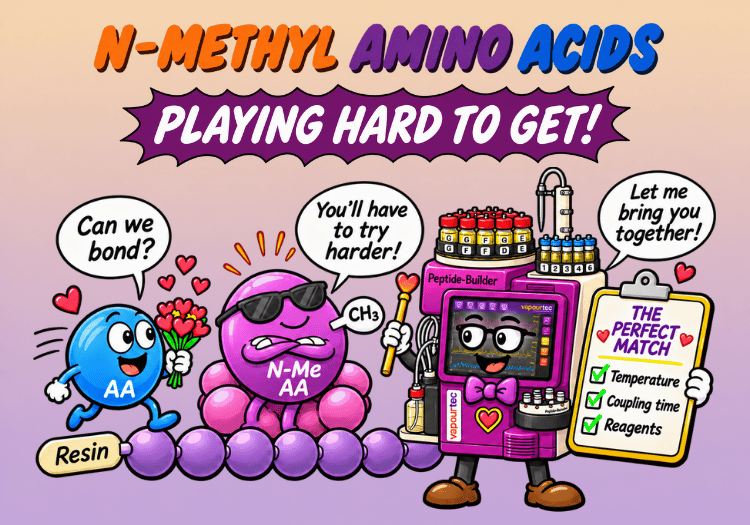
Incorporating N-methyl amino acids into a peptide sequence can introduce a significant synthetic challenge: achieving complete coupling at sterically hindered sites. Slower reaction kinetics can lead to incomplete couplings and deletion sequences, making the choice of temperature, activation time and coupling protocol particularly important.
How can these conditions be optimized in Fast-Flow solid-phase peptide synthesis? Drawing on Vapourtec’s experimental work, this Q&A explores the practical considerations for synthesizing N-methylated peptides, from coupling chemistry and resin compatibility to crude purity and programming extended couplings on the Peptide-Builder.
How does coupling an N-methyl amino acid differ from coupling a natural amino acid in Fast-Flow SPPS?
N-methylation can make peptide coupling more challenging, particularly when the incoming amino acid must react with an N-methylated residue at the N-terminus of the growing peptide chain. The N-methyl group introduces steric hindrance around the secondary amine, which can reduce coupling efficiency.
As a result, incomplete coupling can occur under standard conditions, leading to deletion sequences. In our experience, elevated temperature and extended coupling times can significantly improve coupling efficiency, although the optimum conditions depend on the amino acid and peptide sequence.
Why can N-methyl amino acids be particularly challenging to couple in conventional batch SPPS?
N-methyl amino acids can be challenging because their coupling is intrinsically slower due to the steric constraints around the N-methylated amine. In conventional batch SPPS, these intrinsically challenging coupling reactions may be further affected by mass-transfer limitations, as the activated amino acid must diffuse into the swollen resin beads to reach the growing peptide chain.
As a result, incomplete coupling can occur, particularly in longer or sterically hindered sequences, leading to deletion products. Increasing coupling time, reagent equivalents or temperature can help improve conversion, although the optimum conditions depend on the amino acid and peptide sequence.
Are N-methyl amino acids always difficult to couple?
Not necessarily. The difficulty depends on both the N-methyl amino acid and the peptide sequence.
In our experience, coupling onto N-methyl glycine (sarcosine) has not presented significant difficulties, and some customers have successfully used standard coupling conditions without observing significant deletion products.
For more challenging N-methyl amino acids, extended coupling conditions can be beneficial. We therefore recommend treating these couplings on a case-by-case basis and optimizing the conditions where necessary.
Which coupling reagent system do you recommend for N-methyl amino acids?
Oxyma/DIC is the coupling system we have primarily used in our work with difficult N-methyl amino acid couplings, and we have obtained good results using this system.
- Fmoc-amino acids: 0.3 M in DMF with 0.45 M Oxyma
- DIC: 25 % (v/v) in DMF
- Deprotection: 20 % (v/v) piperidine in DMF
We have also evaluated different Oxyma-based additives in our broader coupling work. In particular, K-Oxyma did not show a significant difference in performance compared with Oxyma under the conditions we evaluated.
However, the coupling reagent is only one part of the optimization. For challenging N-methyl amino acids, temperature, activation time, coupling time and reagent equivalents can all influence the final conversion.
What activation time and temperature do you recommend for difficult N-methyl amino acid couplings?
The optimum conditions depend on the amino acid and sequence. In our work, elevated temperature can significantly accelerate amino acid activation and coupling, with 80 °C providing effective activation within a relatively short time.
For particularly challenging couplings, we use extended coupling times rather than relying solely on standard coupling conditions. The exact conditions should be optimized according to the amino acid and peptide sequence.
Does prolonged amino acid activation cause any problems?
In our experiments with N-methylated amino acids, we have not observed significant problems with prolonged activation under the conditions tested.
Approximately 40 seconds at 80 °C has been sufficient for activation, and extending activation times to 4 minutes at 80 °C has not resulted in noticeable problems with the N-methylated amino acids investigated.
However, these findings should not be generalized to all amino acids. Prolonged activation can increase the risk of side reactions, particularly with arginine and amino acids susceptible to racemization, such as histidine.
We therefore recommend optimizing activation conditions for the specific amino acid rather than routinely extending activation times.
What crude purity can be achieved when synthesizing N-methylated peptides using the Vapourtec platforms?
Application Note 81 demonstrated high crude purity across two challenging peptide sequences:
- 16-mer GLP-1 analogue: A peptide containing N-methylated phenylalanine achieved 89.5 % crude purity, compared with 90.5 % for its non-methylated analogue.
- 10-mer peptide: A sequence containing four N-methylated glycine residues achieved 86.7 % crude HPLC purity.
These results demonstrate that high crude purity can be achieved even when synthesizing peptides containing multiple N-methylated residues, provided that appropriate coupling conditions are employed.
What happens when an N-methyl amino acid is coupled to another sterically hindered amino acid?
Coupling two sterically hindered amino acids can be particularly challenging because the accessibility of the reactive groups is reduced.
We have not systematically evaluated all combinations of N-methyl and α-substituted amino acids, such as Aib, so we cannot yet make a general recommendation for every sequence.
Based on our experience with difficult N-methyl amino acid couplings, extended coupling times and optimization of the coupling conditions can help improve conversion.
We are currently investigating this further, particularly combinations such as Aib coupled to N-methyl amino acids.
Can CTC resin be used at elevated temperatures?
Yes. CTC resin can be used under elevated-temperature conditions, but both temperature and exposure time need to be considered because the linker is sensitive to heat.
We have used CTC resin under elevated-temperature conditions and, because the exposure to higher temperature is relatively short, we have not observed significant problems. Where possible, our general approach is to use temperatures below approximately 70 °C for CTC resin.
We are continuing to investigate CTC resin at elevated temperatures and plan to provide more detailed information in future work.
How easy is it to program N-methyl amino acid couplings in the Peptide-Builder?
N-methyl amino acids can be programmed in the Peptide-Builder in the same way as natural amino acids. Once the sequence is created, simply select the amino acid after the N-methyl amino acid and choose the appropriate long coupling protocol. This allows challenging N-methyl amino acid couplings to be accommodated within the normal synthesis workflow, without requiring complex programming.