

Date: 15 May 2026
Crude purity is a critical factor in peptide synthesis, affecting purification time, yield, and overall efficiency. Traditional batch SPPS improves purity through longer reaction times, excess reagents, or repeated steps. In contrast, Fast-Flow peptide synthesis improves purity by fundamentally controlling where and when reactions occur within the resin bed.
Effect of Constrained Resin Geometry in Single-Pass Flow Coupling
The defining features of Vapourtec’s flow synthesis are, constrained resin and amino acids coupled in one single-pass of the resin, these features fundamentally change how reactions propagate.
Consider a solid-phase synthesis with four linker sites and a target 4-mer peptide. At each coupling step, only 0.5 equivalents of amino acid are added, meaning sufficient reagent is available to react with only two of the four linker sites. Assuming coupling is random as in the case of a traditional batch reactor and couplings are 100% efficient, each linker has a theoretical 50% probability of coupling during each cycle.
The resulting peptide length distribution follows a binomial model. After four coupling cycles, the probabilities of obtaining peptides containing 0, 1, 2, 3, or 4 amino acids are 6.25%, 25%, 37.5%, 25%, and 6.25%, respectively.
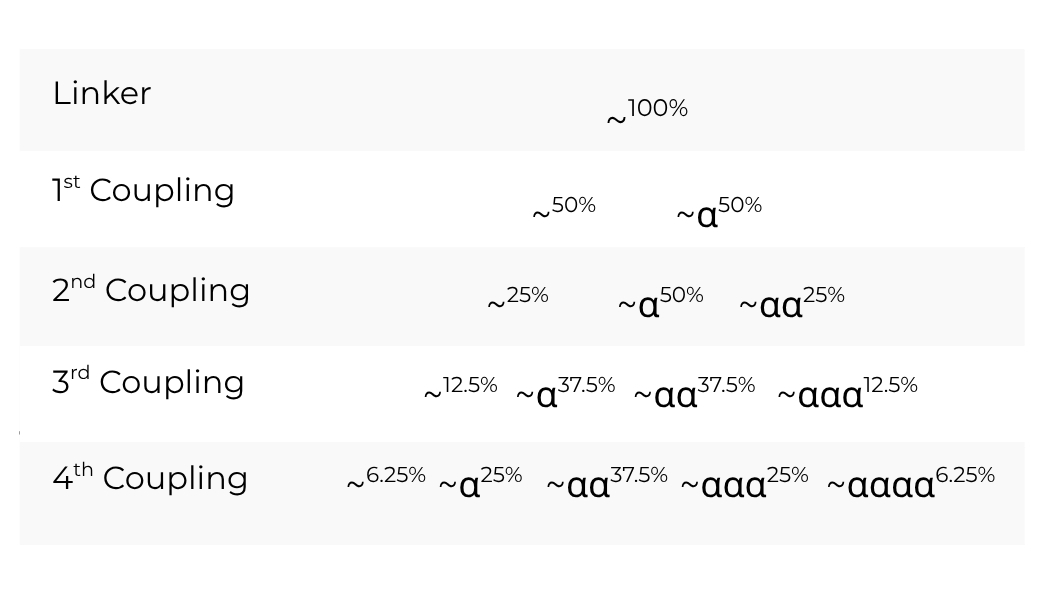
Consequently, only 6.25% of chains reach the full 4-mer length, despite perfect coupling efficiency. For a 10-mer peptide under the same conditions, the probability of obtaining the full-length product falls to just 0.098%.
Consider a packed-bed flow reactor in which the resin is constrained and the reaction conditions are such that each amino acid is 100% coupled within the first half of the bed length. If 0.5 equivalents of amino acid are added relative to the total linker loading, then the reagent is consumed quantitatively by the first 50% of available linker sites encountered in the bed.
Under these conditions, the process is no longer described by a random binomial distribution. Instead, coupling is spatially defined: the upstream half of the resin bed is fully coupled, while the downstream half remains uncoupled for that amino acid.
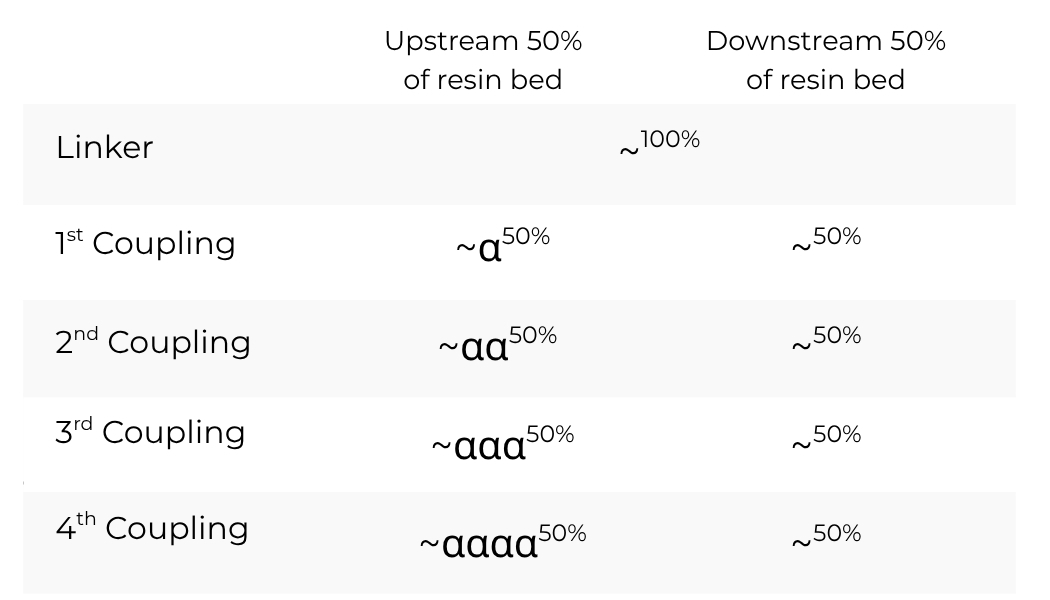
For a repeated 4-mer synthesis under identical conditions, 50% of the resin would generate full-length 4-mer peptide and 50% would remain as unextended linker.
The same principle applies to a 10-mer synthesis. If each amino acid is consumed within the first half of the bed, then the same upstream 50% of resin is extended during every coupling cycle. Consequently, 50% of the resin would generate full-length 10-mer peptide, while the remaining 50% would remain as unextended linker, rather than producing the broad statistical peptide-length distribution predicted for a random batch system.
This simple analysis illustrates an important distinction between batch and constrained-flow SPPS. In a batch reactor, sub-stoichiometric amino acid addition distributes coupling events randomly across the resin population, generating a statistical mixture of deletion sequences. In a constrained single-pass flow reactor, coupling events become spatially localised, concentrating product formation onto a defined fraction of the resin and favouring formation of the target peptide. Vapourtec’s patented Variable Bed Flow Reactor (VBFR) has been specifically designed to support this behaviour by minimising channelling, controlling resin swelling, and reducing axial dispersion within the packed bed. As a result, reagent consumption occurs in a predictable and spatially ordered manner, allowing reaction propagation through the resin bed to differ fundamentally from the random statistical behaviour observed in conventional batch and recirculating SPPS systems, whilst continuing to favour formation of the target peptide.
Separating Activation and Coupling Reduces Side Reactions
A key advantage is the separation of amino acid activation and coupling. In most batch synthesis, both occur together, increasing the risk of side reactions such as racemisation and aspartimide formation. Flow systems generate activated species in situ and deliver them immediately to the resin, minimising degradation and improving selectivity.
Precise Control of Deprotection and Washing
Fast-Flow synthesis also enables precise control over deprotection and washing. Short, controlled deprotection steps reduce both incomplete reactions and side reactions, while continuous flow washing efficiently removes by-products and prevents carryover.
Flow Processing Minimises Impurities
Unlike batch processes, where reagents and by-products remain in the same vessel, flow systems use a single-pass approach. By-products are removed immediately, limiting secondary reactions and keeping impurity levels low.
Summary of Key Advantages Over Batch
| Batch | Fast-Flow | Benefit | |
|---|---|---|---|
| Coupling distribution | Random across resin population | Spatially controlled in packed bed | Reduces deletion sequences and favours target peptide formation |
| Activation and coupling | Occur together | Controlled independently | Reduced side reactions (e.g., racemisation) |
| Deprotection | Longer, less controlled | Short, highly controlled flow steps | Fewer side reactions and incomplete deprotections |
| By-products | Remains in the vessel | Immediately removed | Prevents secondary reactions |
Higher Crude Purity by Design
Fast-Flow peptide synthesis improves crude purity through process design rather than optimization. Constrained resin geometry and single-pass coupling localise reactions within the resin bed, favouring formation of the target peptide over a statistical mixture of sequences.
Combined with controlled activation, rapid reagent delivery, and efficient by-product removal, this results in a cleaner, more predictable synthesis environment.
As demand for longer and more complex peptides continues to grow, Fast-Flow synthesis offers a practical and scalable route to higher-quality crude peptides, delivering cleaner products, simpler purification, and more reliable outcomes by design rather than compromise.
Learn more about Vapourtec peptide synthesizer product range