

Date: November 26, 2026 | Category: Headline News, News
John Stephens and co-workers from Maynooth University have disclosed a flow-based procedure for the preparation of bioconjugation-ready naphthalene-based azo fluorescent quenchers (naph-AFQs), which are valuable alternatives to Black Hole Quencher-2s (BHQ-2s), Figure 1.[1] Early investigations into preparation of these materials used a batch-based approach, but the diazonium intermediates (2) suffered from severe instability and poor solubility, resulting in degradation of material and purification difficulties. However, deploying a telescoped two-step diazotisation/azo-coupling continuous flow process overcame these challenges, and both improved the reaction safety profile and reproducibility. Finally, process intensification was conducted through elevated flow rates and increased reactant concentrations. A throughput of 14.7 g/h was achieved for the dioxopyrrolidinyl derivative, with consistent yield and high analytical purity. Importantly, reproducibility was maintained.
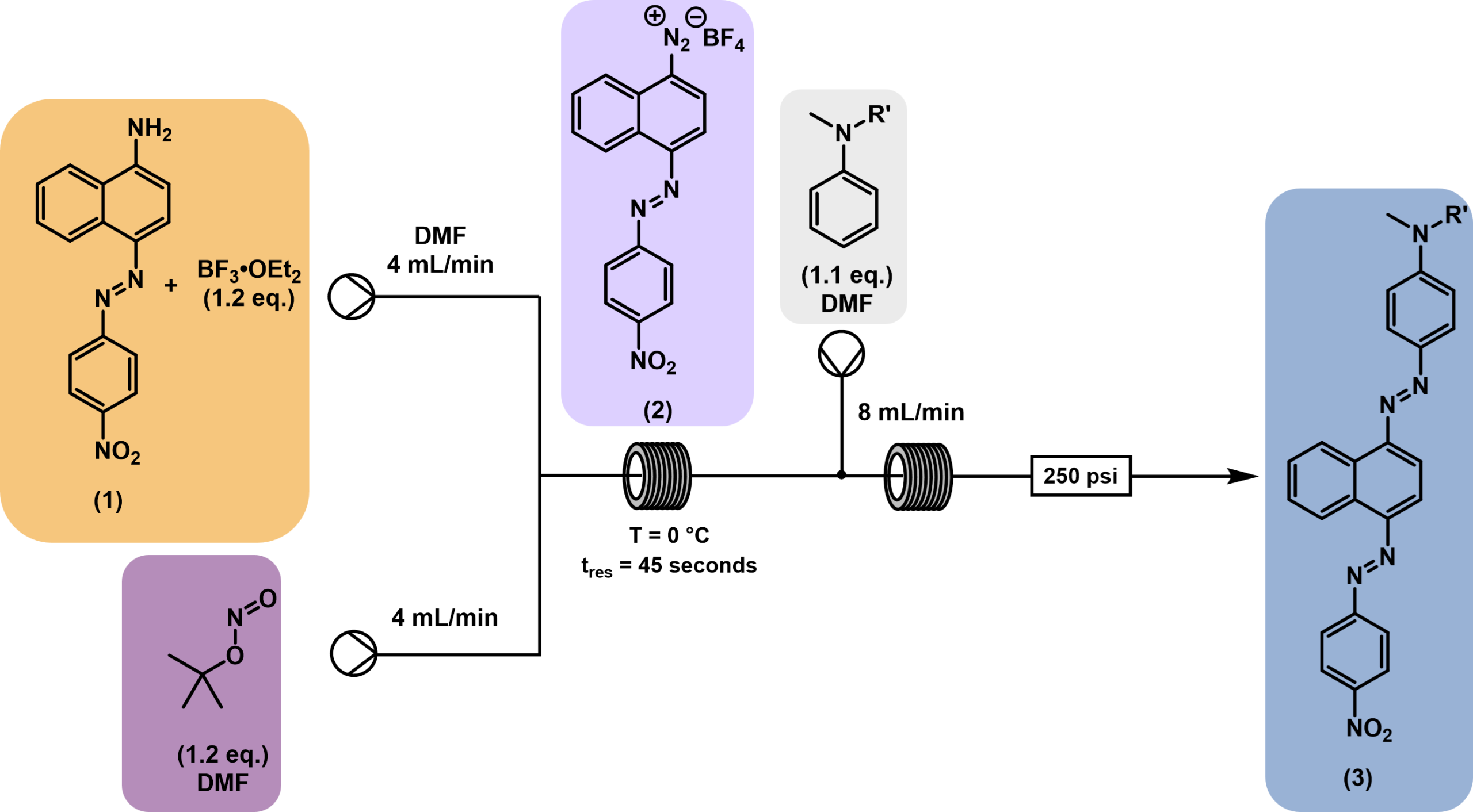
Figure 1: Telescoped flow approach to naph-AFQs, a new class of bioconjugation-ready naphthalene-based azo fluorescent quenchers.
Azo compounds as fluorescent quenchers
Azo compounds are highly versatile, with a range of applications that are often linked to their strong absorbance in the visible region of the electromagnetic spectrum. While traditionally used within the dyes and pigments markets due to their highly-coloured nature, azo compounds are increasingly being used in molecular biology where they function as azo fluorescent quenchers (AFQs) with application in qPCR and fluorescence-based assays, as well as molecular probes, and diagnostics.[2, 3, 4] The most commonly used AFQ is Black Hole Quencher-2 (BHQ-2), which is utilised across many fluorescence-based assays. However, BHQ-2 and any derivatives are challenging to prepare and scale-up is difficult: both batch and continuous flow approaches suffer from low yields, often due to undesired side-reactions. While there are alternatives, such as DABCYL-based quenchers, these are not always suitable for the assay required due to the shifted photophysical characteristics. Therefore, the development of naphthalene-based azo fluorescent quenchers (naph-AFQs) with similar properties to BHQ-2 and that can be further tuned through molecular derivatisation offers an opportunity for the development of a new class of fluorescent quenchers.
Flow chemistry: invaluable for preparing new azo-derivatives and scaling up processes safely
Synthesis of azo-containing compounds in batch mode is not straightforward. In addition to safety hazards that result from the exothermic nature of the diazotisation process alongside the potential for formation of unstable diazonium salts, batch mode can also suffer from low yields and non-uniformity of reagent mixing.[2] However, a continuous flow approach offers significant advantage: high surface-area to-volume ratios enable rapid dissipation of any exotherm, highly precise thermal control can be achieved, and mixing is often more efficient. In addition, through implementation of a telescoping approach isolation of highly energetic intermediates can be circumvented, and with only small quantities of these materials present at any one time as they are quickly consumed in subsequent processes, the safety profile of the reaction is significantly enhanced.
While generation of key diazo species such as those similar to aniline 1 was reliably undertaken in batch, it was quickly noted that the second diazotisation stage, preparation of energetic intermediates such as 2, was capricious. In particular, the requisite diazoniums (2) formed from anilines such as 1 were unstable during work-up and isolation, with purification to acceptable levels difficult.
The telescoping benefits of flow chemistry were therefore explored for the preparation and subsequent reaction of the desired diazonium intermediate (2), removing the need for isolation. To facilitate the process, a staged Design of Experiments (DoE) strategy was adopted that explored parameters including diazotisation residence times and azo-coupling residence times, and Quantitative NMR (qNMR) was used to assess performance. Overall, the use of a telescoped flow approach resulted in excellent reproducibility, with longer diazotisation residence times followed by milder azo-coupling temperatures and shorter azo-coupling residence times identified as optimal.
The telescoped flow process achieved qNMR yields of 30–41%, comparable to the overall yields of the corresponding batch sequence, despite eliminating the need for intermediate isolation and purification.
Telescoping in flow: improving reaction safety and reproducibility
The use of the Vapourtec R-Series System enabled control of the capricious second diazotisation, with significantly improved reproducibility. In particular, the use of flow meant that:
- Isolation of the unstable and thermally sensitive diazonium intermediate was circumvented
- The hazardous diazonium intermediate was generated and consumed in situ
- Operational safety was improved
- DoE studies using the flow system enabled the rapid optimisation of reaction conditions
- Process intensification through increasing flow rates and reactant concentrations was possible, while maintaining reproducibility
- A throughput of 14.7 g/h was achieved for the dioxopyrrolidinyl derivative, with 97% analytical purity.
Authors: Adam T. McCormack, Ciara McEvoy, John C. Stephens
References:
[1] Continuous flow synthesis of bioconjugation ready naphthalene based azo fluorescent quenchers as BHQ-2 alternatives (A. T. McCormack, C. McEvoy, J. C. Stephens, J. Flow Chem., 2026). https://doi.org/10.1007/s41981-026-00383-6
[2] The continuous flow synthesis of azos (A. T. McCormack, J. C. Stephens, J.Flow Chem., 2024, 14, 377–396) https://doi.org/10.1007/s41981-024-00307-2
[3] A. Chevalier, P. Y. Renard, A. Romieu (Tetrahedron Lett., 2014, 55, 6759–6763). https://doi.org/10.1016/j.tetlet.2014.10.053
[4] Straightforward synthesis of bioconjugatable azo dyes. Part 2: Black Hole Quencher-2 (BHQ-2) and BlackBerry Quencher 650 (BBQ-650) scaffolds (A. Chevalier, P. Y. Renard, A. Romieu, Tetrahedron Lett., 2014, 55, 6764–6768). https://doi.org/10.1016/j.tetlet.2014.10.054