Vapourtec Ltd

Telephone +44(0)1284 728659
Email [email protected]
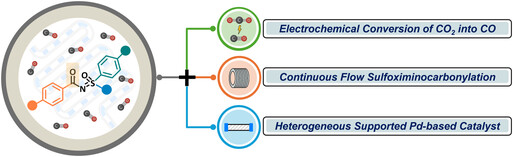
Sulfoximines have emerged as versatile scaffolds in modern synthesis, medicinal chemistry, and catalysis due to their tunable electronic and steric properties. In particular, N-aroyl sulfoximines are valuable intermediates in amide coupling, C-H functionalization, and heterocycle formation. However, conventional synthetic approaches often rely on stoichiometric activating reagents and harsh conditions, generating waste and limiting substrate scope. Herein, we report a sustainable continuous-flow platform for the Pd-catalyzed carbonylative N-aroylation of sulfoximines employing carbon monoxide (CO) as a C1 source under mild conditions. The system integrates a solid oxide electrolysis cell (SOEC) to generate dry CO from CO2 on-demand, enabling a safe, modular, and atom-economical transformation. The process displayed broad substrate tolerance, accommodating electron-rich, electron-poor, and heteroaromatic aryl iodides to furnish N-aroyl sulfoximines in 50%–99% isolated yields within 40 min at 80°C and 6 bar. A heterogeneous Pd-based catalyst, covalently immobilized on Merrifield resin, further enabled efficient flow operation with 96% conversion, facilitating the catalyst recovery. Finally, the adoption of Cyrene, a biomass-derived solvent, afforded quantitative yields and demonstrated the process compatibility with green solvents. This work establishes a scalable, safe, and sustainable strategy for sulfoximine N-aroylation, integrating CO2 valorization, continuous-flow technology, and heterogeneous catalysis for modern carbonylation chemistry.