
Date: 4 June 2026 | Category: Headline News, News
Authors: Niko A. Jenek, Sarah L. Brock, Jiahuang Mao, Amanda A. Fogh, Andreas Phanopoulos, and Mark R. Crimmin
Professor Mark Crimmin and co-workers from Imperial College London have developed a novel approach for recycling fluorochemicals by exploiting transfer fluorination, with a flow-based approach adopted for gaseous substrates.[1] In this work, hydrofluorocarbons, hydrofluoroolefins, fluoroethers, perfluorooctanoic acid and poly(vinylidene) difluoride were treated with either KHMDS or KOtBu (use of K as the counter-ion was crucial), which resulted in rapid defluorination to furnish anhydrous KF. This KF was then used in situ to prepare fluorinated organic and inorganic molecules, including sulfonyl fluorides, aryl fluorides, alkyl fluorides and several p-block fluorides.
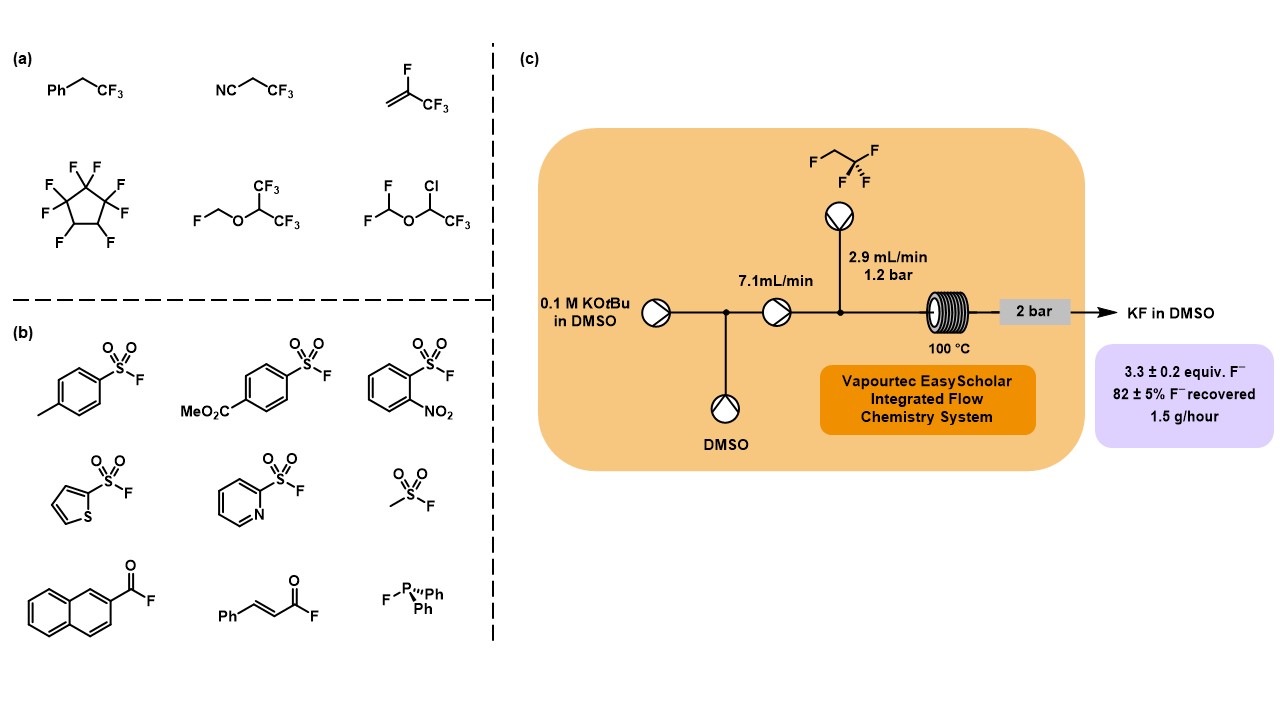
Scheme 1: (a) Range of fluoride sources tolerated; (b) Fluorination products accessible; (c) Use of the Vapourtec easy-Scholar Integrated Flow Chemistry System facilitated scale-up of the transfer fluorination of 1,2,2,2-tetrafluoroethane (HFC-134a).
PFAS, fluorine, and the environment
Per(fluoroalkyl) and poly(fluoroalkyl) substances (PFAS) have been in the news lately due to concerns around their environmental persistence and bioaccumulative behaviours. Due to these concerns, legislation is proposed that will categorize all compounds containing –CF3 and –CF2– groups (when not connected to H, Cl, Br or I atoms) as PFAS.[2] Furthermore, generation of fluorocarbons has historically been through using fluorspar (CaF2) to generate hydrofluoric acid (HF), which then acts as the fluorinating agent. However, HF suffers from several inherent drawbacks, including high toxicity and high corrosivity.
While in recent years there have been some methods for fluorination directly from fluorspar, this material is classified as a critical raw material. Any methods that reduce recycling of these environmentally persistent PFAS materials, as well as reduce the reliance on raw materials, will go some way toward reducing the environmental impact of this sector.
Fluorine-harvesting using flow chemistry
In this work, the team were able to collect fluoride from many different hydrofluorocarbon sources – both electron-rich and electron-deficient – including refrigerants, anaesthetics, battery additives and widely-used perfluorinated materials, to allow fluorine recycling. The process was effectively two mechanistic steps, in one pot:
- Treatment of the fluoride donor with an excess of strong base – ‘excess’ being in relation to the number of fluoride atoms present – to induce elimination of fluoride, in the form of KF, and destruction of the original perfluorinated species.
- Reaction of the anhydrous KF with a range of electrophiles.
Electrophiles formed included sulfonyl, acyl, alkyl and aryl fluorides, as well as a variety of p-block fluorides containing Si–F, P–F and I–F bonds. These newly generated fluorinating agents were then used to synthesise a range of products including a glutathione S-transferase inhibitor, an antibiotic, a protease inhibitor, deoxyfluorinating agents, known fluoride-containing building blocks for a range of active pharmaceutical ingredients and a hypervalent iodine-based fluorinating agent for electrophilic fluorinations. Finally, these reactions were saleable, with up to 50 g of poly(vinylidene) difluoride, a widely-used fluoropolymer, used as the fluorine source in a single run under batch conditions.
Flow chemistry for gases
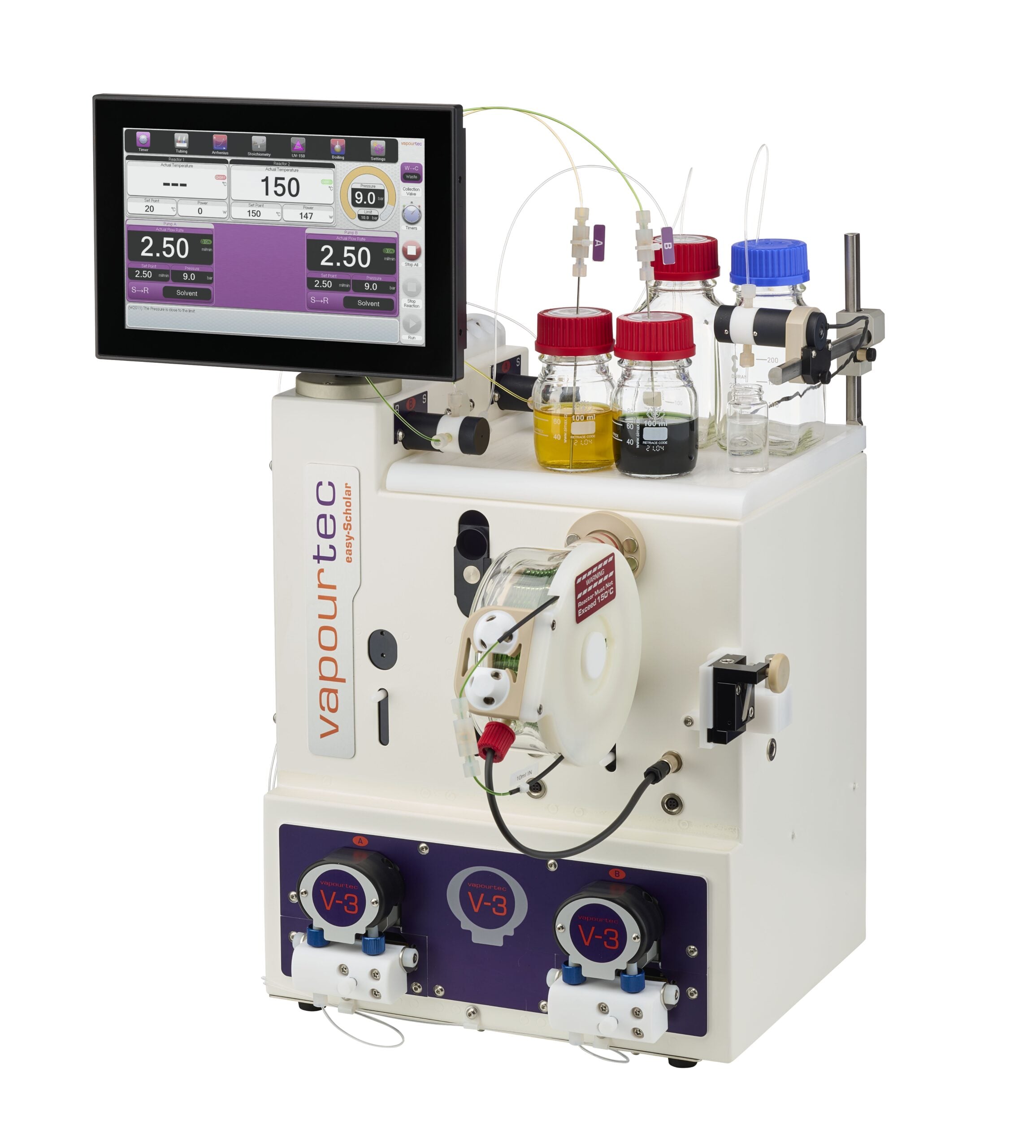
The Vapourtec easy-Scholar Flow Chemistry System was used specifically for scale-up of transfer fluorination of the volatile hydrofluorocarbon gas, 1,2,2,2-tetrafluoroethane (HFC-134a), and allowed precise control over gas pressures, flow rates, reagent concentrations, residence times. Furthermore, adjusting the reactor coil lengths allowed near complete defluorination of 1,2,2,2-tetrafluoroethane, resulting in formation of 3.3 ± 0.2 equiv. of KF, corresponding to 82 ± 5% recovery of available fluorine content. The KF prepared could be used directly as an anhydrous DMSO solution or could be dried and washed before use at a later stage. A range electrophiles including silyl chlorides, sulfonyl chlorides or acyl chlorides were prepared in yields ranging from 66–90%.
References:
[1] Chemical recycling of hydrofluorocarbons by transfer fluorination (N. A. Jenek, S. L. Brock, J. Mao, A. A. Fogh, A. Phanopoulos, M. R. Crimmin, Nature Chem., 2026, 18, 899–904). https://doi.org/10.1038/s41557-026-02096-8
[2] A proposal that would ban manufacture, supply, and use of all fluoropolymers and most fluorinated reagents within the entire EU. (N. D. Tyrell, Org. Proc. Res. Dev., 2023, 27, 1422–1426)