
Date: 7 October 2013 | Category: Headline News, News
Laboratory Teaching Guide for Flow Chemistry Education
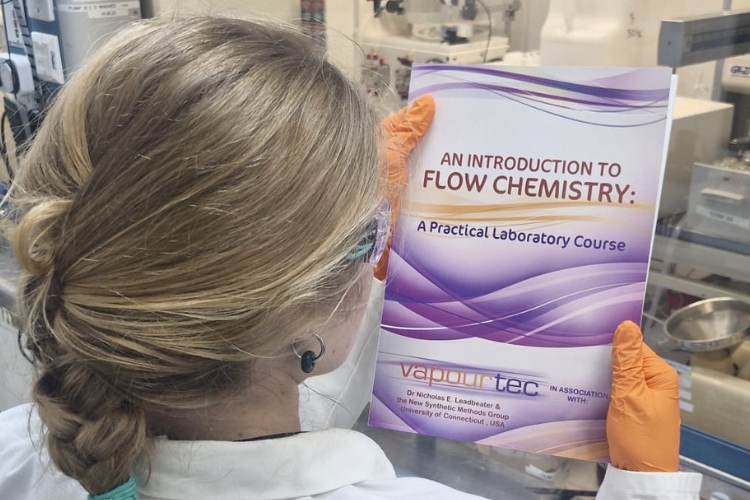
The Vapourtec Laboratory Teaching Guide provides educators with practical resources for introducing flow chemistry into undergraduate teaching laboratories. Developed in collaboration with Dr Nicholas Leadbeater and the New Synthetic Methods Group at the University of Connecticut, the guide offers a structured approach to teaching continuous flow chemistry through hands-on experiments and demonstrations.
Designed specifically for educational environments, it helps institutions incorporate modern flow chemistry techniques into existing laboratory programmes with minimal preparation while giving students practical experience of continuous flow processing and reinforcing key concepts taught in organic chemistry courses.
Whether you are developing a new practical module or enhancing an existing laboratory programme, the guide supports the teaching of core flow chemistry principles alongside modern chemical processing techniques.
Download the Laboratory Teaching Guide to access teaching materials, practical exercises and recommendations for incorporating flow chemistry into laboratory-based learning.
What is included in the guide?
The guide covers:
- Introduction to flow chemistry principles
- Practical laboratory experiments
Teaching objectives and learning outcomes - Flow reactor setup considerations
- Safety guidance for laboratory classes
- Comparison of batch and flow methodologies
- Recommendations for undergraduate teaching programmes
The material is designed to support chemistry lecturers, laboratory technicians and course leaders seeking to introduce students to continuous flow processing in a practical and accessible way.
Why use Flow Chemistry in Teaching Laboratories?
Flow chemistry exposes students to techniques increasingly used in pharmaceutical, fine chemical and academic research environments. Incorporating flow chemistry into laboratory teaching helps students develop a deeper understanding of:
- Reaction optimization
- Process control
- Mixing and mass transfer
- Heat transfer
- Reactor design
Structured flow chemistry experiments also allow students to compare continuous and batch processing approaches while gaining experience with equipment and methodologies used in modern chemical development.
Supporting Modern Chemistry Education
As continuous processing becomes more widely adopted across research and manufacturing, introducing flow chemistry at undergraduate level helps prepare students for contemporary laboratory and industrial environments.
The Laboratory Teaching Guide provides a practical framework for integrating flow chemistry into existing teaching programmes, helping educators deliver engaging laboratory experiences while introducing concepts that complement traditional chemistry education.
Download your copy today to explore practical exercises, teaching recommendations and laboratory resources for flow chemistry education.