
Date: 27 August 2026 | Category: Headline News, News
Authors: Giada Moroni, Maximilian Weiss, Giulia Russo, Gloria Biscontini, Olga Lanaridi, Andreas Limbeck, Tobias Huber, Alexander Karl Opitz, Katharina Bica-Schröder
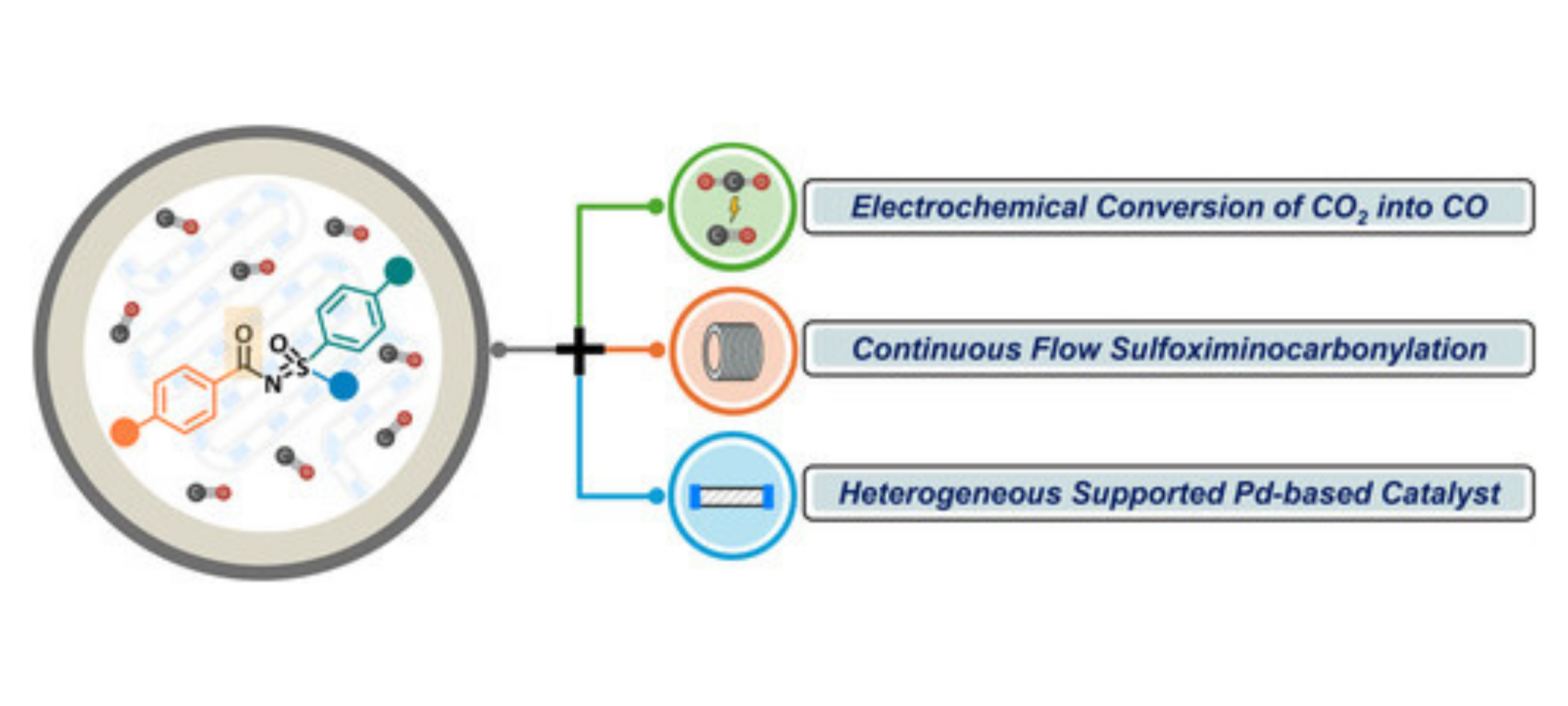
Katharina Bica-Schröder, from TU Wien, Austria, and co-workers used the Vapourtec E-Series Flow Chemistry System to undertake the palladium-catalyzed carbonylative N-aroylation of sulfoximines, where carbon monoxide (CO) was used as a C1 source.[1] While initial work used a homogeneous palladium species, a heterogeneous Pd-catalyst immobilised on Merrifield resin and packed into a tubular reactor, could also be used, allowing full catalyst reusability. The system was also compatible with a solid oxide electrolysis cell (SOEC) for generation of dry CO from CO2 on-demand, considerably improving the safety profile of the reaction.
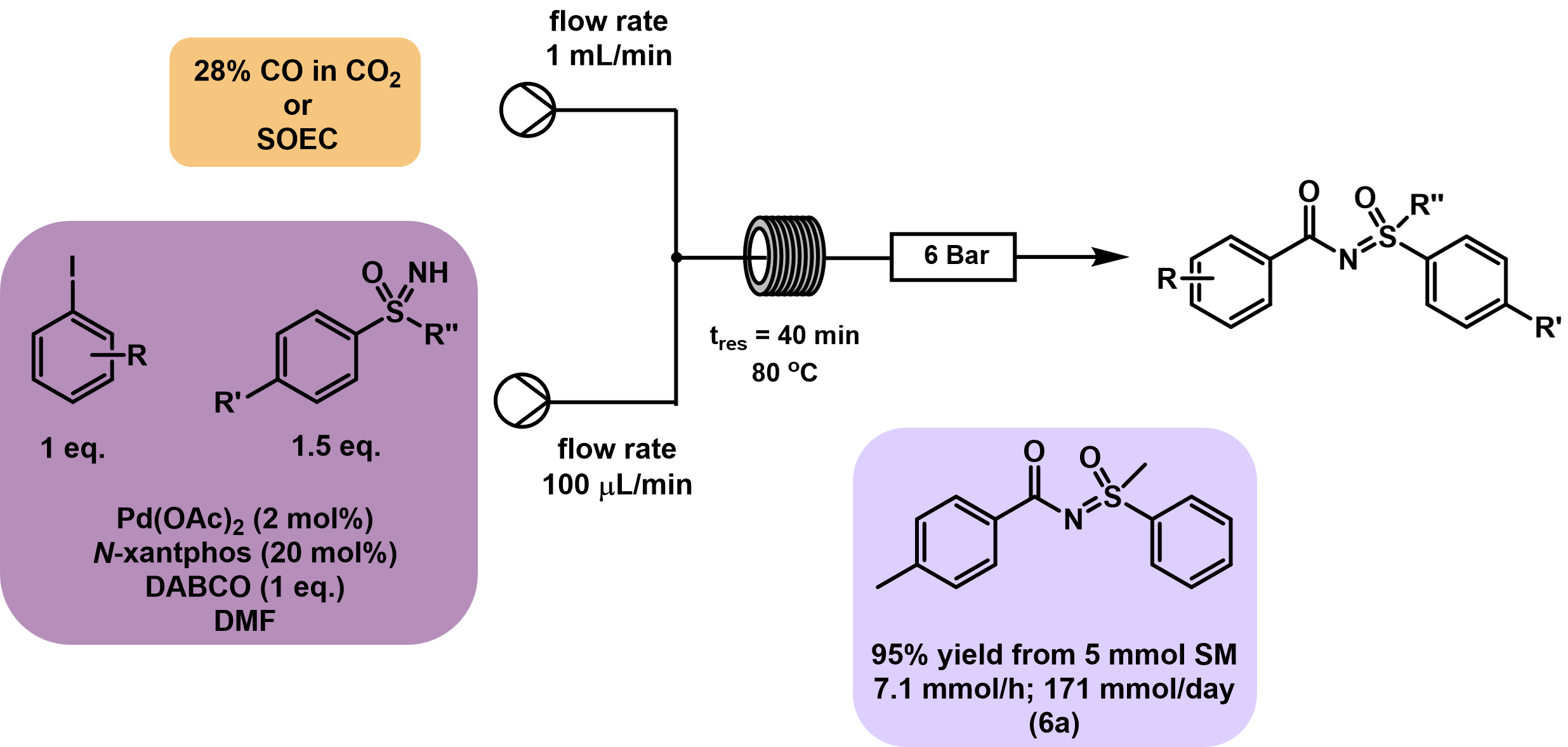
Figure 1: General flow setup for palladium-catalysed N-aroylation of sulfoximines by using CO/CO2 gas mixture. Pd-catalyst immobilised on Merrifield resin and packed into a tubular reactor could be inserted into the system, as well as an SOEC unit for CO generation on-demand.
N-aroyl sulfoximines within organic synthesis
In recent years, sulfoximines have gained traction as privileged motifs within medicinal and agrochemistry, with incorporation into several drug candidates.[1] In particular, N-aroyl sulfoximines have proven to be a versatile sub-class by virtue of their tuneable electronic properties and orthogonal reactivity, with uses as directing groups in C–H functionalisation and precursors for N-containing heterocycles.[2]
However, preparation of N-aroyl sulfoximines often uses strongly basic or dehydrating reaction conditions, limiting functional group compatibility, and usually requires acyl chlorides and stoichiometric quantities of coupling reagents. The ability to prepare these versatile materials using more benign conditions – with a molecule of CO inserted into a metal-aryl bond – is clearly desirable and allows greater functional group compatibility. However, while the use of CO within traditional batch chemistry is challenging primarily due to the acute toxicity, there are also issues with poor solubility, flammability, precise dosing and CO storage. In this regard, the use of flow chemistry provides a viable alternative, enabling safer gas–liquid transformations, with fine control over reaction parameters, excellent scalability and reproducibility.[3, 4] Furthermore, tube-in-tube reactors have been developed that minimise handling of gases while improving mass transfer and reaction performance.[5] Finally, solid oxide electrolysis cells (SOECs) allow for high-temperature, partial electrolysis of CO2 to give a tuneable stream of dry CO with high purity, rapidly.
N-aroyl sulfoximine preparation using continuous flow
During initial studies, which were undertaken in batch mode, 4-iodobenzene and (methylsulfonimidoyl) benzene was combined under a CO atmosphere (balloon), with 2 mol % of a palladium-based catalyst. A range of bases and ligands were screened, with the base having a clear impact upon catalyst efficiency. The most efficient batch conditions were then simply translated into a continuous-flow based protocol. Further optimisation was undertaken, with DABCO identified as the optimum base for both conversion and reaction rate. A wide range of aryl iodides and sulfonimidoyl-species were tolerated. Continuous flow also facilitated the rapid scale-up of the reaction, with compound 6a scaled-up to 7.1 mmol/h, corresponding to 171 mmol/day. The residence time was a mere 40 minutes, whereas batch required 12 hours.
To address safety concerns using a CO cylinder, the use of SOEC was also investigated, which could be directly integrated into the flow set-up. While extended experiments were not reported using this approach, early indications suggest that this process would be amendable to extended use, and yields achieved were comparable using the original conditions.
Finally, use of immobilised palladium was also investigated to allow for catalyst recovery and re-use. The immobilised catalyst was prepared and then packed into a glass reactor, which was inserted into the system in place of the coil and heated to 80 °C. This afforded excellent performance, achieving quantitative conversion in batch and 96 % conversion under flow mode. Further studies into the long-term stability of the immobilised catalyst are ongoing, especially in relation to potential leaching.
Continuous flow for safer use of gases in synthesis
Overall, the use of the Vapourtec E-Series Flow Chemistry System facilitated the use of CO gas in a safer and more controlled manner than afforded using a traditional batch approach, with:
- Improved thermal transfer
- Superior mass transfer
- Reduced reaction times
The in-line introduction of a SOEC offers opportunity to further improve the safety profile of reactions using CO by generation of this acutely toxic gas on demand.
References:
[1] Closing the Carbon Loop: Continuous-Flow Synthesis of N-Aroyl Sulfoximines via Electrochemical CO2 Reduction (G. Moroni, M. Weiss, G. Russo, G. Biscontini, O. Lanaridi, A. Limbeck, T. Huber, A. K. Opitz, K. Bica-Schröder, ChemSusChem, 2026, 19, (13), e70810). https://doi.org/10.1002/cssc.70810
[2] Sulfoximines as Rising Stars in Modern Drug Discovery? Current Status and Perspective on an Emerging Functional Group in Medicinal Chemistry (P. Mäder, L. Kattner, J. Med. Chem., 2020, 63, (23), 14243–14275). https://doi.org/10.1021/acs.jmedchem.0c00960
[3] The Use of Gases in Flow Synthesis (C. J. Mallia, I. R. Baxendale, Org. Proc. Res. Dev., 2015, 20, (2), 327–360). https://doi.org/10.1021/acs.oprd.5b00222
[4] Flow Chemistry: Intelligent Processing of Gas–Liquid Transformations Using a Tube-in-Tube Reactor (M. Brzozowski, M. O’Brien, S. V. Ley, A. Polyzos, Acc. Chem. Res., 2015, 48, (2), 349–362). https://doi.org/10.1021/ar500359m
[5] Continuous Flow Synthesis Enabling Reaction Discovery (A. I. Alfano, J. García-Lacuna, O. M. Griffiths, S V. Ley, M. Baumann, Chemical Science, 2024, 15, (13), 4618–4630). https://doi.org/10.1039/d3sc06808k