

Date: 2 July 2026 | Category: Headline News, News
Authors: Martin Gede, Gergo Ignacz, Catherine S. P. De Castro, Busra Dereli, Mariia Ferree, Frederic Laquai, Luigi Cavallo and Gyorgy Szekely
Gyorgy Szekely and co-workers from King Abdullah University of Science and Technology (KAUST) report the preparation of a series of rationally-designed polymers of intrinsic microporosity (PIMs), specifically tailored for use as photoredox catalysts.[1] A combination of in silico predictions, as well as photophysical and materials characterisation, were used to benchmark the polymers, with a range of applications identified including Minisci reactions, C–H aryl amination, trifluoromethylation, radical sulfonylation, and dual Ni-catalysed C–N, C–C, and C–S couplings. The Vapourtec UV-150 photochemical reactor was used for all photochemical reactions, enabling fine control over the reaction parameters as well as facilitating rapid screening of catalysts prepared. Finally, a large-scale Minisci reaction was undertaken, where 26.61 g of product was isolated, representing product throughput of 0.55 g/h.
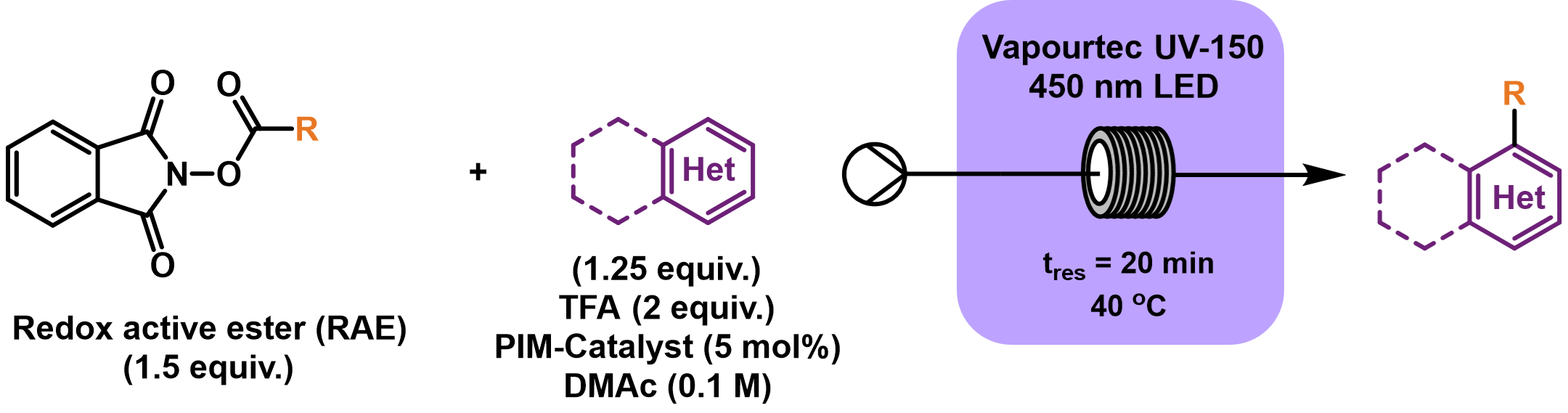
Scheme 1: Example Minisci reaction, using the Vapourtec UV-150 photochemical reactor.
Photoredox catalysis as an enabling technology
While traditionally considered capricious and difficult to reproduce due to batch limitations with the light source, glassware and poor scalability, recent advances in the execution of photochemical reactions through use of flow technology have resulted in many of these serious drawbacks being addressed. Key to this success is that both uniform light penetration and temperature control are now possible, resulting in achievable and predictable scale-up.[2]
Much work has focussed on the development of metal-based photoredox catalysts – often using iridium or ruthenium – but less research has been directed toward the development of metal-free catalysts, which in some cases have been shown to offer comparable performance to their metal-based counterparts. This may be due to difficulties in their preparation – synthesis typically requires several operations, with challenging separations often required – which can result in high costs. However, recent advances in membrane-based technologies means that separation of these homogeneous catalysts is now possible, particularly when using a continuous flow approach, meaning that these precious materials can now be recycled.
Organic solvent nanofiltration (OSN): using pressure as a means for separation
Organic solvent nanofiltration (OSN) is a separation technique that relies upon pressure to effect separation, with catalyst separation/recovery demonstrated for both metathesis and Heck reactions. [1] In particular, OSN can distinguish solutes in the range of 100–2,000 Da based on their physicochemical properties. The opportunity to use an OSN-based approach for catalyst recovery after a photo-mediated reaction enables the possibility of using polymers of intrinsic microporosity (PIMs) – rigid, linear, ladder-type polymers with low conformational flexibility and restricted interchain interactions – as organic photocatalysts.[3]
PIM design and subsequent use in flow
In this work, the PIMs were prepared under batch conditions with their catalytic performance considered under both flow and batch modes. Flow mode was considerably faster than batch, requiring only 5 minutes of irradiation compared to 2 hours for batch, and, in the majority of cases, use of flow furnished higher yields. Using dimethylacetamide (DMAc), the lower molecular weight catalysts showed better performance due to better solubility and therefore activity, with yields from the Minisci reaction ranging from 74% to 79%.[1] A range of substrates were tolerated, although when extended reaction times were required (for example in the case of primary alkyl radicals) a solvent switch from DMAc to DMSO was necessary to avoid solvent-mediated side-reactions. An interesting comparison was between the more widely used metal-based photoredox catalysts and the PIM catalyst: it was found that in many cases the PIM catalyst could be a directly substituted for the metal catalyst, with little to no impact on yield or selectivity and no requirement for reaction optimization.
PIM recycling through OSN: a key methodology for catalyst recycling
The use of organic solvent nanofiltration (OSN) allowed separation of the solid PIM catalyst from the product using in-line filtration, Scheme 2. The retentate stream (containing the catalyst) could be separated and recycled, whereas the permeate stream (containing the product) could be further processed to isolate the product. Using this approach, new reagents could be fed into the system directly while continuously collecting the product from the permeate stream, provided an appropriate back pressure was maintained. In-line quenching of the permeate stream with NaOH removed the DMAc solvent, TFA and phthalimide, while inclusion of a heptane stream allowed the product to be extracted into the organic phase. A Zaiput liquid–liquid membrane separator meant that the only manual operation was simple solvent removal and separation of any residual starting material. In an extended reaction, a total of 26.61 g of product was isolated, with a turnover number (TON) of 504, and a product throughput of 0.55 g/h. The overall reaction yield was 67%, increasing to 91% when accounting for the recovered isoquinoline starting material.
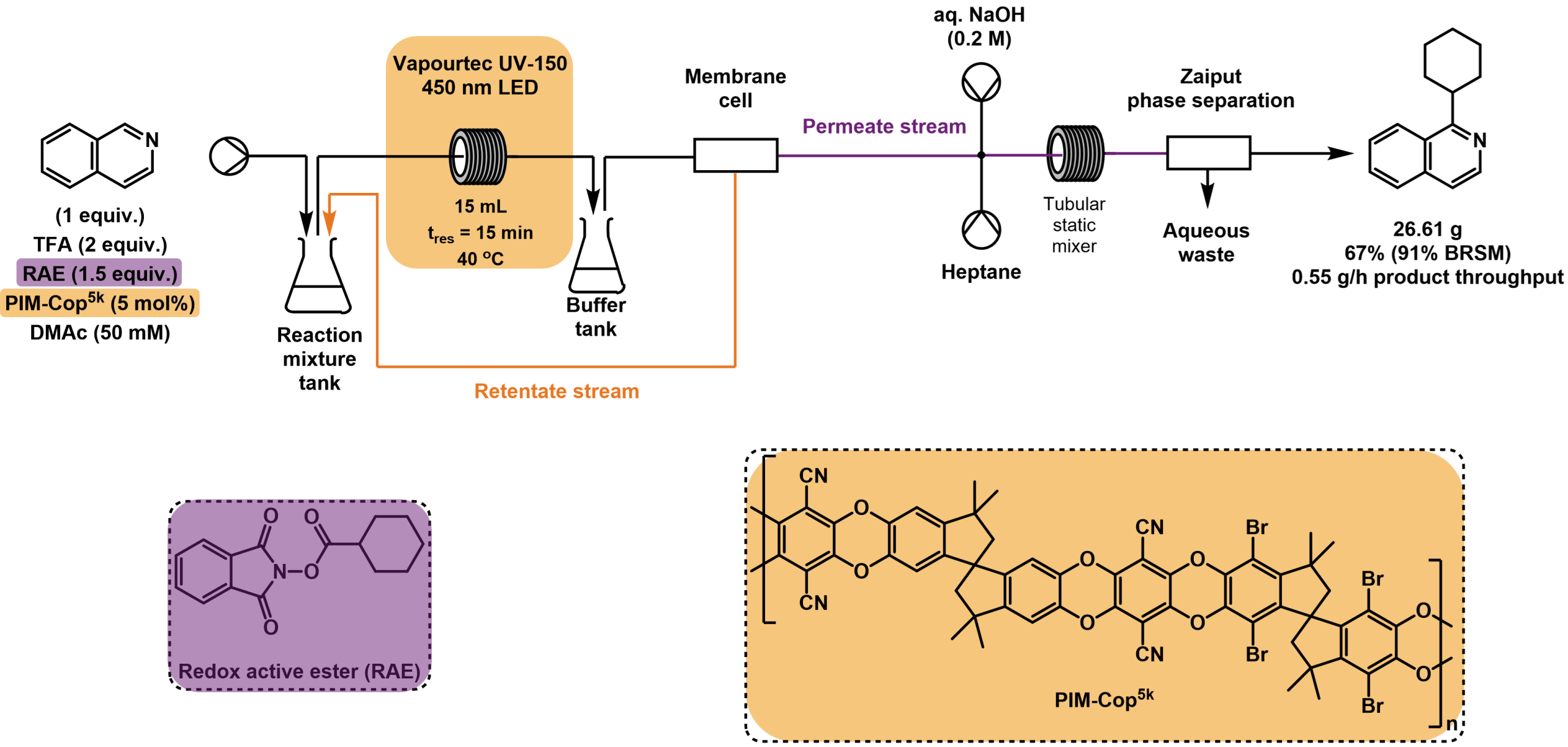
Scheme 2: In-line catalyst recycling through use of OSN with a crosslinked P84 polyimide membrane. For diagram clarity, back-pressure regulators have been omitted.
Flow chemistry as a tool for total integration of processes
In this work, the use of flow chemistry technology – in particular the Vapourtec UV-150 photochemical reactor – was pivotal for the reliable and reproducible irradiation of materials, facilitating the development of a Minisci reaction using polymers of intrinsic microporosity (PIMs) as photocatalysts. Other photocatalytic reactions, such as C–H aryl amination, trifluoromethylation, C–S coupling, heteroarylation, C–C cross-coupling, and C–H amination were also successfully completed, in flow, using these catalysts.
Recycling of the heterogeneous catalyst could be achieved by in-line separation through organic solvent nanofiltration (OSN), and in-line quench and separation minimised the number of manual operations required. While there were some drawbacks, such as catalyst leaching, tuning the catalyst molecular weight by adjusting the degree of polymerisation was shown to overcome this, providing opportunity for sustainable processes and catalyst recycling within the field of flow photochemistry.
References:
[1] Tailoring polymers of intrinsic microporosity as photoredox catalysts for continuous-flow reaction–separation processes (M. Gede, G. Ignacz, C. S. P. De Castro, B. Dereli, M. Ferree, F. Laquai, L. Cavallo, G. Szekely, Nat. Commun., 2026). https://doi.org/10.1038/s41467-026-73833-3
[2] Flow Photochemistry as a Tool in Organic Synthesis (T. H. Rehm, Chem. Eur. J., 2020, 26, 16952–16974). https://doi.org/10.1002/chem.202000381
[3] Polymers of Intrinsic Microporosity. (N. B. McKeown, Polymer, 2020, 202, 122736). https://doi.org/10.1016/j.polymer.2020.122736
Learn more about flow chemistry