
Date: 18 June 2026 | Category: Headline News, News
Authors: Tullio Crovetto, Andrea Pasquale, Daniele Alessandro Consolini, Martina Letizia Contente, Alessandro Pellis
Martina Letizia Contente, Alessandro Pellis and co-workers from the University of Genova, have used a continuous flow-based approach to synthesise poly(caprolactone)(PCL), a polyester material with relevance to many industrial applications, through use of Candida antarctica lipase B (CaLB). Within this work, three sustainable technologies were combined: enzymatic catalysis, biomass-derived solvents, and flow processing.[1]
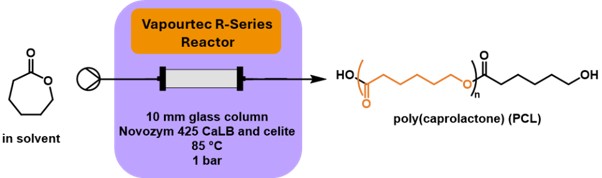 Scheme 1: General overview of the ring-opening polymerization of ε-caprolactone with Candida antarctica lipase B under flow conditions
Polymeric materials in industry
The use of polymeric materials is ubiquitous in industry, due to their unique physical, mechanical, and technological properties. While their uses are diverse, there is an increasing focus on their environmental impact, with reusability, recyclability, and the use of natural feedstocks as primary sources of monomers increasingly coming to the fore.
Polyesters have received substantial interest due to their favourable heat resistance, mechanical properties and biocompatibility, which all feed into their versatility: applications range from textile production to tissue engineering to drug delivery systems. Another advantage of polyesters is that they can be readily accessed by ring-opening polymerization (ROP) of lactones, lactides and carbonates.[2]
However, polyester formation through ROP requires use of catalysts, which are traditionally organometallic species such as ZnEt2, or complexes of Mn, Al or Zr. While effective and amenable to tailoring for the desired structural properties of the final polymers, some cases require the use of harmful, expensive or rare earth metals, bringing with them significant environmental concerns. The use of biocatalysis can circumvent some of these issues, while also allowing milder reaction conditions, regio- and stereoselective processes, and the possibility of reagent recycling.
Flow biocatalysis
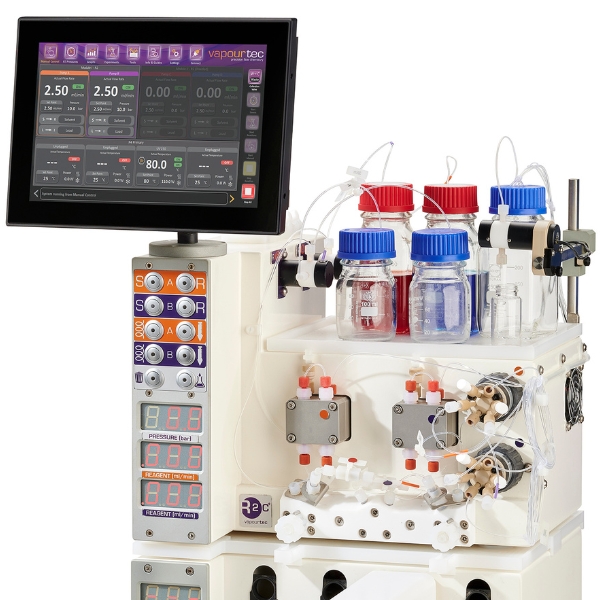
The integration of flow chemistry with biocatalytic technology is a rapidly developing field and is widely acknowledged as a sustainable approach within modern chemistry practice. In particular, though using a flow-based platform – such as the Vapourtec R-Series – reaction parameters can be precisely controlled and scale-up facilitated.
In this work, initial experiments were undertaken in batch, with the solvent traditionally used for ROP of ε-caprolactone, toluene, replaced with greener alternatives, including 2,2,5,5-tetramethyloxolane, eucalyptol, anisole, phenetole, and 2-methyltetrahydrofuran. The monomer to water (ROP initiator) ratio was also varied. Optimal conditions identified used phenetole as solvent and did not require water as an initiator. Conversion of the best batch conditions to a flow-based process was facile and offered several advantages, including:
- Reductions in reaction time compared to conventional batch procedures (5 min vs. 24 h)
- Lower energy consumption
- Enhanced overall sustainability.
Processing costs were also reduced by using commercially available immobilised CaLB. The authors found that the water content of the reaction had a significant influence on the molecular weight of the resulting polymer. Water acts as a chain initiator during ring-opening polymerisation; therefore, increasing the amount of water creates a larger number of growing polymer chains, each consuming fewer monomer molecules and resulting in a lower number-average molecular weight (Mn). Conversely, reducing the water content leads to fewer growing chains and therefore longer polymer chains with higher molecular weights.
Residence time also influenced the properties of the final polymer. Under the conditions studied, shorter residence times produced PCL with higher Mn values, indicating the formation of longer polymer chains. Molecular weight is an important parameter because it strongly affects the physical properties of the polymer, including its mechanical strength, flexibility, melting behaviour and degradation rate. Finally, the polymer product was readily isolated by precipitation from the reaction stream into cold ethanol, providing a simple downstream purification step.
References:
[1] Enzymatic Ring-Opening Polymerization of ε-Caprolactone in Novel Green Solvents: from Batch Systems to Continuous Flow Mesoreactors (T. Crovetto, A. Pasquale, D. A. Consolini, M. L. Contente, A. Pellis, Macromol. Mater. Eng., 2026, 311, e00332). https://doi.org/10.1002/mame.202500332
[2] Ring-Opening Polymerization for the Goal of Chemically Recyclable Polymers. (C. M. Plummer, L. Li, Y. Chen, Macromolecules, 2023, 56, 731–750) https://doi.org/10.1021/acs.macromol.2c01694