Vapourtec Ltd

Telephone +44(0)1284 728659
Email [email protected]
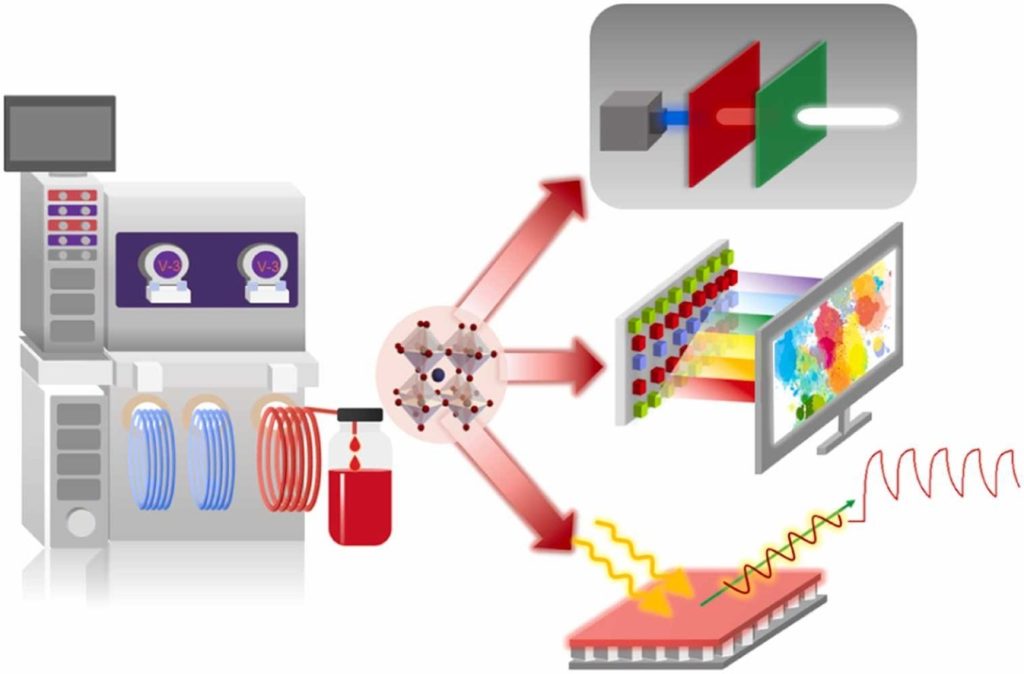
All-inorganic CsPbI3 perovskite quantum dots (PeQDs) are promising red emitters and photoactive semiconductors for next-generation displays, micro-LED color conversion, and photodetection. However, their applications are limited by the metastability of black-phase CsPbI3, dynamically bound OA/OAm ligands, and inefficient charge transport across long-chain insulating surfaces. Herein, we integrate continuous-flow synthesis with benzothiazole-based short-chain ligand engineering to develop efficient, stable, and device-ready CsPbI3 PeQDs. The flow reactor precisely regulates nucleation and crystal growth, while 2-aminobenzothiazole (ABT) and 6-(tert-butyl)benzo[d]thiazol-2-amine (ABT-tBu) passivate undercoordinated Pb-related surface defects and reduce interparticle transport barriers. The optimized ABT-tBu PeQDs exhibit bright red emission at 678 nm, a photoluminescence quantum yield of 99 %, 98 % PLQY retention after more than 70 days under ambient conditions, and robust thermal cycling stability up to 125 °C. The resulting PeQDs enable LED backlighting with a color gamut of 148.7 % NTSC 1931, uniform red micro-LED color conversion, and planar photodetectors with over 50-fold enhancements in photogain and responsivity. This work provides a scalable materials strategy for high-performance CsPbI3 PeQDs-based optoelectronic devices.
Equipment used in this paper: R-Series Flow Chemistry System