Vapourtec Ltd

Telephone +44(0)1284 728659
Email [email protected]
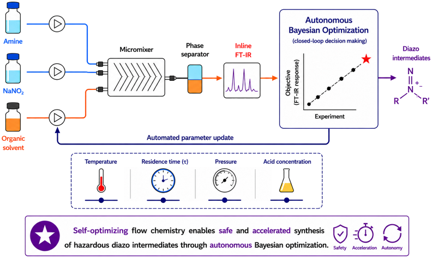
Highly reactive diazo intermediates are valuable building blocks in organic synthesis but present significant challenges due to their instability and associated safety risks. Continuous flow chemistry offers a strategy for handling these compounds under controlled conditions, however, identifying optimal reaction parameters across multiple interacting variables remains experimentally demanding. Here we report an autonomous continuous-flow platform for the safe and accelerated synthesis of diazo intermediates. The system integrates a microfluidic reactor with automation, inline FT-IR monitoring, and Bayesian closed-loop optimization to iteratively refine key reaction parameters including temperature, residence time, pressure, and acid concentration. Real-time monitoring of temperature and pressure prevents excursions beyond predefined and potentially unsafe operating limits. The platform was validated using three representative systems: diazoacetonitrile (DAN), trifluoromethyl diazomethane (TFDM), and ethyl diazoacetate (EDA). For DAN, autonomous optimization reduced the optimal residence time from 62 to 21 s while improving the objective metric by 27.3%. In the TFDM system, variation of acid concentration revealed a narrow optimal window, highlighting the competing roles of acid-promoted diazotization and diazo decomposition. Multi-objective optimization of EDA demonstrated the trade-off between reaction yield and process throughput through identification of Pareto-optimal operating conditions. Optimal conditions for all systems were identified within a few hours, significantly reducing experimental effort compared to conventional manual screening. The modular architecture provides a general strategy for feedback-driven continuous-flow synthesis of unstable or safety-critical intermediates.