Vapourtec Ltd

Telephone +44(0)1284 728659
Email [email protected]
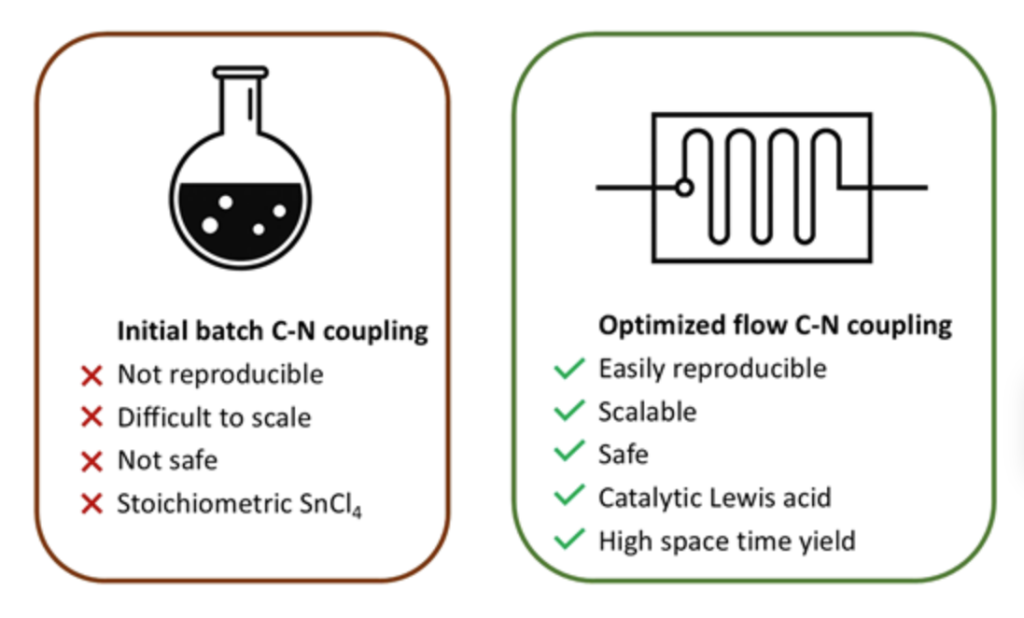
To address the environmental persistence of fluoroquinolone antibiotics and their contribution to antimicrobial resistance, new benign-by-design fluoroquinolone derivatives, incorporating cleavable linkers, have been developed to enable degradation into products with reduced antimicrobial activity. The synthesis of these compounds, however, is limited by a key Vorbrüggen C–N coupling step that shows poor reproducibility, limited scalability, and safety concerns under conventional batch conditions employing stoichiometric amounts of SnCl4. Herein, we report the development of a continuous-flow Vorbrüggen C–N coupling within the Cip-hemi synthesis platform. Screening of alternative Lewis acids identified Cu(OTf)2 as an effective catalyst, providing high conversions under catalytic conditions. Process optimisation revealed that temperature, residence time, tube diameter and especially reaction concentration were critical to suppress precipitation-induced reactor clogging. The residence time could be reduced to 1 min without loss of performance and the reaction was successfully translated to 5 g scale, achieving a space–time yield of up to 1498 g L−1 h−1. This work demonstrates that continuous-flow processing provides a robust and more readily scalable solution to a critical transformation in the synthesis of environmentally improved fluoroquinolone derivatives.
Equipment used in this paper: SF-10 Laboratory Pump