Vapourtec Ltd

Telephone +44(0)1284 728659
Email [email protected]
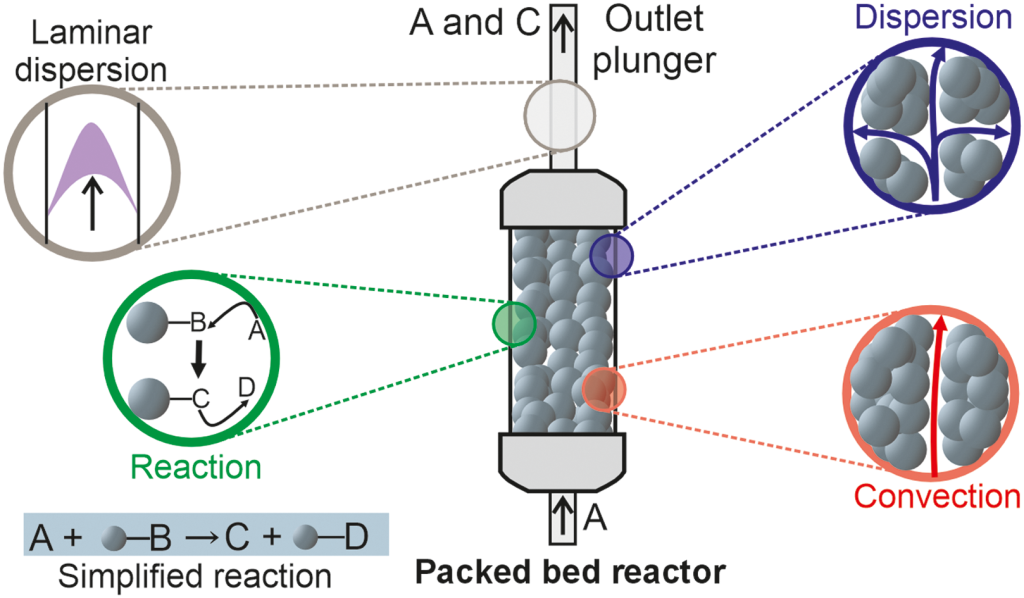
Flow reactors greatly reduce cycle times in solid-phase synthesis (SPS) but typically operate with a large excess of reagent, generating considerable amounts of waste. The lack of a mathematical framework limits the implementation of optimal operating conditions. A transient-dispersion model integrating reaction kinetics and axial dispersion is introduced to predict the conversion of solid-bound reagents in packed-bed flow reactors (6.6 mm I.D., flow rate range: 1–4 mL min−1). The model is experimentally validated using levaloyl (Lev) ester and 9-fluorenyl-methoxycarbonate (Fmoc) deprotection at the milligram scale on a mannoside-functionalized resin. When the Damköhler number (Da) is less than 0.25, the system behaves as a pseudo-first-order batch reactor. Direct monitoring of a mannoside building block coupling via a variable-bed flow reactor (VBFR) confirms that the pseudo-first-order approximation predicts solid-bound product formation. The Da < 0.25 guideline provides a simple and practical tool for designing SPS processes.
Equipment used in this paper: R-Series Flow Chemistry System, Variable-Bed Flow Reactor (VBFR)