Vapourtec Ltd

Telephone +44(0)1284 728659
Email [email protected]
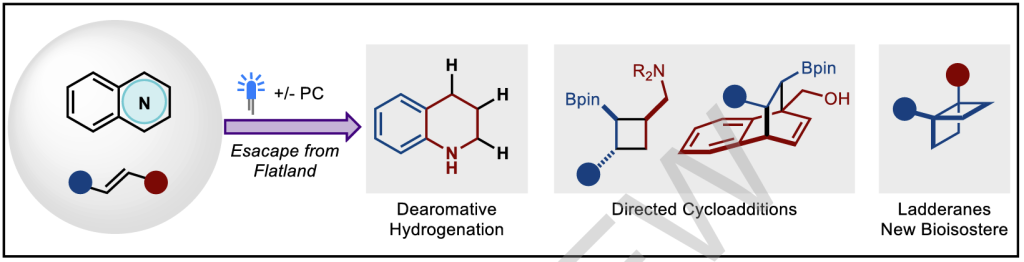
The increasing demand for structurally diverse and three-dimensional molecular architectures in medicinal chemistry has accelerated the development of synthetic methods capable of escaping the limitations of flat aromatic chemical space. In this dissertation, photochemical dearomatization and cycloaddition strategies are utilized to access medicinally relevant, saturated, and conformationally unique scaffolds with potential applications in drug discovery and molecular
design. The work highlights the power of light-driven transformations to rapidly construct complex molecular frameworks from simple and abundant starting materials.
The first chapter focuses on the photochemical reduction of quinolines using γ-terpinene as a hydrogen atom donor. This operationally simple and mild protocol enables efficient access to partially saturated nitrogen-containing heterocycles, important motifs frequently encountered in biologically active compounds and pharmaceutical intermediates. The method demonstrates broad substrate scope and functional group tolerance while avoiding the need for harsh reducing
conditions.
The second part of this thesis describes the development of a boron-enabled directed cycloaddition strategy mediated by visible-light energy transfer. This approach enables efficient synthesis of medicinally relevant borylated cyclobutanes and selective dearomative transformations of aromatic systems to generate structurally complex bicyclic and polycyclic scaffolds under mild conditions. Post-modification of ‘C-B’ bond in these building blocks providing a versatile platform
for the synthesis of architecturally sophisticated molecules.
The final section establishes [2]-ladderanes as simplified cubane analogs and non-classical bioisosteres of ortho-substituted benzene rings for medicinal chemistry applications. While cubanes have emerged as powerful saturated bioisosteres, the synthesis and application of 1,2- disubstituted cubanes remain challenging. This work demonstrates that [2]-ladderane derivatives can serve as accessible and versatile alternatives, providing a balance between structural rigidity, three-dimensionality, and synthetic practicality. Gram-scale syntheses of ladderane building blocks, medicinal chemistry-relevant functionalizations, and matched-pair studies of bioactive compounds collectively validate ladderanes as promising scaffolds for physicochemical and biological optimization.
Collectively, the studies presented in this dissertation demonstrate how photochemical strategies and strain-enabled molecular design can unlock new regions of chemical space and provide efficient access to structurally complex, medicinally relevant three-dimensional scaffolds
Equipment used in this paper: UV-150 Photochemical Reactor