
Date: 8 October 2026
Why perform organometallic chemistry in continuous flow?
Organometallic reagents are among the most versatile tools in synthetic organic chemistry, enabling carbon–carbon bond formation and a wide range of transformations used in pharmaceutical, fine chemical and materials synthesis. However, the same high reactivity that makes these reagents valuable can also make their use challenging, particularly when reactions are highly exothermic or involve unstable intermediates.
Organolithium, organomagnesium and organozinc reagents can be sensitive to air and moisture, while rapid heat release, competing reaction pathways and the decomposition of reactive intermediates can make reaction conditions difficult to control. These challenges can become more pronounced as reactions are scaled up.
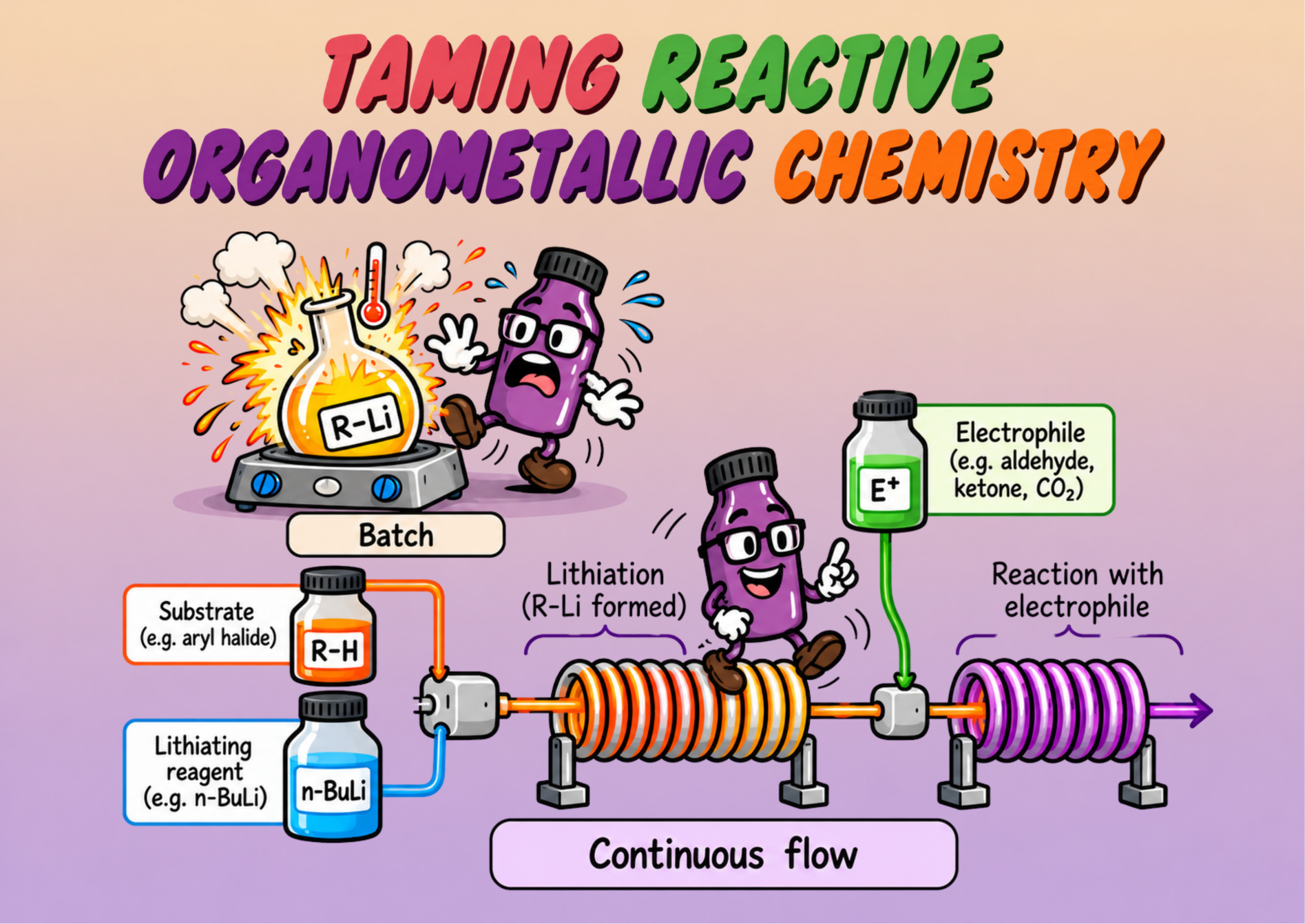
Continuous flow offers an alternative approach by providing precise control over reagent mixing, temperature and residence time. Reactive intermediates can be generated and consumed within a defined time interval, while efficient heat transfer helps manage highly exothermic reactions. The relatively small reaction volume also limits the quantity of reactive material present in the reactor at any one time.
These advantages are particularly valuable when reaction performance depends on controlling heat release, minimising the lifetime of unstable intermediates or preventing unwanted side reactions. However, the suitability of continuous flow depends on the chemistry involved, including reagent solubility, solids formation and the requirements for safe reagent handling.
Controlling fast, exothermic reactions
In batch, adding an organolithium or Grignard reagent to a larger reaction volume can create local temperature and concentration differences. Slow addition and cooling help manage the exotherm but can extend processing time. These effects become more difficult to manage as the reaction volume increases.
In a flow reactor, reagents meet in a defined mixing zone and travel through a comparatively small reaction volume. Efficient heat transfer helps remove heat as it is produced. The combination of flow rate and reactor volume defines the residence time, allowing the reaction duration to be controlled and reproduced. For suitable chemistries, this can reduce the formation of by-products associated with local overheating or prolonged exposure to reactive conditions.
Better heat transfer does not mean cryogenic cooling can always be avoided. The required temperature still depends on the substrate, reagent and competing reaction pathways. The practical benefit is greater control over the temperature the reaction experiences.
Generating reactive intermediates when they are needed
Some organometallic intermediates are most useful immediately after formation. In batch, a reagent may have to be prepared, held and transferred before the next step, giving it time to decompose or react with unwanted species.
Flow allows generation and consumption to be connected directly. For example, an organomagnesium reagent can be formed by passing an organic halide through a magnesium packed bed, then fed into a subsequent reaction. The intermediate is produced continuously and used shortly afterwards, without accumulating a large amount in a separate vessel. Similar approaches have been reported for organozinc reagents and for short lived organolithium species.
For particularly unstable intermediates, controlling the time between their formation and subsequent reaction can be critical. In continuous flow, this interval can be reduced to seconds or even fractions of a second, depending on the reactor configuration. By adjusting flow rates and reactor volume, the interval between generating an intermediate and introducing the next reagent can be precisely controlled and reproduced. This creates opportunities to use reactive intermediates that may be difficult to handle in conventional batch processes.
Reducing the amount of hazardous material present
Many organometallic reagents are sensitive to oxygen and moisture; some are pyrophoric. A closed, properly dried and inert flow path can help limit their exposure. Because only a small quantity is present in the reactor at any one time, the inventory of reactive material is also lower than in a batch vessel of equivalent total output.
That is a useful safety advantage, particularly when an unstable intermediate can be generated and consumed in line. It does not remove the need to assess feed reservoirs, pumping, pressure, quenching and downstream collection. The full process, rather than the reactor alone, determines how safely the chemistry can be run.
What does this mean in practice?
In a published paper titled: Flow Process for Production of Crisaborole Using Organolithium Chemistry with Control over Impurity Formation, researchers from Academy of Scientific and Innovative Research (AcSIR) used an organolithium reaction on a Vapourtec R-Series flow chemistry system. The reported process increased the reaction temperature from −78 °C in the established batch procedure to −60 °C while improving yield. The result illustrates how control over mixing, temperature and residence time can change the workable conditions for a specific transformation.
Choosing the right flow approach
Organometallic chemistry is not automatically straightforward in flow. Precipitated salts, low reagent solubility or metal particles can obstruct narrow channels, and solvent compatibility and pumping performance matter. Where a metal bed is used to generate a reagent, changes in the bed as the metal is consumed must also be considered. Reactor selection should follow the chemistry, including how solids are formed, transported and removed.
Continuous flow provides valuable opportunities for performing organometallic chemistry, particularly where rapid heat release, unstable intermediates or demanding temperature requirements make conventional batch processing challenging. By controlling mixing, temperature and residence time, chemists can investigate reaction conditions that may be difficult to achieve in batch. The ability to generate reactive intermediates and consume them almost immediately is particularly valuable.
The most successful applications arise from understanding the limitations of the chemistry and selecting a reactor configuration that addresses those specific challenges.