
Date: 18 September 2026 | Categories: Headline News, uv-150, News
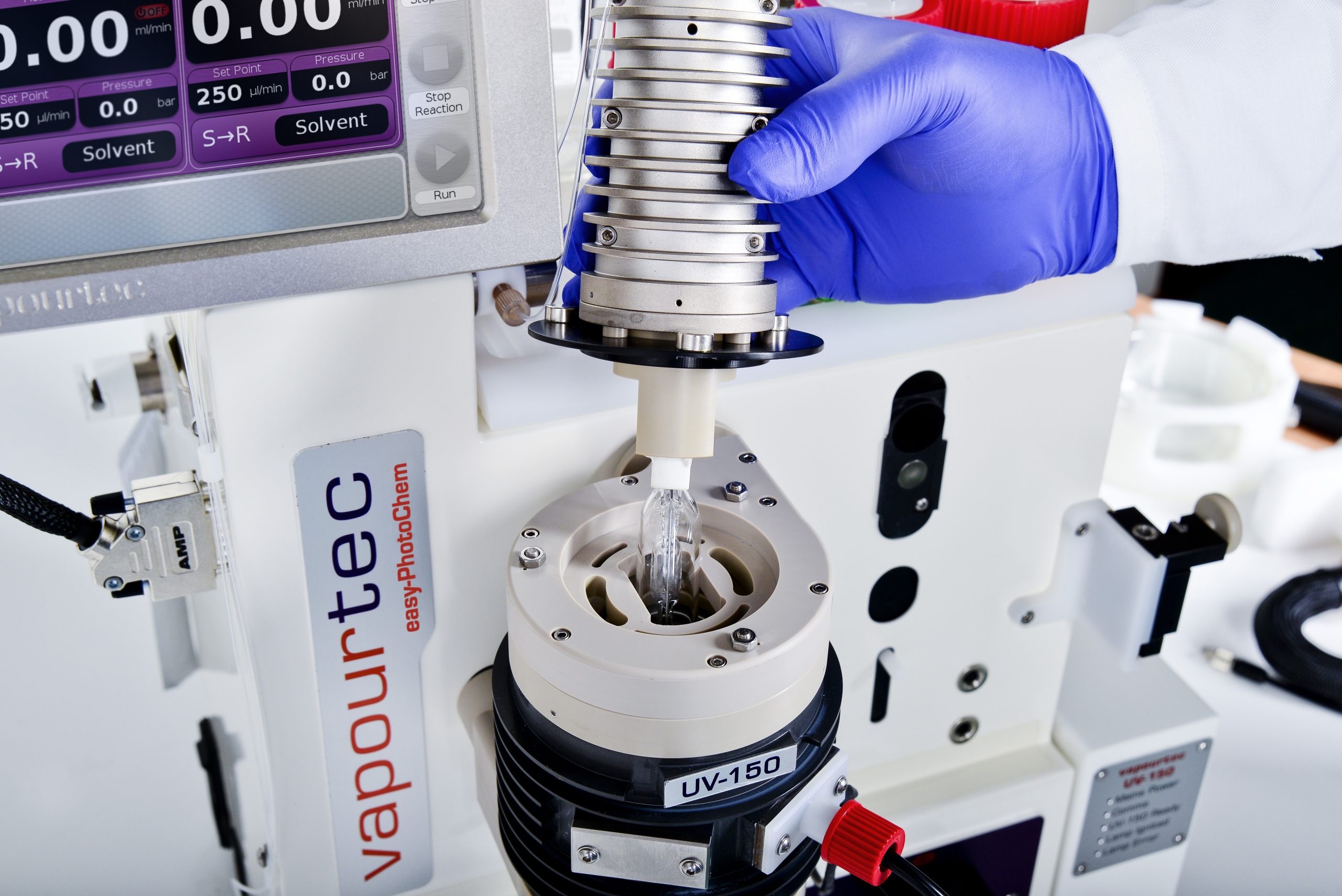
Researchers from Queen Mary University of London and Imperial College London used the Vapourtec UV-150 photochemical reactor to develop a continuous-flow Mallory photocyclization for the synthesis of thia-, oxa- and azahelicenes. [1]
Most substrates were synthesized with a residence time of just 100 seconds, and the method was demonstrated at multigram scale, producing 2.06 g (9.8 mmol) of a thienohelicene in 79% yield in a continuous run.
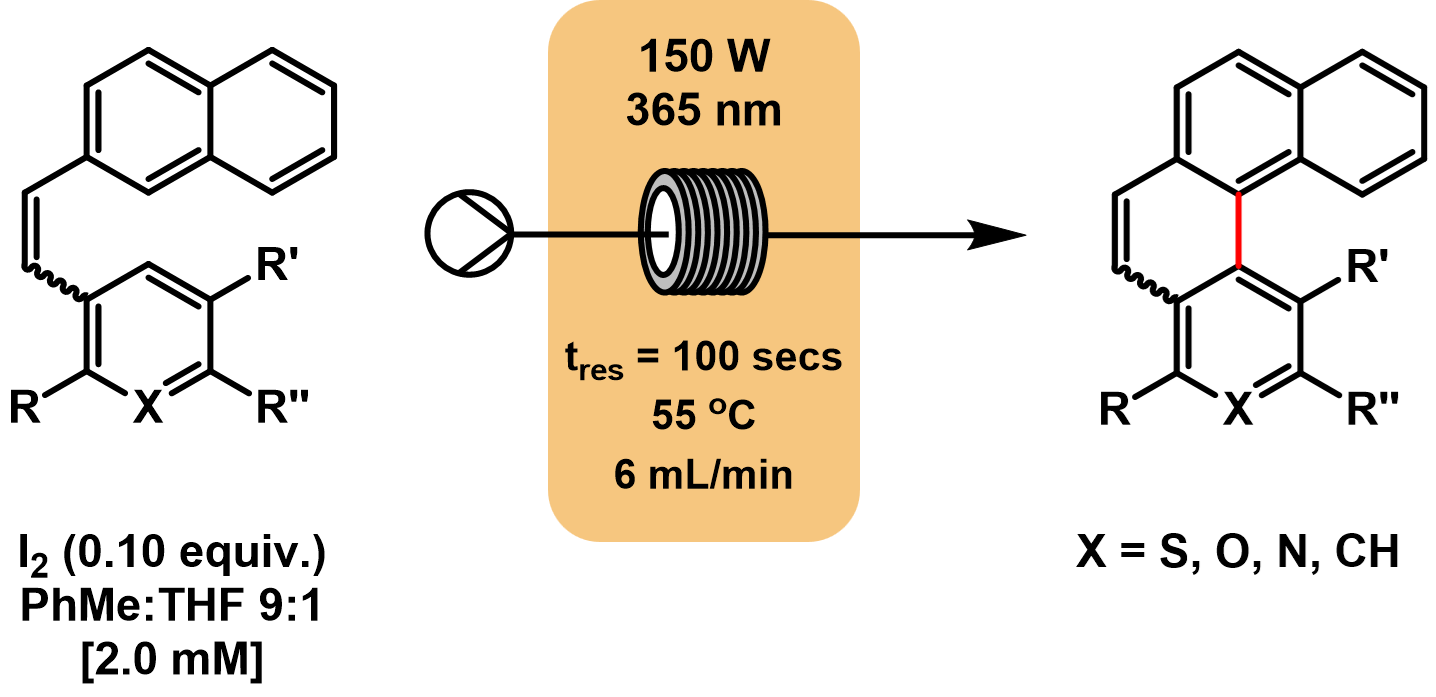
Figure 1: General flow setup for the Mallory photocyclization of stilbenes using the Vapourtec UV-150 photochemical reactor.
Helicenes: broad applications in functional materials
Helicenes are a class of polyaromatic compounds characterised by their ortho-fused aromatic rings, which adopt a distinctive screw-like structure and give rise to helical chirality. Their combination of helical chirality and extended aromatic structure results in highly dissymmetric interactions with circularly polarised light and efficient charge transport. These properties make helicenes attractive materials for applications including organic field-effect transistors (OFETs), as well as the emission and detection of circularly polarised light. Incorporating heteroatoms into the helicene structure provides an additional means of tuning their physical and optoelectronic properties. [2]
Helicene preparation using photochemical approaches
The preparation of helicenes has been achieved using photochemical approaches, with the Mallory cyclization being a key route to their formation,[3] but the use of a flow-based photochemical approach has been investigated less. This is surprising, as a flow-based photochemical approach offers many advantages including improved scalability, shorter reaction times, and a safer reaction set-up.
In this work, the requisite heterostilbene starting materials were prepared under Wittig conditions as a mixture of E and Z isomers, however this was not an issue as the isomers rapidly interconverted under the photochemical conditions for cyclization. Optimization using the Vapourtec UV-150 established conditions of 2 mM substrate concentration and a 6 mL/min flow rate, corresponding to a residence time of 100 seconds. Under the optimized conditions, [4]thienohelicene 2a was obtained in 94% yield. Most substrates were synthesized using the same 100-second residence time, with throughputs of up to 195 mg of stilbene precursor per hour.
For some substrates, reaction conditions were adjusted to address solubility or competing photochemical reactions. In particular, reducing the lamp power from 150 W to 60 W improved yields for certain substrates. While most substrates tolerate stoichiometric quantities of iodine (1.1 equiv.), some required catalytic iodine (0.1 equiv.), which was attributed to the formation of HI as a by-product that may have protonated the N-heterocyclic products and caused degradation. Catalytic quantities of iodine also allowed preparation of newly disclosed materials.
Photochemistry in flow: rapid and reliable
The use of a continuous flow approach in the execution of photochemical reactions offers significant advantage over a batch-based approach, including:
- Precise control of residence time
- Efficient and uniform irradiation
- High surface-area-to-volume ratio
- Effective temperature control
- Straightforward scale-up by extending operating time
- Reduced reaction times compared with conventional batch photochemistry
In this work, the UV-150 enabled Brandt and co-workers to translate Mallory photocyclization into a rapid continuous-flow process, access a range of thia-, oxa- and azahelicenes, and demonstrate straightforward multigram scale-up. The work illustrates how continuous photochemistry can provide both the reaction control and scalability required for the preparation of novel chiral materials.
Authors:
Katherine Lyon, Chenyu Pan, Shainthavaan Sathiyalingam, Yang Wu, Jayden Matthews, Jochen R. Brandt
References:
[1] K. Lyon, C. Pan, S. Sathiyalingam, Y. Wu, J. Matthews, J. R. Brandt (Continuous Photoflow Synthesis of Heterohelicenes, Org. Lett., 2026, 28, 5918–5922). https://doi.org/10.1021/acs.orglett.6c00559
[2] Impacts of heteroatom substitution on the excited state dynamics of π-extended helicenes (Y. Kondo, Y. Tsutsui, Y. Matsuo, T. Tanaka, S. Seki, Nanoscale Adv., 2024, 6, (18), 4567–4571). https://doi.org/10.1039/d4na00516c
[3] Photocyclization of Stilbenes and Related Molecules (F. B. Mallory, C. W. Mallory, Org. React., 2005). https://doi.org/10.1002/0471264180.or030.01