
Date: 3 September 2026 | Categories: Headline News, uv-150, News
Authors: Ángel Manu Martínez, Jorge García-Lacuna, Gema Domínguez, Pau Prats-Colàs, Inés Alonso, Marcus Baumann, Javier Pérez-Castells
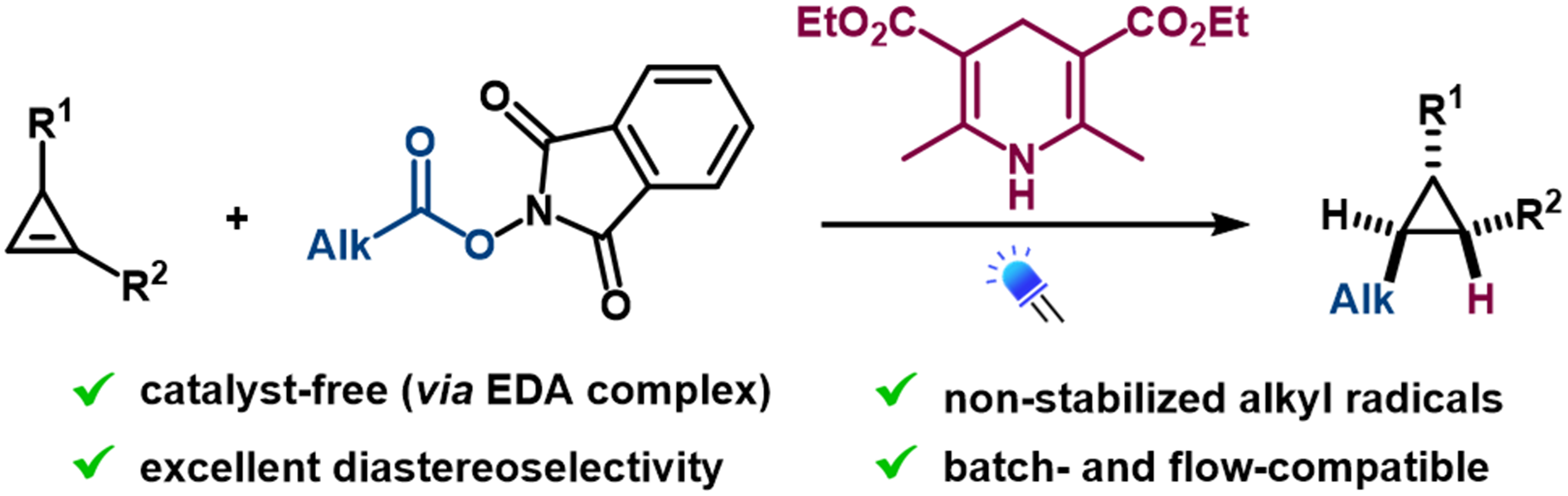
Ángel Manu Martínez, Jorge García-Lacuna and colleagues from the Universidad San Pablo-CEU, and Marcus Baumann from University College Dublin, report a new approach for synthesis of polysubstituted cyclopropanes through a visible-light-driven ring retentive hydro alkylation, Figure 1.[1] This reaction was shown to be scalable and reliable through use of the Vapourtec UV-150 photoreactor, which enabled continuous operation, a markedly shorter reaction time and higher productivity than the batch-based process. This new method offers a complementary approach to previously disclosed preparations of polysubstituted cyclopropanes, which relied upon organometallic-based syntheses, and the use of photochemistry allows for radical mediated transformations under mild conditions, with a wide range of functional groups tolerated.
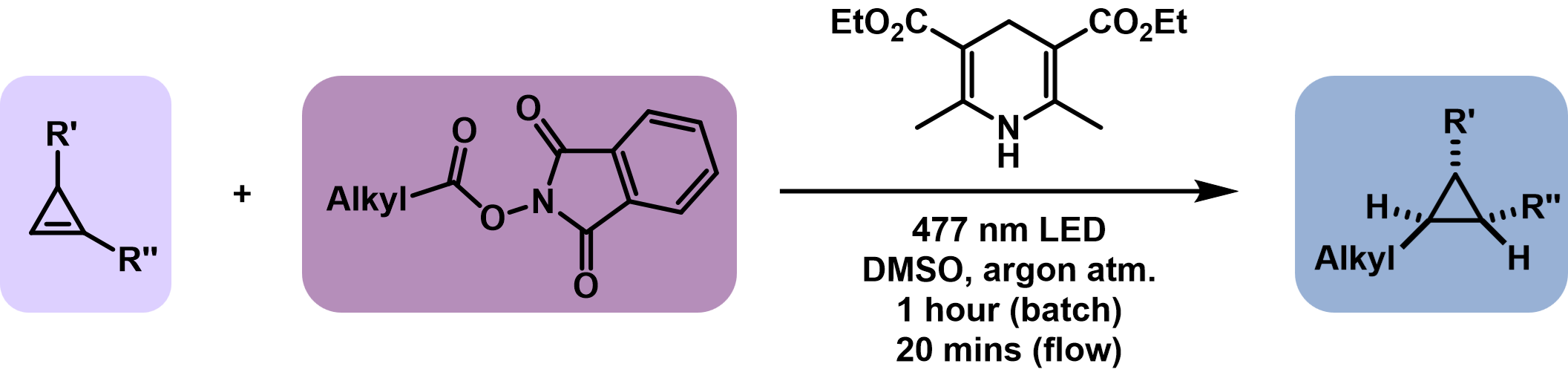
Figure 1: General overview of the UV-mediated reaction between a redox-active N-hydroxyphthalimide (NHPI) ester, a cyclopropene and Hantzsch ester, under UV light (477 nm).
Photochemical transformations using EDA complexes
Electron donor–acceptor (EDA) complexes are well-established as being a cost-effective and sustainable alternative to traditional transition metal catalysis in photochemical transformations. EDA complexes are comprised of both an electron donor and an electron acceptor, with their interaction forming a charge-transfer complex. Irradiation of this multipart with light of the relevant wavelength leads to a light-induced single electron transfer (SET), which results in formation of two new radical species. This method of forming radical is extremely attractive as it can occur under mild conditions at room temperature.[2]
In this example, redox-active N-hydroxyphthalimide esters (NHPI) and the Hantzsch ester were used to create the EDA complex, which was converted into a polysubstituted cyclopropane by reaction with a clopropene. Polysubstituted cyclopropanes are versatile building blocks for strain-releasing ring-opening reactions, and cyclopropyl rings are common in natural products. They are also considered a privileged scaffold within drug discovery, used to improve potency, drive conformation and improve pharmacokinetics of APIs and drug-like materials.[1]
Excellent stereoselectivity and good yields for rapid generation of complex cyclopropane scaffolds
One of the highlights of this protocol is the excellent diastereoselectivity – dr >20:1 – and good yield, with formation of two new stereocentres. However, to achieve this, several parameters needed strict control to ensure an efficient transformation: solvents needed to be dry, polar, and required rigorous removal of oxygen through degassing; blue light irradiation was optimal; temperature, time and concentration were crucial; and, rate of radical generation through Hantzsch ester addition was important.
A good range of redox-active carboxylate derivatives were tolerated, including primary aliphatic alkyl chains, sterically-demanding alkyl groups, terminal alkynes, aryl groups and halogens, as well as both electron-poor and electron-rich substrates. A range of cyclopropane substrates were tolerated, with sensitive functional groups and those with more steric bulk both performing well.
However, there were some limitations. Amino acid-derived NHPI esters and those with certain branched substituents were not well-tolerated, leading to substrate consumption and formation of extensive side-products. When it came to the cyclopropene, those that were highly congested or with additional substitution at C-2 did not undergo reaction, enabling recovery of the cyclopropene starting material.
Photo-induced hydroalkylations in flow
While much of this work was undertaken using a batch reactor, in order to investigate the scalability and operational robustness, the reaction was translated into flow. Primarily, this was intended to address the shortcomings of batch-mediated photochemistry, where limited light penetration and non-uniform irradiation can complicate scale-up and industrial implementation, and gaseous build-up can lead to reactor over-pressure at large scales, a severe safety issue.[3, 4]
To this end, the Vapourtec UV-150 photoreactor was easily fitted with a 450 nm LED module and, after brief optimization, it was shown that reaction times could be cut to a mere 20 minutes, Figure 2. Continuous operation for 75 minutes allowed scale-up to 2.1 mmol of NHPI ester, affording the alkyl product in 41% isolated yield and a throughput of 227 mg/h (space–time yield of 68.2 mmol/L/h). While this yield was lower than in batch, the scale and productivity achieved would be difficult to match under conventional batch conditions. One smaller scale, the yields achieved were comparable to those under batch conditions.
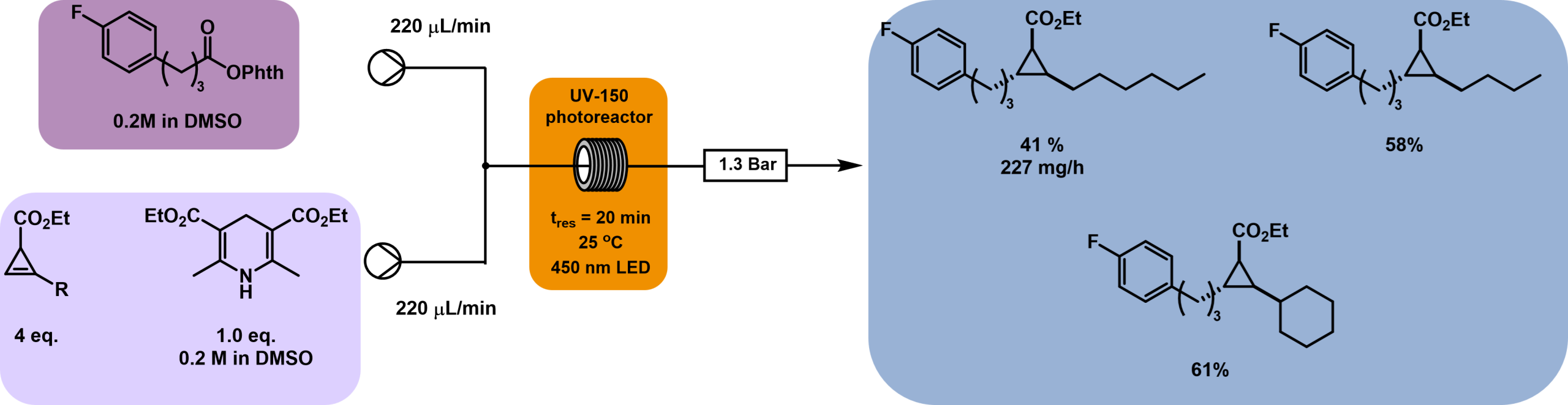
Figure 2: Conversion of the diastereoselective radical hydroalkylation of cyclopropenes into a flow-based approach to facilitate scale-up.
Photochemistry in flow: the Vapourtec advantage
While batch photochemistry is still in widespread use, the number of publications citing photochemistry in flow are exploding. Using flow-based methods readily increases the scalability of photochemical reactions, making it more attractive to process development – meaning that photochemistry is no longer exclusively a discovery tool.
While scaling photo-induced reactions in batch can result in poor light-penetration, inconsistent heat dissipation, non-uniform irradiation and over pressure if gaseous by-products are formed, flow-based methods circumvent these issues by giving:
- Greater control over reaction conditions
- Increased photon transfer
- Higher surface-to-volume ratios
- Uniform irradiation
- Precise control over reactor residence time.
This leads to more predictable outcomes for scale-up and can benefit yields through reduced side-product formation. [5]
Using the Vapourtec UV-150 photochemical reactor offers tangible advantage, as it addresses the limitations of light-penetration that are inherent within larger scale batch processes. The easily interchangeable light sources allow the use of wavelengths between 220 and 650 nm, giving excellent flexibility over irradiation conditions, and the modular design of the reactor also allows for rapid screening of conditions and reaction optimization.
References
[1] Diastereoselective Radical Hydroalkylation of Cyclopropenes Enabled by EDA Complexes (Á. M. Martínez, J. García-Lacuna, G. Domínguez, P. Prats-Colàs, I. Alonso, M. Baumann, J. Pérez-Castells, Org. Chem. Front., 2026, 13, 5870-5878) https://doi.org/10.1039/d6qo00827e
[2] EDA Photochemistry Using Continuous Flow (S. L. Nickels, A.-L. Lee, F. Vilela, J. Flow Chem., 2025, 15, 221-247) https://doi.org/10.1007/s41981-025-00362-3
[3] Continuous flow synthesis enabling reaction discovery (A. I. Alfano, J. García-Lacuna, O. M. Griffiths, S. V. Ley, M. Baumann, Chem. Sci., 2024, 15, 4618–4630). https://doi.org/10.1039/d3sc06808k
[4] Trends and Challenges in Multistep Continuous Flow Synthesis (J. Chen, Y. Zou, L. Liao, B. Yang, D. Xing, J. Zhou, X. Qian, Y. Liu, H. He, S. Gao, J. Am. Chem. Soc. Au, 2026, 6, 731–755). https://doi.org/10.1021/jacsau.5c01611
[5] Flow Photochemistry: Shine Some Light on Those Tubes! (C. Sambiagio, T. Noël, Trends Chem., 2020, 2, 92-106) https://doi.org/10.1016/j.trechm.2019.09.003