Vapourtec Ltd

Telephone +44(0)1284 728659
Email [email protected]
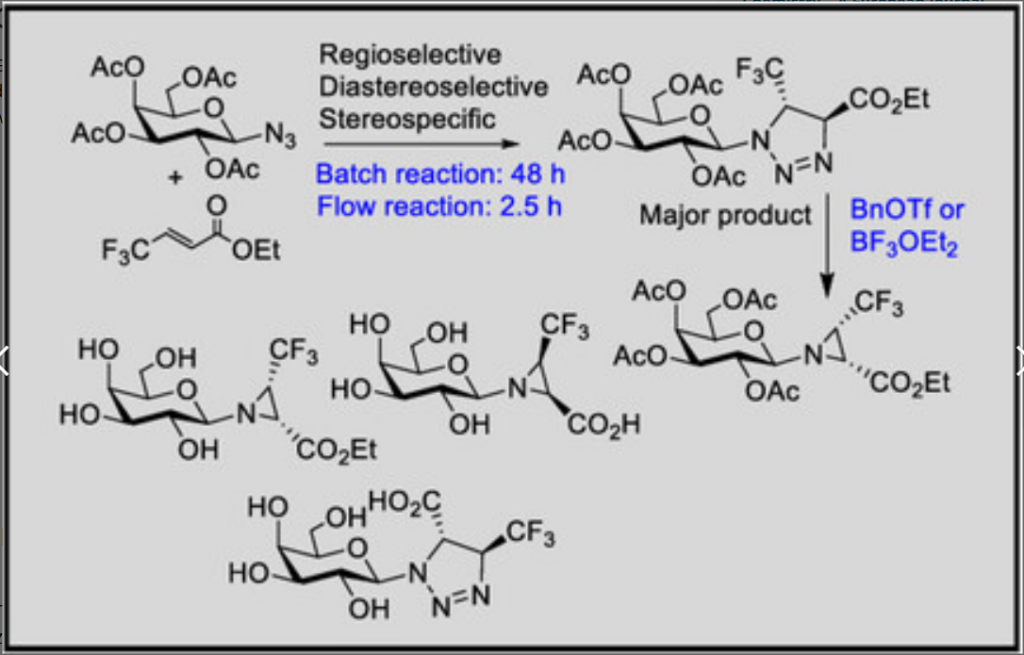
Triazoline and aziridine derivatives were synthesized by diastereo- and regioselective Huisgen cycloaddition of 2,3,4,6-tetra-O-acetyl-β-D-galactopyranosyl azide with ethyl 4,4,4-trifluorocrotonate. Use of a continuous-flow reactor led to reduced reaction time and enabled use of ethyl acetate as a greener solvent for the cycloaddition. Thermolysis of trans-triazolines yielded trans-aziridines, while treatment with BF3·OEt2 (or BnOTf) produced cis-aziridines. Density functional theory calculations supported a mechanism for trans-triazoline conversion to cis-aziridine involving boron trifluoride catalysed N-N bond cleavage to give an intermediate with boron trifluoride stabilised nitrogen that then undergoes SN2 reaction. Deacetylation yielded N-galactopyranosyl aziridines and triazolines, which were identified as substrate-based inhibitors of β-galactosidase. Synthesis of glycosyl aziridines from reactions of N-phenylmaleimide is included.